
20
May
Web Development
16 Min Read

Most enterprise CMS problems don’t appear at the start. They show up later.
As businesses grow, content no longer lives in one place. Websites multiply, and more integrations are added to the workflow as the business scales globally.
What once worked fine begins to feel restrictive. Publishing slows down. Integrations feel bolted on. Scaling under pressure becomes harder than expected.
This is usually when teams start questioning the CMS itself. Not because it’s no longer efficient, but because it wasn’t built for multi-channel delivery, API-driven development, or global content workflows at scale. The structure starts getting in the way of progress.
Interestingly, this is where headless CMS makes a difference.
It separates content from the front end, giving enterprises room to adapt without constantly reworking the underlying system.
When considering headless CRMs, platforms like Strapi are often the go-to option for business owners, not as a trend, but as a means of changing content requirements. Strapi doesn’t just improve content management, but enterprise handles it as they scale.
This blog takes a closer look at why enterprises choose Strapi for a scalable, future-proof headless CMS in the following sections.
Organizations move toward a headless CMS when content and delivery fail to keep pace.
Teams create content in one place, but it needs to show up everywhere. Websites, apps, internal tools, and newer interfaces all pull from the same source. Traditional CMS setups aren’t designed to manage content across multiple platforms.
However, things are different in a headless model. The content is stored centrally and delivered through APIs, while the frontend is handled separately , which is often part of a headless CMS set up and implementation. REST or GraphQL moves content where it’s needed, without assuming how it will be displayed.
It separates how teams use the workflow regularly. The platform’s flexibility allows business owners to develop an interface without restrictions, allowing them to focus on the backend rather than templates, which is one reason headless CMS solutions increase agility and scalability. Updates occur independently rather than waiting for a single release cycle.
Platforms like Strapi are often considered when enterprises reach this point. Not because of features, but because the model fits how systems evolve.
| Area | Traditional CMS | Headless CMS (Strapi) |
| Structure | Backend and frontend are tied together. | Separate front and back end. |
| Delivery | Built mainly for websites | Content is delivered through APIs |
| Frontend choice | Limited by the CMS | Chosen independently |
| Channel reuse | Content is often duplicated | Content is reused |
| Scaling | Gets harder over time | Feels more predictable |
| New platforms | Require changes | Use existing content |
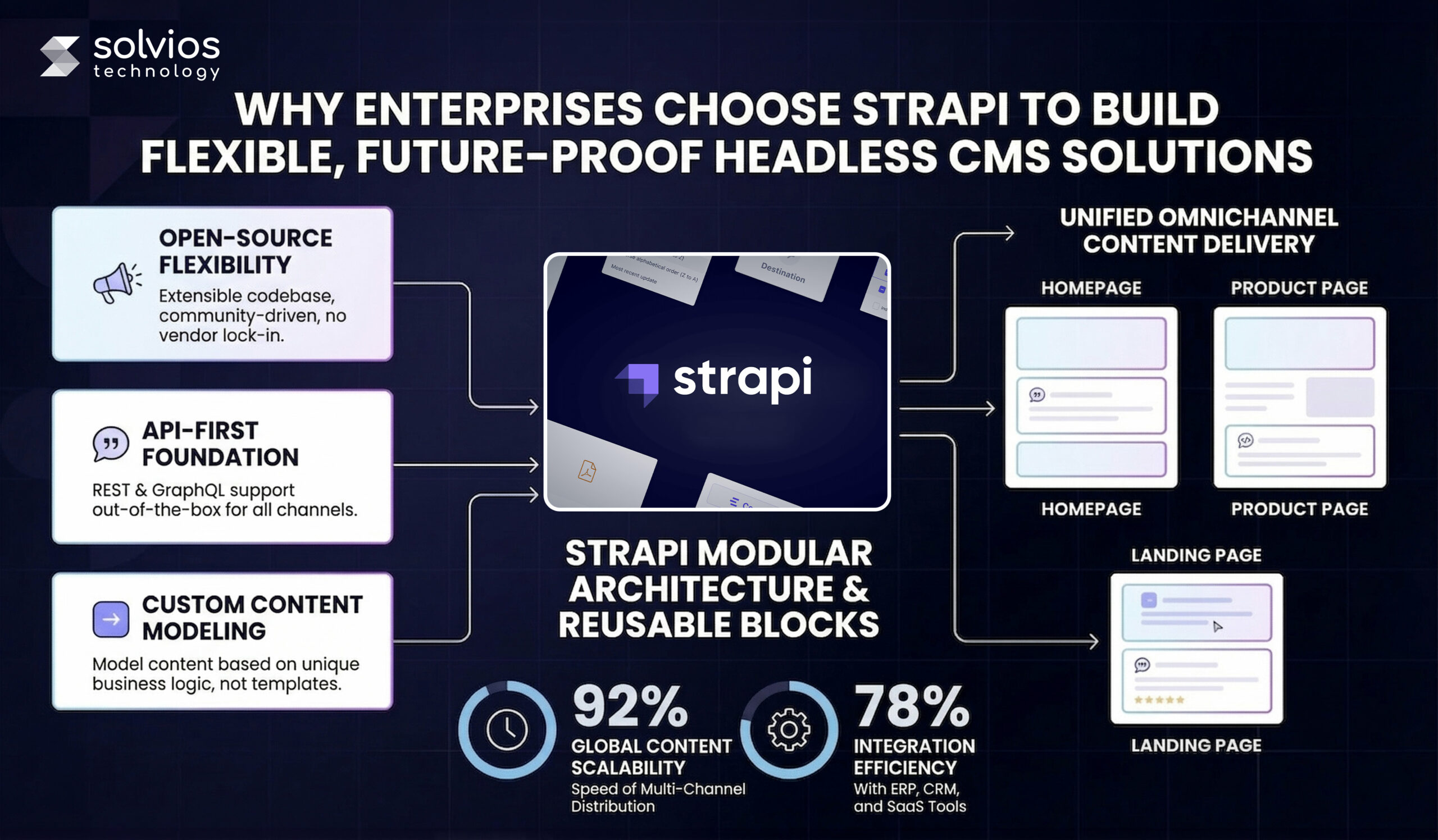
Strapi is open-source, which changes how teams approach it. The codebase is visible, extensible, and shaped over time by a large developer community rather than locked behind vendor-controlled updates.
With Strapi, APIs can’t be added later; they’re the foundation. Content is created with delivery in mind, which makes it easier to connect frontends, services, and internal tools without forcing workarounds.
Different teams prefer different approaches: some rely on REST, while others prefer GraphQL. Strapi supports both without additional layers, which keeps delivery flexible as requirements change.
Strapi isn’t designed to stay static. Users can add features as needed, not all at once. Plugins, extensions, and custom logic fit into the core without changing how the system behaves elsewhere.
With Strapi, content structures aren’t predefined, which is why many enterprises exploring headless CMS benefits and use cases evaluate it early. Teams model content based on real use cases, not templates. That flexibility becomes important as content grows more complex across regions, channels, and products.
Strapi doesn’t treat APIs as an extra layer. Content has been created, and endpoints are already in place. This gives the architect the flexibility to use REST or GraphQL depending on the situation. The backend remains separate, keeping frontend choices from being locked in early.
Customization rarely stays small. Over time, changes stack up. Closed systems make this harder to manage. Strapi’s open-source model leaves room to adjust logic, workflows, and structure as needs change.
Traffic patterns don’t stay stable for long. Usage grows, drops, and changes shape. Strapi is often used during these phases. Deployments vary, but the focus remains on maintaining steady delivery as demand increases.
Access control usually tightens over time. More users, more roles, more reviews. Strapi follows standard API security patterns, which helps teams manage growth without constantly revisiting core setup.
Global content rarely moves at the same pace everywhere. Some regions update faster than others. Strapi handles this through localized structures that prevent workflows from splitting as markets expand.
| Feature | Traditional CMS | Headless CMS (Strapi) |
| API-first | APIs are usually added later | APIs exist from the start |
| Multi-channel delivery | Mainly designed for websites | Used across websites, apps, and other interfaces |
| Frontend flexibility | Tied to templates and themes | Frontend is handled independently |
| Scalability | Works up to a point | Designed to scale as usage grows |
| Full customization | Changes are more constrained | Structure and logic can be adjusted freely |
Content usually starts in one place and ends up everywhere. Websites, apps, and internal tools pull from the same source. Strapi is often used when teams want content to move without rebuilding it each time.
Global campaigns rarely move at the same pace. Some regions publish faster. Others lag behind. Strapi is used to keep content connected while still allowing markets to operate independently.
Commerce stacks change often. Frontends evolve, integrations shift, and catalogs grow. Strapi is commonly placed behind the storefront to manage product content without tying it to the store’s build. Teams looking to build websites with a headless CMS often find this separation of concerns particularly valuable in eCommerce contexts.
SaaS products usually need internal views that customers never see. User data, plans, and configurations live there. Strapi is a good fit when structured data needs to power those panels without extra overhead.
Mobile apps and internal tools tend to share more content than expected. Strapi is used to serve that content consistently, instead of maintaining separate systems for each use.
Most Strapi projects are shaped early by a few technical decisions. Hosting, scaling, and security choices tend to stay in place longer than expected. This is usually where Solvios gets involved first, before those decisions become hard to undo.
Strapi rarely sits alone. Content needs to move into ERP systems, CRM tools, and other platforms. These connections work best when they’re planned rather than added later to fill gaps.
Frontend and backend teams often move at different speeds. When APIs and interfaces aren’t aligned, friction shows up quickly. Solvios works across both layers, so the system evolves as one, not in pieces, similar to how a headless cms development company approaches long-term scalability.
Migration usually carries more assumptions than expected. Old content models, workflows, and shortcuts don’t always translate cleanly. Reviewing these early helps avoid rebuilding the same constraints in a new setup.
Launch isn’t the end. Traffic grows. Usage changes. New requirements appear. Ongoing work around performance, security, and observability helps keep the system steady as it’s used in the real world.
If you’re planning to build or expand with Strapi, starting with a clear technical direction often saves time later. especially when supported by a team experienced in strapi development.
Most enterprise content challenges don’t come from volume alone. They come from systems that can’t adapt to changing requirements. Channels multiply, teams grow, and delivery expectations shift faster than traditional CMS platforms can keep up.
This is why many CTOs, CIOs, and enterprise leaders move toward headless architectures. Flexibility in how content is modeled, scalability under real traffic, and security that evolves with the organization become baseline needs, not differentiators.
This is usually where headless CMS enters the discussion. Not as a trend, but as a response to systems that can’t change easily. Flexibility, scale, and security stop being separate concerns once content starts moving across more teams and platforms.
Platforms like Strapi tend to fit into this shift because they don’t force decisions too early. Content, delivery, and infrastructure can evolve at different speeds, giving teams room to adjust as priorities change.
Enterprises choose Strapi for headless CMS development due to its open-source flexibility, API-first architecture, customization capabilities, and ability to scale across multi-channel, enterprise-level content workflows.
Yes, Strapi is suitable for enterprise applications as it supports scalable architecture, role-based access control, API-driven delivery, and flexible integrations with ERP, CRM, and modern frontend frameworks.
Strapi offers better flexibility, API-first content delivery, frontend independence, and scalability compared to traditional CMS, making it ideal for omnichannel content management and enterprise digital ecosystems.
The cost of a Strapi-based headless CMS solution depends on customization, integrations, and infrastructure, typically ranging from mid to high investment for enterprise-grade scalability and performance requirements.
Developing a Strapi headless CMS for enterprise typically takes several weeks to months, depending on content complexity, integrations, frontend development, and scalability requirements.
Businesses should migrate to a headless CMS like Strapi when they need better scalability, faster content delivery, omnichannel publishing, and flexibility beyond the limitations of traditional CMS platforms.
Planning something next? Let’s turn ideas into action.
Join our community and get updates, insights, and ideas delivered right to your inbox. Stay connected!
 We respect your privacy. Unsubscribe anytime.