 Startups
 Fintech
 Healthcare
 Manufacturing
 Marketplaces
 Mortgage
 Real Estate
 Retail
 Sports and Fitness
 Telecom and IT
 Logistic
 SaaS Product
 About Us
 Blog
Blog Careers
 Become A Partner
 Contact





Solvios Technology successfully delivered the project within the agreed timeline and budget, while maintaining a strong transaction success rate and reliable reporting accuracy. Their team demonstrated a high level of commitment, focus, and results-driven execution throughout the engagement. What stood out most was their ability to identify and resolve challenges quickly, making them a dependable and efficient technology partner.

AI-Native API Integration Services
We're an AI-first API integration company helping startups, scale-ups and enterprises connect the systems their business actually runs on payment gateways, CRMs, ERPs, AI and LLM APIs, third-party platforms and custom enterprise stacks. Senior integration engineers, honest assessments and the kind of engineering discipline that turns brittle connector spaghetti into resilient, secure, AI-ready integration architecture.
13+
Years of Experience
50+
Experts in Our Team
40+
Happy Customers Worldwide
250+
Projects Delivered Successfully


4.9/5 ratings

5/5 ratings

End-to-End API Integration Services From Architecture to Production
Whether you're integrating your first payment gateway, wiring AI APIs into existing workflows, modernizing legacy connector plumbing or building an enterprise integration architecture across CRM, ERP and a long tail of third-party platforms, our API integration services cover every layer of how production integrations actually get built. Delivered by senior integration engineers who treat APIs as the connective tissue of modern business, not just the boring work between the real engineering.

API Integration Strategy & Consulting
Most integration projects don't fail at the API layer. They fail in the strategy that never mapped the integration landscape, never asked the hard questions about data ownership and never accounted for the rate limits, authentication flows and edge cases that only surface in production. We deliver API integration strategy and consulting that surfaces those questions early: integration architecture audits, system-of-record decisions, build-versus-buy analysis for middleware, integration roadmaps and executive advisory that gives your team the answers needed before the connector spaghetti gets worse.

Custom API Development
Off-the-shelf APIs rarely fit the integration worth building. We design and develop custom APIs engineered for your business logic, your security requirements and your scale REST, GraphQL, gRPC and event-driven architectures, with versioning strategy, authentication done right, rate limiting that protects downstream systems, OpenAPI documentation engineers actually use and the kind of API design that survives both internal consumption and external partner integration. Built on Node.js, Python, Go, .NET and the language your existing stack already speaks.
AI-First API Integration, Not Legacy Connector Plumbing
Most integration shops still treat APIs as the boring middle layer between "real" engineering. We treat integration as the architecture that determines whether your AI, your automation and your data actually work together or whether you spent two years building a stack of disconnected tools nobody trusts.

01
Integrations designed for AI workloads, not retrofitted around them
Modern integrations need to handle AI API calls, vector embeddings, streaming responses and the latency profile AI workloads actually have. We design integration architectures that make AI a first-class citizen, not a square peg.
Highlights:
- AI API orchestration
- Streaming response handling
- Vector & embedding integration
01
Integrations designed for AI workloads, not retrofitted around them
Modern integrations need to handle AI API calls, vector embeddings, streaming responses and the latency profile AI workloads actually have. We design integration architectures that make AI a first-class citizen, not a square peg.
Highlights:
- AI API orchestration
- Streaming response handling
- Vector & embedding integration
API Integrations We Deliver Every System, Every Workflow
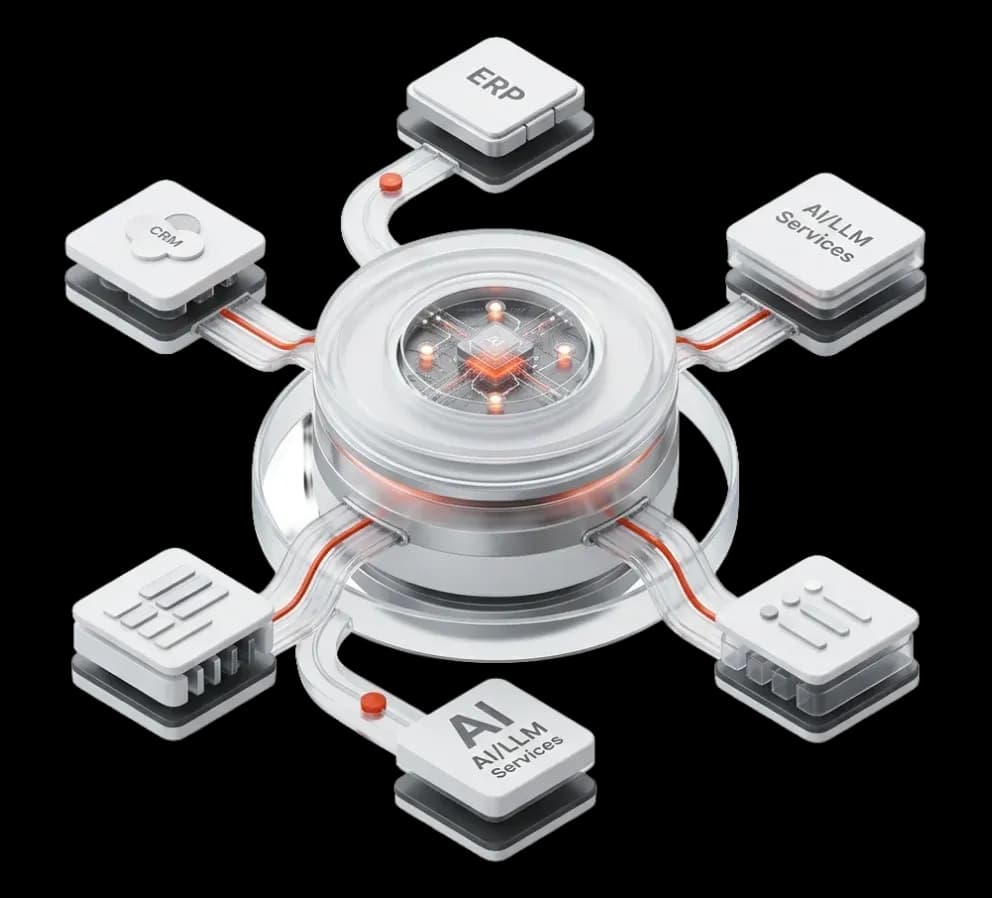
API integration isn't one capability. It's a category spanning payment infrastructure, customer data systems, enterprise resource planning, AI APIs, marketing technology, ecommerce platforms, communication APIs and the long tail of third-party systems modern businesses run on. Here are the integration categories we deliver, and the engineering bar we hold ourselves to on each one.

Payment Gateway Integrations
Stripe, PayPal, Square, Adyen, Braintree, Razorpay, Authorize.Net and regional payment providers. Idempotent transaction handling, webhook reliability, PCI-DSS-aligned data flows, comprehensive sandbox and production testing, subscription billing logic, refund automation and the kind of payment integration architecture that earns the trust your finance team, your auditors and your customers all require.

CRM Integrations
Salesforce, HubSpot, Microsoft Dynamics 365, Zoho CRM, Pipedrive, Close, Copper and custom CRMs. Bidirectional sync engineering, custom object handling, field-level mapping, real-time event flows, contact deduplication, lead routing automation and the data architecture discipline that prevents CRM integrations from accumulating the technical debt most enterprises quietly inherit.

ERP Integrations
SAP, NetSuite, Oracle, Microsoft Dynamics 365 Business Central, ERPNext, Odoo and enterprise ERP systems. Master data management across systems, inventory sync, order-to-cash workflows, procurement integration, financial data flows and the kind of ERP integration engineering that respects the complexity of enterprise resource planning systems without breaking under it.

AI & LLM API Integrations
OpenAI, Anthropic Claude, Google Gemini, Hugging Face, Cohere, Mistral, AWS Bedrock, Azure OpenAI Service and emerging AI APIs. Token-level cost monitoring, prompt versioning, output validation, fallback model routing, semantic caching, streaming response handling and the kind of AI API integration architecture that makes generative AI features reliable, cost-controlled and safe for production users.

Marketing & Analytics Integrations
GA4, Segment, RudderStack, Mixpanel, Amplitude, HubSpot Marketing, Marketo, Klaviyo, ActiveCampaign, Customer.io, Iterable and the marketing data infrastructure that ties campaigns to outcomes. Event tracking architecture, server-side analytics, attribution data flows and the kind of MarTech integration discipline that delivers the data CMOs actually need to defend marketing budgets.

Communication APIs
Twilio, SendGrid, Mailgun, Postmark, Vonage, Slack, Microsoft Teams, Discord, WhatsApp Business API and communication infrastructure. SMS workflows, email deliverability engineering, voice integration, video conferencing APIs, real-time messaging integration and the kind of communication API architecture that handles real volume reliably.

Ecommerce & Marketplace API Integrations
Shopify, BigCommerce, WooCommerce, Magento, Salesforce Commerce Cloud, Amazon Selling Partner API, eBay, Etsy and multi-channel commerce systems. Catalog sync, inventory management across channels, order fulfillment integration, marketplace data flows and the kind of ecommerce integration architecture that scales with multi-channel growth.

Custom Enterprise API Integrations
Custom-built integrations for the systems no one publishes a connector for legacy enterprise platforms, internal microservices, partner APIs, regulatory data exchanges, industry-specific platforms and the proprietary systems your business actually depends on. Engineered with the same production discipline as our standard integrations, designed for systems that don't show up on any vendor's "supported integrations" list.

Why Founders and Entrepreneurs Pick Solvios as Their API Integration Company
We're not just another API integration shop. We're the AI-first integration partner founders and entrepreneurs hire when the connections between systems have to be reliable, secure, scalable and ready for the AI workloads ahead, not just functional enough to pass UAT.

AI-First Integration DNA
AI API integration, intelligent observability, AI-assisted API engineering and AI-native integration architecture are built into how we approach every engagement not bolted on as a "we do AI too" tagline.

Senior Integration Engineers, No Bench Warmers
You work directly with senior integration architects, API engineers and middleware specialists who've shipped production integrations at real scale not juniors learning OAuth on your retainer.

Production-First Engineering
Idempotency, retry logic, webhook reliability, rate limit handling, observability and the kind of production engineering that separates integrations that work from integrations that survive. We don't ship integrations that "work in the happy path."
Why Our Clients Love Working With Us
We build long-term partnerships through transparent communication, technical excellence, and consistent delivery aligned with business goals.
Our API Integration Delivery Process
Most integration engagements don't fail technically they fail because the discovery never mapped the real integration landscape, the architecture never accounted for failure modes or the testing never covered the edge cases that only surface in production. Our AI-first API integration services follow a structured delivery methodology designed to surface those problems early and ship integrations that survive real production load.
Here's exactly how it works.

01
Discovery & Integration Audit
We audit your current integration landscape, system architecture, data flows, API inventory and the accumulated integration debt no one's documented. The deliverable is an honest picture of what's actually connected, what's brittle and where the highest-leverage moves are.

02
Architecture & Strategy
We design the target integration architecture, system-of-record decisions, middleware versus point-to-point trade-offs, security posture and the integration patterns that will scale with your business. A roadmap your team can execute, not a framework deck.
Flexible Engagement Models to Hire Our API Integration Company
Your integration engagement doesn't fit a template, and the contract shouldn't either. The right way to hire an API integration company depends on your scope, your timeline and your in-house team's depth. Three models, all built for how production integration work actually gets delivered.
You need integration engineers who know your systems, your data models and your business workflows as well as your in-house team building for your integration roadmap, not splitting attention across five other clients. The Dedicated Team model gives you a fully embedded integration unit accountable to your production outcomes.
- Right for you if
You're running a multi-quarter integration program, building out enterprise integration architecture, modernizing legacy connectors at scale or augmenting your in-house integration team without the cost and lead time of full-time hires.
- What you get
Hand-picked integration architects, API engineers, middleware specialists and a delivery lead working only on your environment. Sprint planning, integration reviews and weekly reporting run on your calendar and your tooling.
- Economics
Monthly retainer. No surprise invoices, no scope-creep billing. Team composition flexes as your integration roadmap evolves.
Typical profile

3-8 engineers

6-month minimum

Scales with 30-day notice

Not sure which model fits your integration initiative?
Most companies start with one and evolve into another as their integration footprint grows. Let's figure out the right starting point together.

Ready To Ship Integrations That Actually Survive Production?
Building AI-First Integration Foundations for the Businesses That Will Define the Next Decade. The companies investing in production-grade integration engineering now won't be the ones explaining connector outages, data sync failures and integration debt that's compounded into a full re-platforming bill two years from now.


Industries We Deliver API Integration Services For
Integration challenges look different across industries; the regulatory posture, the system landscape, the data sensitivity and the operational rhythm all change the engineering. These are the verticals where we've shipped integrations in production and know what real integration work looks like.

HIPAA-compliant API integrations, PHI-aware data flows, EHR/EMR integration patterns, HL7 and FHIR API engineering, audit-ready integration logging and the kind of compliance posture that healthcare integrations actually demand. We've integrated clinical systems in production. We know what compliance looks like in live integrations, not just in the spec document.
Explore More


HIPAA-compliant API integrations, PHI-aware data flows, EHR/EMR integration patterns, HL7 and FHIR API engineering, audit-ready integration logging and the kind of compliance posture that healthcare integrations actually demand. We've integrated clinical systems in production. We know what compliance looks like in live integrations, not just in the spec document.
Explore MoreFrequently Asked Questions
Honest answers to the questions every founder, CTO and head of engineering asks before they hire an API integration company. If something isn't covered here, our integration architects will walk you through it on a discovery call, no sales pitch, no fluff.
Look beyond the connector list. The right API integration company asks more questions than it answers in the first conversation about your system landscape, your data architecture, your compliance posture and what an integration failure would actually cost your business. Evaluate on production integration depth in the discovery phase, transparency about edge cases and failure modes, tool-agnostic thinking (not vendor advocacy) and whether they push back constructively when they disagree. Anyone who quotes integration work before they've mapped your architecture isn't the right partner.
End-to-end API integration services cover integration strategy and consulting, custom API development, third-party API integration, AI and LLM API integration, payment gateway integration, CRM and ERP integration, middleware architecture, API security and management, integration testing and quality engineering, and ongoing integration operations and monitoring. The best engagements also include an integration landscape audit before any connector work begins because decisions made in week one shape integration debt for years.
A focused integration single API integration or payment gateway setup: $5,000-$30,000. A mid-complexity integration project (CRM-to-ERP, multi-system data sync, AI API integration): $30,000-$150,000. An enterprise integration program with custom middleware, multiple system connections and ongoing operations: $150,000-$750,000+. Ongoing integration operations typically run $5,000-$40,000 per month depending on integration count and complexity. We provide detailed estimates after an architecture audit.
A focused integration (single payment gateway, single third-party API): 2-6 weeks. A mid-complexity integration (CRM-to-ERP sync, AI API integration, custom middleware): 8-16 weeks. An enterprise integration program with multiple systems and custom architecture: 6-18 months, executed in phases. We provide milestone-based timelines in writing before integration work begins.
REST is the dominant API architecture resource-based, HTTP-method-driven, predictable and broadly supported across every third-party platform. GraphQL is query-based clients that request exactly the data they need in a single call, reducing over-fetching and giving frontend teams more flexibility. Most modern integration architectures use both: REST for third-party integrations where it's the standard, GraphQL where flexible querying or aggregation across multiple sources earns its keep. We engineer both based on what fits the architecture, not what's currently fashionable.
AI-first API integration means designing integration architecture with AI workloads as a first-class consideration AI API orchestration, streaming response handling, token-level cost monitoring, vector and embedding integration, and the kind of integration design that makes AI features reliable, cost-controlled and safe to ship. If your roadmap includes AI features, retrofitting AI into legacy integration architecture is harder than designing for it from the start. The integrations worth building now are the ones that don't need rebuilding when AI workloads scale.
API security is engineered into the architecture from day one. OAuth 2.0 and OpenID Connect for authentication, API key rotation, rate limiting against abuse, input validation, output sanitization, encryption in transit and at rest, secrets management through Vault or cloud-native equivalents, audit logging and the kind of API security posture that survives both penetration testing and the compliance audit your industry actually requires.
Yes, that's most of what we do. We work across Salesforce, HubSpot, SAP, NetSuite, Microsoft Dynamics, Oracle, Stripe, PayPal, Square, Twilio, SendGrid, AWS, Google Workspace, Microsoft 365, OpenAI, Claude and the long tail of third-party platforms. For custom or legacy systems, we engineer custom integrations based on whatever interface the system exposes: REST, SOAP, EDI, file-based, database-level. Few systems are truly impossible to integrate; many are harder than they should be.
Webhooks are where most third-party integrations quietly accumulate failures. We engineer webhook handlers with idempotent processing, replay capability, retry logic with exponential backoff, dead-letter queues for unprocessable events, signature verification for security, comprehensive logging and the kind of webhook architecture that turns delivery failures from silent data loss into monitored, alerted, automatically-recovered events.
Three models: Dedicated Integration Team (for long-term, multi-quarter integration programs), Time & Material (for evolving scope and iterative integration work) and Fixed Cost (for well-scoped integration projects with defined deliverables). When you hire our API integration company, we recommend the model honestly based on your situation not based on which is most profitable for us.
AI API integration is a different category requiring different engineering. We integrate OpenAI, Anthropic Claude, Google Gemini, Hugging Face, Cohere and AI APIs with token-level cost monitoring, prompt versioning, output validation, fallback model routing, semantic caching, streaming response handling and the kind of AI integration architecture that makes generative AI features production-ready not demo-ready.
Yes. Managed integration operations is one of our core offerings 24/7 monitoring, error tracking, rate limit management, third-party API change tracking, security posture management, incident response and quarterly architecture reviews. You can hand over the operational load entirely, or run it alongside your in-house team. SLAs are defined and reported on every month.
Yes. API modernization is one of our specialties wrapping legacy SOAP/XML APIs with modern REST or GraphQL interfaces, migrating off legacy ESBs to modern integration platforms, replacing point-to-point connectors with event-driven architectures and the kind of modernization work that pays back without forcing a full re-platforming. We modernize incrementally where it makes sense and rebuild where the engineering economics justify it.
Didn't Find What You Were Looking For?
Get In Touch With Our Experts +1 (561) 717-2700
 +91 96620 35673


















 About Us
 Blog
Blog Careers
 Become A Partner
 Contact