Startups
 Fintech
 Healthcare
 Manufacturing
 Marketplaces
 Mortgage
 Real Estate
 Retail
 Sports and Fitness
 Telecom and IT
 Logistic
 SaaS Product


 About Us
 Blog
Blog Careers
 Become A Partner
 Contact










CMS Development
End-to-end web development covering custom websites, web applications and modern frontend engineering built by senior engineers who treat the web stack as a serious engineering surface.
Learn More about CMS Development
 About Us
 Blog
Blog Careers
 Become A Partner
 Contact
Connecting People With Technology
Solvios is the leading IT company in the business to give you growth, revenue, and a global platform.

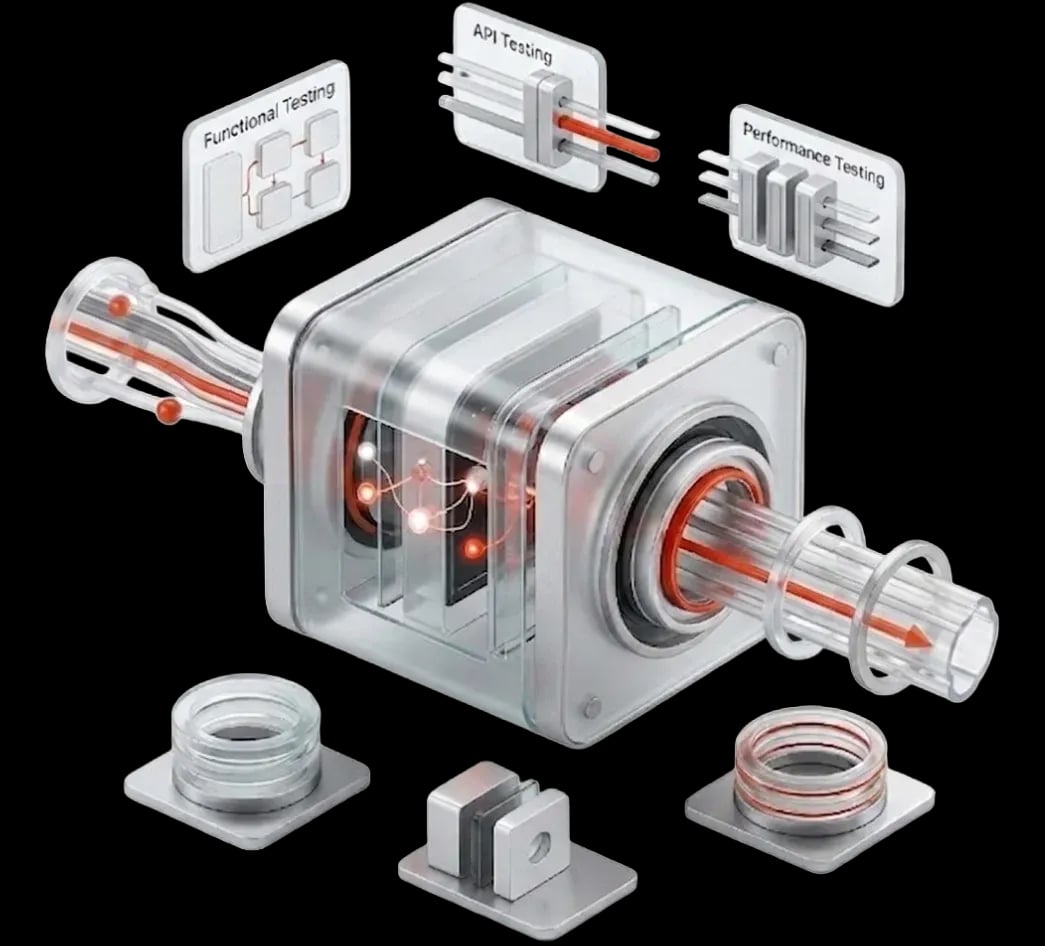
We're a US-based AI-augmented QA testing services company helping startups, scale-ups and enterprises ship software that works under real-world conditions manual testing, performance and load testing, security testing, API testing, mobile app testing and regression testing delivered by senior QA engineers who treat quality as an engineering discipline, not a checklist run the week before release. Because the bug your team finds in staging costs an hour to fix. The one your users find on launch day costs a lot more.
Years of Experience
Experts in Our Team
Happy Customers Worldwide
Projects Delivered Successfully


4.9/5 ratings

5/5 ratings

Whether you're launching a new product and need QA coverage from day one, scaling a release cadence that's outgrown manual testing, preparing for a security audit, dealing with a performance problem that only surfaces under real load or trying to understand why your regression suite keeps missing the bugs that reach production our software testing and QA services cover every layer of quality engineering. Manual, automated, performance, security, API and mobile testing delivered by QA engineers who measure success by defect escape rate, not by test case count.

Automated testing catches what it was programmed to catch. Manual testing catches what a real user would actually encounter in the edge case, the requirements never mentioned, the UI state that only exists after a specific sequence of interactions and the usability problem that passes every assertion but still makes users abandon the flow. Our manual testing services cover functional testing against documented and undocumented requirements, exploratory testing that goes beyond the test plan to find what the test plan missed, usability testing that evaluates the experience from the user's perspective rather than the developer's, cross-browser and cross-device compatibility testing on real hardware and the regression coverage that keeps previously fixed bugs from reappearing quietly in the next release.

Most applications perform fine with ten concurrent users. The ones that matter get ten thousand on a product launch, a flash sale or a regulatory deadline that every user in the industry hits on the same day. We design and execute performance testing programmes that surface the bottlenecks before your users do: load testing against realistic concurrent user profiles, stress testing to find the point at which the system fails and how it fails, spike testing for the traffic patterns that don't look like a load test but feel like one, endurance testing for the memory leaks and connection pool exhaustion that only surface after twelve hours of sustained load, and the performance baseline documentation that tells your engineering team exactly which component broke under which condition and what fixing it actually requires.

Security vulnerabilities don't announce themselves. They sit quietly in your authentication logic, your API input validation, your session management and your third-party dependency tree until someone with the right motivation finds them. Our security and penetration testing services cover OWASP Top 10 vulnerability assessment, authentication and authorisation testing, injection attack surface analysis, session management and token security testing, third-party dependency scanning, API security testing, infrastructure penetration testing and the detailed remediation guidance that gives your engineering team a clear priority-ordered fix list not a PDF of CVE numbers to interpret alone. For regulated industries, we produce the evidence documentation your auditor will ask for.

APIs are where the integration assumptions your team made in separate sprints collide with reality. We test API layers with the rigour that production integration actually demands: functional testing of every endpoint against the contract, boundary and negative case testing that finds the input combinations no developer tested manually, authentication and authorisation verification across every permission level, rate limiting and throttling behaviour under load, error response consistency and the contract testing that catches breaking changes before they reach the consumers depending on the API. REST, GraphQL, gRPC and SOAP tested against the real integration scenarios, not the happy path the documentation was written around.

Mobile applications fail in ways that web applications don't device fragmentation, OS version variation, network condition sensitivity, battery and memory constraints, background app lifecycle behaviour and the interaction patterns that differ fundamentally between a 6.1-inch OLED and a 4.7-inch LCD on a carrier network with 150ms latency. We test mobile applications on real devices across iOS and Android functional testing, UI and gesture interaction testing, network condition simulation including offline and degraded connectivity, battery and performance profiling, push notification behaviour, deep link handling and the OS upgrade regression testing that catches the compatibility breaks that only surface when your user's phone updates overnight.

Every new feature is a potential regression. Every dependency update is a potential regression. Every infrastructure change is a potential regression. Without a disciplined regression testing practice, the question isn't whether a previously working feature will break, it's which one will break, when, and whether your team will find it before your users do. We design and execute regression testing programmes that give your engineering team confidence to ship: risk-based test prioritisation that focuses coverage on the areas most likely to be affected by each change, well-maintained regression suites that don't accumulate flaky tests and false confidence, AI-assisted test impact analysis that identifies which tests need to run for a given change and the regression reporting that tells your product and engineering leads exactly what was verified before the release went out.
Most QA teams treat AI as a shortcut for writing test cases faster. We treat it as a layer that changes what gets tested, how failures get diagnosed and how quality gets maintained across a release cadence that manual-only testing can't keep up with. Every layer below uses AI to extend coverage, accelerate root cause analysis and surface the quality signals that traditional testing approaches miss entirely.

AI-assisted analysis of code diffs, user behaviour data and historical defect patterns to identify the areas of the application most likely to harbour undiscovered defects so testing effort goes where the risk actually is, not where the test plan was last updated.
Highlights:
AI-assisted analysis of code diffs, user behaviour data and historical defect patterns to identify the areas of the application most likely to harbour undiscovered defects so testing effort goes where the risk actually is, not where the test plan was last updated.
Highlights:
Software testing and QA isn't one capability. It's a discipline that spans test strategy, test automation architecture, performance engineering, security assessment, accessibility validation, CI/CD quality gates and the AI layer that separates QA practices that scale with your release cadence from ones that become the bottleneck. Here are the capabilities we deliver and the engineering bar we hold ourselves to on each one.

Test Strategy & QA Consulting
A testing strategy designed for your actual release cadence, your team's maturity and your risk profile not a testing framework template from a conference slide. Test pyramid design, automation ROI analysis, tooling selection, quality gate definition for CI/CD pipelines, QA team structure recommendations and the honest assessment of where your current testing practice is failing to catch defects before they reach production.

Test Automation Architecture
Automation frameworks built for long-term maintainability Playwright, Selenium, Cypress, Appium and REST Assured selected based on the application architecture and the team's capability, not the tool the last QA engineer was most familiar with. Page Object Model, screenplay pattern, data-driven test architecture and the CI integration that makes automation a quality gate rather than an optional post-release verification step.

Functional & Exploratory Testing
Systematic functional coverage against documented requirements combined with the structured exploratory testing that finds the defects requirements never anticipated. Session-based test management, charter-driven exploration, persona-based testing and the test documentation that gives your team a clear picture of what was tested, how it was tested and what was found not a spreadsheet of pass/fail results that nobody reads after the release.

Accessibility Testing & WCAG Compliance
WCAG 2.1 AA compliance testing across screen readers, keyboard navigation, colour contrast, focus management, form labelling and the full scope of accessibility requirements that enterprise procurement teams and regulated industry clients are increasingly mandating. Automated accessibility scanning through axe-core and Lighthouse combined with the manual assistive technology testing that automated tools consistently miss because a passing Lighthouse score and a genuinely accessible application are not the same thing.

Cross-Browser & Cross-Device Testing
Real device testing across the browser and OS combinations your actual users bring is not a Browserstack matrix that satisfies the test plan without reflecting the real-world distribution of your user base. Browser compatibility matrix defined from analytics data rather than assumption, real device lab testing for the mobile combinations that matter and the visual regression testing that catches the rendering differences that functional tests don't.

CI/CD Quality Gates & Pipeline Integration
Quality gates wired into your CI/CD pipeline that enforce coverage thresholds, performance budgets, accessibility standards and security checks before code reaches production not as a compliance checkbox but as the engineering constraint that prevents quality from being traded away under release pressure. GitHub Actions, GitLab CI, Jenkins, Azure DevOps and the pipeline-native testing integration that makes quality a continuous practice.

Test Environment & Data Management
Stable, production-representative test environments that don't become the reason test results can't be trusted. Environment provisioning through infrastructure as code, test data management with synthetic data generation for edge cases and privacy-compliant masking for regulated data, environment parity monitoring and the discipline that means a test environment failure is an infrastructure problem rather than a QA credibility problem.

Defect Management & Quality Reporting
Defect tracking that gives engineering teams actionable fix information reproduction steps, environment state, expected versus actual behaviour, severity and priority defined honestly rather than as a political negotiation. Quality dashboards that track defect density, escape rate, automation coverage, test execution trends and the release readiness metrics that let engineering leadership make go/no-go decisions based on actual quality data.

We're not just another software testing services company. We're the AI-augmented quality engineering partner you bring in when defect escape rates, release confidence and test automation ROI aren't acceptable to leave unsolved and when the current QA practice has become the thing slowing every release down rather than the thing making every release safe.

AI-driven test coverage analysis, intelligent automation, predictive defect detection and continuous quality intelligence are built into how we approach every QA engagement not positioned as a premium add-on after the test plan is already written.

You work directly with QA engineers who've built quality practices for production systems at real scale automation frameworks that survived codebase growth, performance testing programmes that found the bottlenecks before launch day and security assessments that caught the vulnerabilities before the auditor did. Not juniors learning Selenium on your release cycle.

We treat QA as engineering, not as a final-phase gate. Test strategy designed for your CI/CD pipeline, quality gates defined before the first sprint, automation built for maintainability not ticket-closure and the shift-left practices that find defects when they cost ten minutes to fix rather than ten days.

Manual, performance, security, API, mobile and regression testing delivered by a single team that understands how the layers interact, not a rotating cast of specialists who've each only seen one dimension of your quality problem.

Defect escape rate, test coverage trends, automation health, release readiness scores reported honestly every sprint. You always know whether quality is improving, where the highest remaining risk sits and what it would take to ship with confidence.

We build QA practices for continuous delivery, not for the waterfall-shaped testing phase at the end of a quarterly release. Shift-left testing, AI-assisted automation, risk-based prioritisation and the pipeline integration that means quality gates run on every commit, not on the night before the release.
Most QA engagements don't fail because the testers couldn't find bugs. They fail because the test strategy was never designed for the release cadence the team actually runs, the automation was built fast and never maintained and the quality gates were defined after the bugs had already escaped to production. Our AI-augmented QA testing services follow a structured delivery methodology designed to integrate quality into the engineering process rather than appending it at the end.
Here's exactly how it works.

We assess your current quality posture: defect escape rate, test coverage, automation health, CI/CD quality gate maturity, release cadence and the historical defect patterns that tell us where your testing practice is systematically missing the bugs that matter. For greenfield engagements, we map requirements, risk areas, integration dependencies and the performance and security requirements that need to be designed into the test strategy from day one.

We define the test strategy matched to your actual release cadence, risk profile and team structure: test pyramid design, automation scope, tooling decisions, quality gate thresholds for CI/CD, test environment requirements and the AI-augmented practices that extend coverage beyond what manual and traditional automated testing deliver alone.

We stand up stable, production-representative test environments provisioned through infrastructure as code and configure the test data management capability synthetic data generation for edge cases, privacy-compliant masking for regulated data, baseline datasets for regression suites before any test execution begins. Environment instability is the most common reason test results can't be trusted.

We write the test cases, build the automation framework and implement the quality gates in parallel with feature development not after it. Manual test suites covering functional, exploratory and regression scenarios. Automation framework built for maintainability with self-healing selectors and the CI integration that makes it run on every commit rather than every release.

We execute test cycles against the defined strategy, triage defects with the actionable reproduction detail that engineers actually need, track defect density and escape rate trends and provide release readiness assessments that give your engineering and product leadership a clear, honest picture of what was tested and what risk remains before the release goes out.

We maintain the quality practice after the initial engagement automation suite health monitoring, flaky test resolution, test coverage expansion as the application grows, performance baseline updates and the quarterly quality reviews that surface where the practice needs to evolve as your release cadence and codebase complexity change.
QA engagements don't fit one template. An embedded QA team on a product squad, a managed testing service for a steady-state application and a time-bounded security assessment are three very different scopes with three different risk profiles. The right engagement model depends on your release cadence, your in-house QA capability and how continuous the testing need actually is. Three models, all built for the quality standard modern software delivery demands.
You're running a continuous delivery pipeline, scaling a product where the release cadence has outgrown ad-hoc testing, building a formal QA practice for the first time or augmenting your in-house team without the cost and lead time of permanent headcount.
Hand-picked QA engineers, automation specialists, a performance tester and a QA lead embedded in your delivery process. Sprint planning, defect triage and release readiness reviews run on your calendar and your tooling. AI-augmented testing is built into how the team operates.
Monthly retainer. No surprise invoices. Team composition flexes as your release cadence and scope evolve.

2-6 engineers

6-month minimum

Scales with 30-day notice

Most engineering teams start with one and evolve into another as their release cadence and quality maturity grow. Let's figure out the right starting point together.

Building AI-Augmented QA Foundations for the Businesses That Will Define the Next Decade. The engineering teams investing in production-grade, AI-augmented quality practices now won't be the ones explaining production incidents, emergency hotfixes and missed compliance audits two years from now.


Software quality requirements look different across industries; the regulatory evidence burden, the performance tolerance, the security surface area and the consequences of a defect reaching production all change the engineering. These are the verticals where we've delivered QA practices in production and understand what real-world quality assurance actually demands.

Honest answers to the questions every CTO, head of engineering and product manager asks before they hire a QA testing services company. If something isn't covered here, our QA architects will walk you through it on a discovery call no sales pitch, no fluff.
Look beyond the tool logos and the test case count claims. The right QA testing services company asks more questions than it answers in the first conversation about your defect escape rate, your current release cadence, your automation maturity and what a production incident actually costs your business. Evaluate on QA strategy depth in the discovery phase, transparency about what testing will and won't catch, the ability to integrate with your engineering process rather than running parallel to it and whether they push back when the test scope proposed doesn't match the risk profile of what you're building. Anyone who quotes a test case volume before they've understood your architecture isn't the right partner.
End-to-end software testing and QA services cover test strategy and QA consulting, manual functional and exploratory testing, test automation framework design and build, performance and load testing, security and penetration testing, API testing, mobile app testing, regression testing, accessibility testing, CI/CD quality gate integration, test environment and data management, defect management and quality reporting. The best engagements start with a quality audit of the current state before any test cases are written because the testing strategy that makes sense depends entirely on where quality is currently failing.
A focused QA engagement manual testing for a specific release, API testing programme or accessibility audit: $5,000-$25,000. A mid-complexity QA programme with automation build, performance testing and ongoing regression coverage: $25,000-$100,000. An enterprise QA programme with embedded teams, full automation framework, continuous quality gates and multi-environment coverage: $100,000-$500,000+. Ongoing managed QA services typically run $5,000-$30,000 per month depending on team size and scope. We provide detailed estimates after a quality audit. We won't quote before we understand what we're actually testing.
A focused testing engagement release-specific manual testing, performance test sprint or security assessment: 2–6 weeks. An automation framework built for a mid-complexity application: 6–12 weeks. An embedded QA programme for a continuous delivery product: ongoing, with 6-month minimum for a Dedicated Team engagement. We provide milestone-based delivery plans before any engagement begins.
Manual testing involves a human tester exercising the application finding defects that require judgement, understanding of context and the kind of exploratory investigation that automation can't replicate. Automated testing runs scripted checks repeatedly and consistently ideal for regression coverage, performance measurement and the repetitive validation that manual testing would make prohibitively slow at continuous delivery speeds. The best QA practices use both: automation for the coverage that needs to run on every commit, manual and exploratory testing for the discovery work that finds what the automation wasn't written to check. Replacing all manual testing with automation is a common mistake that creates high automation coverage and high defect escape rates simultaneously.
AI-augmented QA testing means applying AI across the quality engineering practice test coverage gap analysis driven by code change data rather than gut feel, self-healing automation that doesn't break every time the UI changes, predictive defect detection that concentrates testing effort on the highest-risk areas, synthetic test data generation for the edge cases real data doesn't cover and continuous quality intelligence that surfaces trend deterioration before it becomes a production incident. If your release cadence has outgrown what manual testing can keep up with and your automation suite is spending more time being maintained than running, AI-augmented testing is the engineering investment that changes the economics. The QA practices worth building now are the ones that scale with continuous delivery rather than becoming the bottleneck that forces you back to quarterly releases.
We integrate quality gates at the pipeline stages that match the test type and the risk level unit and component tests on every commit, integration and API tests on every pull request merge, full regression suite on every deployment to staging, performance baseline comparison on every production candidate and security checks on a defined cadence. We work in your existing pipeline tooling GitHub Actions, GitLab CI, Jenkins, Azure DevOps, CircleCI and configure the quality gate thresholds that reflect genuine release risk rather than arbitrary coverage numbers. The goal is a pipeline where a quality gate failure is informative and actionable, not a source of noise that engineers learn to ignore.
Yes. We start with a quality audit, current test coverage, automation health, defect escape rate trends, test environment stability and the accumulated technical debt in the automation suite that's usually the first thing a QA handover reveals. We give you an honest picture of what you've inherited and a clear recommendation for what to do about it. Sometimes the automation foundation is solid and needs extension. Sometimes it needs a measured rebuild. Sometimes the manual test coverage is the gap rather than the automation. We tell you what we find, not what's most convenient for us to recommend.
Security testing is structured around the OWASP Top 10 as the floor, not the ceiling. We scope penetration testing engagements against your actual application architecture web application, API, mobile, infrastructure and execute with the methodology and documentation that regulated environments require. Findings are delivered with severity ratings, reproduction steps, remediation guidance and the prioritisation that gives your engineering team a clear fix sequence rather than a vulnerability list to interpret. For compliance-driven security testing, we produce the evidence documentation your auditor will request.
Three models: Dedicated QA Team (for continuous delivery products and ongoing quality engineering programmes), Time & Material (for release-specific testing engagements, automation builds and scoped testing sprints) and Fixed Cost (for well-defined QA projects security assessments, automation framework builds, performance testing programmes with stable scope and a clear deliverable). We recommend the right model honestly based on your release cadence and quality maturity, not based on which model is most convenient for us to staff.
Didn't Find What You Were Looking For?
Get In Touch With Our Experts



Curated insights, comparisons and best practices on test automation, performance testing, security testing, QA strategy, CI/CD quality gates and the AI-augmented testing patterns reshaping how modern engineering teams ship software with confidence.
We'd love to understand what you want to build. The more context you share, the faster we can give you a useful response not a sales pitch, but a genuine assessment of how we can help and what working together would look like.








Solvios is a leading software development company crafting innovative solutions for businesses. We Specialize in custom software, web & mobile app development, and digital marketing. Partner with us to transform your vision into reality and achieve digital success.