How a Wealth Management Platform Secured Family Financial Data While Making It Shareable Across Generations

The client is a finance-sector company building tools for responsible, long-term wealth planning. Their idea was simple to explain and hard to build: give families one secure place to record what they own, so that money and policies don't sit unclaimed for years because nobody else knew they existed. They came to Solvios needing a full web platform built from the ground up, one that could hold sensitive financial data and still let people share it safely with the family members and advisors who needed it.

How a Wealth Management Platform Secured Family Financial Data While Making It Shareable Across Generations
Client

A wealth management platform serving high-net-worth families and their advisors

Duration

6 Months

Industry

Finance

Country

Not confirmed in source material placeholder, pending client confirmation

Tech Stack

The Challenge They Brought to the Table

The client, a finance-sector platform focused on family wealth planning, needed a secure web application where users could log sensitive financial and insurance data, then share it selectively with relatives and advisors. Solvios designed and built a role-based sharing platform secured with combined AES and RSA encryption, giving families one dashboard to track assets while keeping advisors and heirs on appropriately scoped access. Within six months, the client had a production-ready platform handling encrypted data storage, multi-party sharing and real-time visibility into family wealth.

Billions of dollars in insurance payouts and bank deposits go unclaimed because heirs never learn the accounts exist.

No existing system let a user register, log wealth data and grant selective access to specific family members.

Financial documents and account details needed encryption both at rest and in transit, not just a login wall.

The platform needed to separate full-access family relationships from read-only or advisor-managed ones.

Financial advisors managing several clients needed one interface to update multiple client records at once.

The build had to hold up years after the last login, since the whole point is data still being there when it's needed.

The Situation When Solvios Stepped In

The client had validated the problem, families lack an accessible way to record and pass down financial details, but had no product yet. They came to Solvios at the concept stage, which meant the entire platform, from data architecture to interface, had to be built rather than extended.

No existing codebase or infrastructure. The engagement started from a blank product, not a legacy system to modernize.

No defined encryption approach for account numbers, policy details, and the documents tied to them.

No data model for representing family relationships, shared access levels, or advisor permissions.

No design system built for a product that had to feel trustworthy to a non-technical, often older user base.

No hosting or DevOps setup suited to a compliance-sensitive financial application.

No plan yet for how one financial advisor could manage several client records from a single login.

key challenges background

The Problem That Needed More Than a Quick Fix

None of this could be solved with a login form and a database table. The data was sensitive enough that a security shortcut early on would have meant a rebuild later, and the sharing model had to work for relationships that don't fit a typical user-permissions system.

Encrypting Sensitive Financial Data Without Slowing the Product Down

Account numbers, policy details and uploaded documents all needed encryption strong enough to satisfy a finance-sector audit, without turning every page load into a noticeable wait for the user

Designing Access Levels That Reflect Real Family and Advisor Relationships

A spouse, an adult child, and a financial advisor all need different views of the same data. The permission model had to support that without becoming a maze of settings a user would give up on.

Making a Security-Heavy Product Feel Simple to a Non-Technical User

The people entering this data aren't engineers. If encryption, key management or sharing controls surfaced as friction, the product would fail on adoption even if the security was airtight.

Structuring Data So One Advisor Could Serve Many Clients From a Single Account

Advisors needed a console that separated each client's records cleanly, so updating one client's information carried zero risk of touching another's.

How We Approached It

We locked the encryption approach before writing a single screen. Every later decision, the data model, the sharing logic, the advisor console, had to sit on top of that foundation without contradicting it.

Locking Down the Encryption Model First

We paired AES for symmetric encryption of the actual data with RSA for key exchange. The backend generates an RSA key pair, the public key encrypts the AES key on the client side, and the AES key encrypts the payload before anything reaches storage. Sensitive fields and uploaded documents are never stored or transmitted in plain form.

Building a Data Model Around Relationships, Not Just Records

Instead of a flat table of users and assets, we modeled relationships as first-class objects: who shared what, with whom, and at what access level. That structure is what let family sharing, advisor access and read-only views all run on the same underlying logic instead of three separate systems.

Designing an Interface Around Trust

We kept the UI deliberately plain: clear labels, minimal steps to add an asset, no security jargon on screen. The goal was a dashboard someone's parent could use without a walkthrough call, while the encryption work happened invisibly underneath.

Engineering the Sharing Layer as a Distinct System

Sharing wasn't bolted on after the core product. We built it as its own layer, capable of granting view-only access to a family member, editable access to a co-owner, or managed access to an advisor, all from the same data source, without duplicating records for each viewer.

Hosting for Compliance and Reliability

We deployed on AWS with the backend on Laravel, giving the client a REST API layer that could support the web dashboard now and additional clients later without a rebuild. Infrastructure was set up to keep encrypted data backed up and available, not just fast.

filter list background

What We Built & Delivered

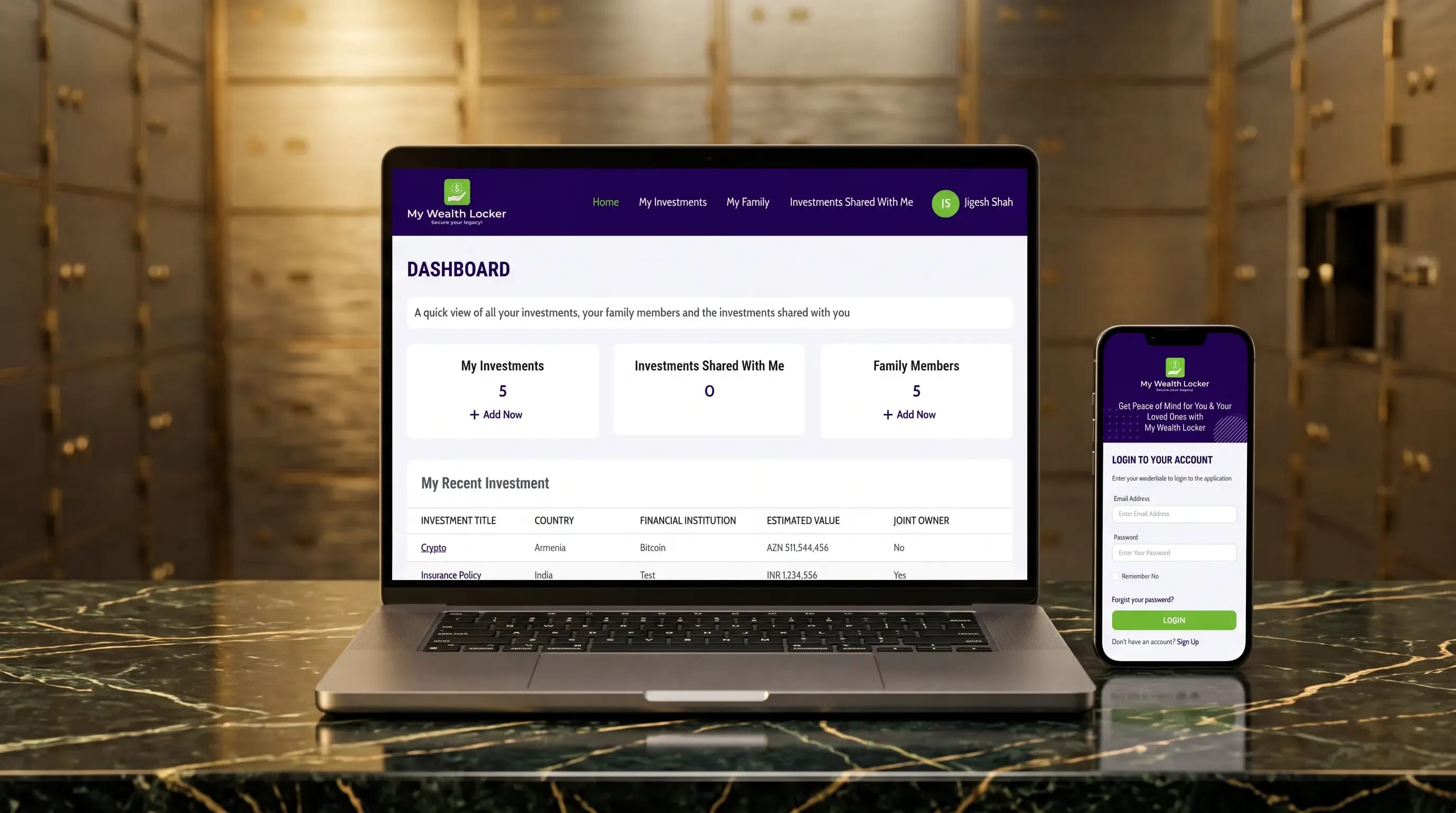
The finished platform covers the full loop: a family member records their financial picture, decides who sees what, and an advisor can step in without needing a separate account for every client they manage.

Encrypted Document & Data Vault

Encrypted Document & Data Vault

Users store account details, policy numbers and supporting documents in a vault encrypted with AES, with RSA-managed key exchange protecting the encryption keys themselves.

Family Sharing Controls

Family Sharing Controls

A user can add unlimited family members and set what each one can see, from full visibility to a single shared asset, without creating duplicate copies of the underlying data.

Advisor Multi-Client Dashboard

Advisor Multi-Client Dashboard

Financial advisors log into one console that lists every client who has granted them access, with each client's records kept cleanly separated from the next.

Consolidated Wealth Dashboard

Consolidated Wealth Dashboard

A single screen shows total holdings, shared accounts and recent updates, so users get the high-level picture without digging through individual records.

Read-Only Family Access Mode

Read-Only Family Access Mode

Family members who are granted view access can log in for free and see exactly what's been shared with them, without any ability to alter the source records.

Cloud-Hosted, Always-On Architecture

Cloud-Hosted, Always-On Architecture

The platform runs on AWS behind a Laravel REST API, so data stays available and backed up regardless of how long it sits untouched between logins.

What Changed After We Shipped

The client went from an idea about protecting generational wealth to a working platform that families and advisors could actually use. The results map directly back to the gaps identified at the start.

Centralized Records - Wealth Data in One Secure Place

Centralized Records - Wealth Data in One Secure Place

Families now keep account, policy and document details together instead of scattered across paperwork, emails and separate logins.

Unlimited Sharing - Family & Advisor Access Without Duplication

Unlimited Sharing - Family & Advisor Access Without Duplication

Data can be shared with any number of family members or advisors from a single source record, with access levels enforced per relationship.

AES + RSA - Encryption Built In From Day One

AES + RSA - Encryption Built In From Day One

Sensitive fields and documents are encrypted end-to-end, so security wasn't a retrofit after launch, it shaped the architecture from the first sprint.

Single Login - One Console for Multiple Advisor Clients

Single Login - One Console for Multiple Advisor Clients

Advisors manage several client relationships from one account instead of juggling separate logins or spreadsheets per client.

6 Months - Concept to Production Launch

6 Months - Concept to Production Launch

The full platform, design, backend, encryption layer and cloud deployment, shipped in six months with a five-person delivery team. None of these outcomes were the point on their own. Together, they solve the original problem: wealth information that's actually accessible to the people who are supposed to inherit it, protected well enough that storing it there feels safer than not writing it down at all.

“We went into this knowing security couldn't be an afterthought, and the Solvios team treated it that way from the first conversation. They pushed back on shortcuts a few times, which is exactly what we needed. What we ended up with is a platform our users trust enough to actually put their financial details into, and that was the entire point.”

Michael, Product Lead, a finance-sector platform for family wealth management

How the Engagement Ran

The six-month build ran in five phases, with the encryption and data model decided early enough that later phases didn't have to work around late-stage security changes.

Discovery & Security Architecture
01

Discovery & Security Architecture

We mapped the family and advisor relationships the platform needed to support, then defined the AES/RSA encryption approach before any interface work began.

Data Model & UX Design
02

Data Model & UX Design

With encryption settled, we designed the relationship-based data model and the interface around it, keeping the UI plain enough for non-technical users.

Core Platform Development
03

Core Platform Development

The React frontend and Laravel/REST API backend were built in parallel, with the encrypted vault and dashboard as the first features to reach a working state.

Sharing Layer & Advisor Console
04

Sharing Layer & Advisor Console

We built the sharing system as its own layer, then the advisor console on top of it, so both features drew from the same underlying relationship model.

Hardening, QA & Cloud Launch
05

Hardening, QA & Cloud Launch

Before launch, we tested encryption edge cases and access-control boundaries specifically, then deployed the platform to AWS with monitoring in place.

More Success Stories Worth Exploring

filter list background

Frequently Asked Questions

A platform of this scope, encrypted data storage, family sharing, an advisor console and a consolidated dashboard, typically takes around six months from discovery to production launch with a small, focused team. That timeline assumes the encryption approach and data model are settled early, since both influence almost every feature built afterward. Simpler versions with fewer access levels can move faster, while platforms adding integrations with external financial institutions or additional compliance requirements usually extend the timeline into the eight-to-twelve-month range.

A common, proven approach combines AES for encrypting the actual data with RSA for securing the AES key itself. The backend generates an RSA key pair, the public key encrypts the AES key on the client side before transmission, and the AES key encrypts the underlying financial data before it's stored. This means sensitive fields and documents are never stored or transmitted in plain, readable form, and even if storage were compromised, the data inside it wouldn't be immediately usable.

Family sharing access is typically read-only: a relative can view what's been shared with them but can't edit the underlying records. Advisor access is usually broader and structured differently, since one advisor often needs to view and update information across several separate clients rather than one family's data. Building these as distinct permission types, rather than a single generic sharing setting, keeps the access model clear and avoids giving either group more control than the relationship actually calls for.

Yes, when the platform is architected for it from the start. Rather than requiring a separate login per client, an advisor console can list every client who has granted access, with each client's records kept fully separated behind the scenes. This requires the underlying data model to treat advisor relationships as their own structure rather than an extension of family sharing, which is a decision worth making during initial architecture rather than retrofitting later.

There's no single required stack, but a common, reliable combination is a React frontend, a Laravel backend exposing a REST API, and MySQL for relational data storage, deployed on a cloud provider like AWS for reliability and backup. What matters more than the specific stack is how encryption is layered in: AES and RSA implemented at the application level, rather than relying solely on database or transport-layer encryption, gives more control over exactly what's protected and how.

Didn't Find What You Were Looking For?

Get In Touch With Our Experts

Building a Product That Handles Sensitive Data? Let's Talk Architecture First.

If your product needs to store financial, medical or otherwise sensitive user data and still stay usable, the encryption and access-control decisions have to happen before the first screen gets designed. We've done that work before, and we're glad to talk through your specific case.

Response within 24 hours. No commitment required.

Start a Conversation
Building a Product That Handles Sensitive Data? Let's Talk Architecture First.

Need Project Consultation? Let’s Talk

We'd love to understand what you want to build. The more context you share, the faster we can give you a useful response not a sales pitch, but a genuine assessment of how we can help and what working together would look like.