• Sales:USA+1 (561) 717-2700
  • INDIA+91 96620 35673
  • HR:+ 91 9328830413
  • Emailinfo@solvios.technology
  • Company
    Company

    With offices in India & the USA, we drive digital transformations for businesses worldwide, ensuring global success.

    • About Us
    • Blogs
    • Careers
    • Become a Partner
    • Contact Us
    Connecting People With Technology

    Solvios is the leading IT company in the business to give you growth, revenue, and a global platform.

    Download Our Profile Download Our Profile
  • Services
    Services

    Empowering businesses with advanced websites and apps that redefine digital experiences and craft your digital future.

    • Web Development
      • Enterprise Solutions
      • Custom Web Apps
      • ECommerce
      • CMS Development
      • Frontend Development
      • Headless CMS Development
    • Cloud Services
      • Cloud Migration
      • Infrastructure Management
      • DevOps
    • Mobile App Development
      • Native iOS
      • Native Android
      • Cross Platform
    • CRM & ERP
      • Salesforce
      • NetSuite
      • Microsoft Dynamics
      • HubSpot
      • ERPNext
    • Emerging Technologies
      • Blockchain
      • Data Warehousing & BI
    • Digital Marketing
      • SEO Services
      • Social Media
      • Performance Marketing
    Let’s Build What’s Next.

    Let’s discuss how Solvios Technology can simplify your IT challenges and accelerate your digital transformation.

    Let’s Talk
  • AI Services
    AI Services

    Advanced AI solutions to transform your business with automation, analytics, and next-gen intelligence.

    • AI Consulting
    • AI/ML Development
    • AI Integration
    Transform Your Business with AI Solutions

    Solvios delivers advanced AI solutions—from strategy to deployment—to automate workflows, enhance customer experiences, and enable smarter business decisions.

    Get Your AI Strategy
  • Technologies
    Technologies

    Leaning on expertise across all platforms and technologies, we stay ahead of the innovation curve, crafting future-proof solutions that seamlessly adapt to your evolving needs.

    • Web
      • .NET
      • PHP
      • Python
      • Node
      • Laravel
      • MEAN
      • Angular
      • ReactJS
    • Mobile
      • iOS
      • Android
      • React Native
      • Flutter
    • CRM & ERP
      • Salesforce
      • NetSuite
      • Microsoft Dynamics
      • HubSpot
      • ERPNext
    • Ecommerce & CMS
      • Umbraco
      • Shopify
      • WordPress
      • Strapi
      • nopCommerce
      • WooCommerce
      • Magento
    • Cloud Infrastructure
      • AWS
      • Azure
      • Google Cloud
    • Data Warehousing & BI
      • Tableau
      • Power BI
      • Qlik Sense
    Take the next step

    Solvios is the leading IT company in the business to drive your success.

    Let’s Talk
  • Solutions
    Solutions

    We provide industry-specific IT solutions, addressing unique challenges and opportunities. From risk management to growth strategies, our agile approach ensures success in every sector.

    • Telecom and IT
    • Mortgage
    • Fintech
    • Sports and Fitness
    • Real Estate
    • Startups
    • Manufacturing
    • Marketplaces
    • Retail
    • Healthcare
    Recognization Badges
  • Build Your Team
  • Case Studies
    • Sales:+1 (561) 717-2700
    • +91 96620 35673
    • info@solvios.technology
    • HR:+ 91 9328830413
    • Facebook
    • Twitter
    • Instagram
    • LinkedIn
    • Behance
    • YouTube
    Connecting People With Technology Download Our Profile
Book a Call
  1. Home /
  2. ERPNext vs Traditional ERP Systems: Which Is Better for You? /

ERPNext vs Traditional ERP Systems: Which Is Better for You?

  • ERP
  • November 7, 2025
  • 10 Min Reads
  • Author
  • By Dhwani Shah
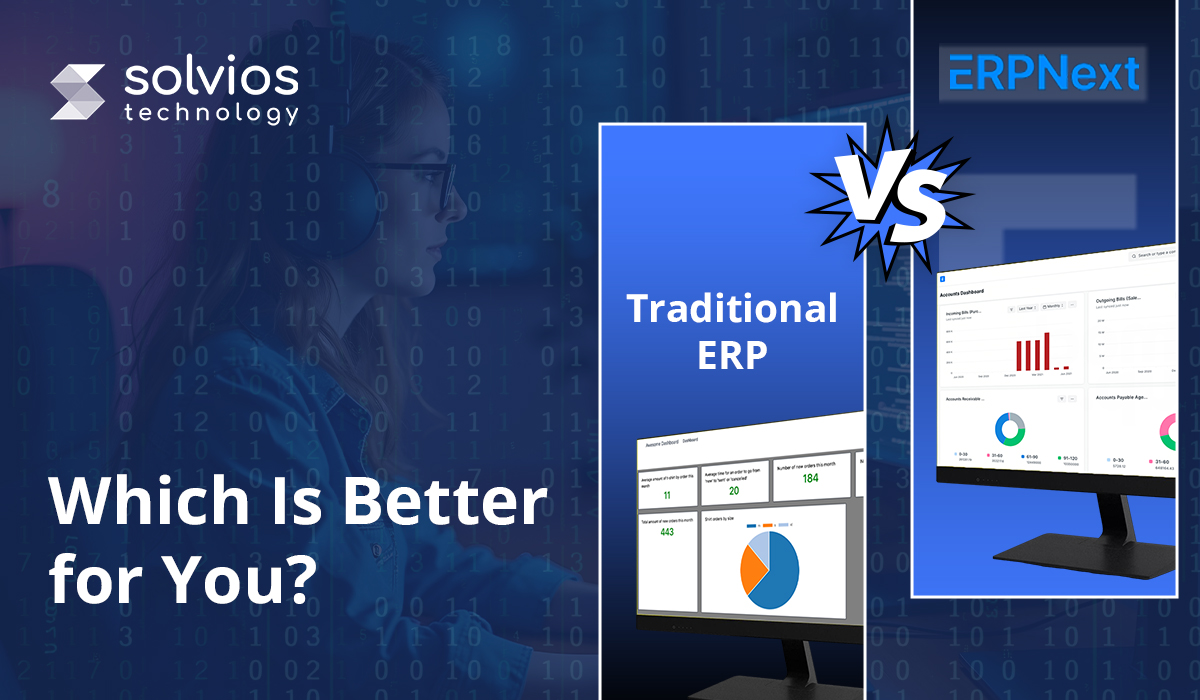
ERPNext vs Traditional ERP Systems Which Is Better for You
Table of Contents
  • Introduction
  • What is ERPNext?
  • What are Traditional ERP Systems?
  • Comparative Analysis: ERPNext vs Traditional ERP Systems 
  • Advantages of ERPNext
  • Advantages of Traditional ERP Systems
  • Challenges with ERPNext
  • Challenges with Traditional ERP Systems
  • Which ERP System is Right for Your Business?
  • Conclusion
  • Frequently Asked Question
Listen to this article

Introduction

Choosing the right ERP system can be a significant decision. It impacts how you scale. 

But with so many platforms promising the same results, it’s easy to get lost in the noise.

Do you go for something open-source and flexible, or stick with a proven enterprise name? 

That’s where most businesses hesitate and comparison comes in.

In this guide, we break down ERPNext and traditional ERP systems; what they offer, where they differ, and how each fits a different kind of business.

The goal is to help you see which one aligns with your size, goals, and resources.

If you’re a growing small or mid-sized enterprise looking for clarity before you commit, this piece will give you the context you need to make a confident, informed choice.

Let’s get started! 

What is ERPNext?

ERPNext is an open-source ERP built by Frappe Technologies Pvt. Ltd., designed for businesses that don’t want to be tied to expensive software licenses or rigid systems. You own the code, the data, and how it works; that’s the real difference.

It comes with numerous modules: Accounting, CRM, Sales, Purchasing, Projects, HR, Manufacturing, and Inventory, plus built-in support for eCommerce and POS. Everything connects without extra plugins or integrations.

If you’re wondering about the total cost, you can explore our detailed ERPNext implementation cost and pricing guide for better clarity on budgeting your ERP journey.

The best part is how easy it feels. The interface is clean, updates are frequent, and you won’t need long manuals to figure it out.

Why it’s popular:

  • Fully open-source and free to host anywhere.
  • Customizable enough to match how your business actually works.
  • Built on the Frappe framework: stable, web-based, and modern.
  • Backed by a global community that keeps improving it.

ERPNext is best suited for growing companies that want power, control, and freedom without enterprise pricing, and partnering with a trusted ERPNext service provider ensures smooth setup, integration, and long-term scalability.

Need Help Setting up ERPNext for Your Business?

Contact Solvios to Get Started Today.

What are Traditional ERP Systems?

Traditional ERP systems include established brands that support multinational companies. Some common names in the list of traditional ERPs include SAP, Oracle, and Microsoft Dynamics. 

These software solutions provide support and scalability as brands grow, offering a 360-degree approach to your operations: from finance to HR. These systems require a significant investment and customization, adding to their overall integration. 

The catch? You depend on the vendor for updates, support, and even system compatibility. That control rarely sits with the business itself.

Key Highlights:

  • Broad feature coverage across all business areas.
  • Significant investment for licensing and fees. 
  • Complex customization and upgrades require professionals. 
  • An ecosystem that the vendors manage. 

Traditional ERPs are the go-to option for large enterprises; however, flexibility isn’t their most significant perk. 

Comparative Analysis: ERPNext vs Traditional ERP Systems 

Feature ERPNext Traditional ERP Systems 
Cost Low upfront cost; open-source High licensing and implementation costs 
Customization Highly customizable; flexible Customizable but at a high cost 
Ease of Use User-friendly interface; short learning curve Complex interfaces; long learning curve 
Implementation Time Quick deployment; suitable for SMEs Long implementation time; suitable for large enterprises 
Support Community-driven support; cost-effective Vendor-dependent support; expensive 
Scalability Scalable for growing businesses Scalable but may require significant investment 

Still Comparing ERP Solutions?

Contact us for Custom ERPNext Demo and Consultation

Advantages of ERPNext

ERPNext’s real strength isn’t unique features; it’s how practical it feels when you start using it.

1. Cost-Effective

You don’t need deep pockets here. Since it’s open-source, there are no license costs eating into your budget. The money you save can go toward setup, training, or long-term operational improvements.

2. Flexible by Nature

Every company runs a little differently. ERPNext lets you tweak workflows, reports, and permissions without needing vendor support. It adapts as you grow; that’s rare in ERP land.

If you’re in a product-heavy space, you’ll appreciate how ERPNext streamlines manufacturing operations through production planning, BOMs, and inventory control — all within one dashboard.

3. Simple to Use

The interface is clean, straightforward, and light. Most users find their way around within days, not months. No steep learning curve, no stress.

4. Community-Driven

The platform improves because real users shape it. The community builds tools, fixes bugs, and keeps updates steady. You never feel stuck waiting on one vendor.

ERPNext isn’t about complexity. It’s about control, cost, and convenience: three unique factors that rarely come together on a single platform.

Want to Explore How ERPNext can Simplify Your Operations?

Get in touch with us Now

Advantages of Traditional ERP Systems

Traditional ERP systems like SAP, Oracle, and Dynamics are the go-to option for established organizations for one reason: they scale along with the firm.

1. Comprehensive Features

These platforms come packed with every module you could think of: from finance and procurement to HR, compliance, and analytics. Large businesses like that everything talks to each other under one roof. It’s complex, but it works.

2. Trusted Reputation

They’ve been around for decades and have a proven record in regulated, global environments. When a boardroom wants “safe and tested,” these names still carry weight. That recognition alone can influence decisions at the enterprise level.

3. Robust Vendor Support

Here’s where traditional ERPs still shine: dedicated teams, 24/7 service contracts, and certified partners worldwide. When something breaks, there’s a phone number to call and a process already waiting.

They may not be the most flexible, but when stability matters most, these systems rarely disappoint.

Challenges with ERPNext

ERPNext is great for control, but it’s not for everyone. You get a scalable platform, but as a business owner, you need to understand how to leverage it for your operations. 

Technical Know-How

If you don’t have someone who understands the Frappe Framework or server setup, you’ll hit roadblocks. Basic tweaks or updates can feel heavier than expected. It’s not impossible to manage, just not as plug-and-play as cloud ERPs. For businesses exploring setup options, here’s a guide comparing ERPNext deployment models — Cloud vs On-Premise to help you choose the best fit.

Performance on Big Data

Most small or mid-size setups run fine. Once you start handling large volumes or multiple sites, the system can slow down. Good hosting fixes a lot of that, but it takes tuning and patience.

Reports and Insights

The default reports do the job, but they’re not deep analytics. If you want fancy dashboards or predictive views, you’ll probably connect another tool.

ERPNext gives you control, but you need to invest in learning how to drive it.

Challenges with Traditional ERP Systems

Big ERPs like SAP or Oracle do a lot, but they come with a cost: in both money and flexibility.

High Spend

Licenses, consultants, support plans; every step has a fee. Large companies plan for it; smaller ones feel the pinch fast.

Setup and Maintenance

Getting it live isn’t quick. Even small updates can need specialist help. Once it’s stable, your team won’t want to keep updating the platform. 

Locked Ecosystem

You depend on the vendor for updates and fixes. Moving out isn’t simple. You play by their timeline, not yours.

These systems are powerful, yes, but businesses have to give up flexibility and budget while leveraging traditional ERP systems. 

Which ERP System is Right for Your Business?

There’s no one-size-fits-all ERP. It really depends on your business’s stage and how much control you want over the system.

ERPNext might be your pick if:

  • You’re a small or mid-size business that needs something lean but capable.
  • Spending big on licenses doesn’t make sense right now.
  • You like tweaking things to match your process, not the other way around.
  • You’ve got someone in-house (or on-call) who’s a little tech-savvy.

If you’re considering adopting the system, you can follow our step-by-step guide on how to implement ERPNext successfully.

ERPNext fits teams that want ownership: of data, workflow, and growth speed. You can customize the software as you scale your operations. This is a unique feature because it allows business owners to maintain control over their growth. 

Traditional ERP suits better if:

  • You’re an established enterprise that needs to keep up with global operations. 
  • Your firm has the budget to spend on licenses, consulting, and training.
  • You’d rather rely on vendor support than manage things internally.
  • You want everything ready-made (finance, HR, manufacturing), all in one stack.

These systems are built for scale and compliance. They move slower, but when stability matters, that’s a fair trade.

Conclusion

At the end of the day, it’s not about features; it’s about how the software fits with your workflow.

ERPNext gives flexibility and lower cost; traditional ERPs give structure and proven reliability.

The smart move is to match the tool to how your business actually runs.

Ready to clear the confusion around the best ERP for your business?

Schedule a Free Consultation Today!

Frequently Asked Question

ERPNext can handle medium to large-scale operations, but it may require advanced customization and infrastructure. For enterprises with strict compliance and multi-site operations, traditional ERPs like SAP or Oracle often provide more out-of-the-box scalability and support.

ERPNext is open-source and has no licensing costs, making it cost-effective for SMEs. Traditional ERPs involve high upfront licensing, implementation, and maintenance costs, which can significantly increase total ownership expenses.

ERPNext offers higher customization flexibility through the Frappe framework, allowing businesses to adapt workflows easily. Traditional ERPs are also customizable but require vendor involvement or certified consultants, making the process more expensive and time-consuming.

ERPNext can typically be deployed within weeks for SMEs, while traditional ERP systems often take several months to fully implement due to complex configuration, integration, and testing requirements.

ERPNext provides robust security features like role-based access and SSL encryption, but the responsibility for server security and updates lies with the host. Traditional ERPs come with enterprise-grade, vendor-managed security and compliance certifications.

Solvios Technology can help assess your business needs, recommend the right ERP platform (ERPNext or traditional), customize it to fit your operations, and ensure a smooth transition through professional implementation and ongoing support.

About Author

Author

By Dhwani Shah

Co-Founder

Dhwani Shah is the Co-Founder of Solvios Technology. She focuses on building strong relationships, guiding teams, and helping businesses move forward with clear direction. Her perspective comes from real-world experience, thoughtful leadership, and a genuine passion for creating long-term value for clients and partners.

Let’s Connect

Like What You See? Share with a Friend

Turn Insights Into Action

Planning something next? Let’s turn ideas into action.

    Related Blogs

    08 Jan
    ERP 10 Min Read

    When to Migrate to ERPNext: Signs You’ve Outgrown Your Current System

    Read More
    02 Jan
    ERP 8 Min Read

    Automating Repetitive Tasks in Dynamics 365 with Power Automate

    Read More
    11 Dec
    ERP 9 Min Read

    ERPNext + Payment Gateways: Seamless Invoicing and Collection

    Read More
    08 Jan
    ERP 10 Min Read

    When to Migrate to ERPNext: Signs You’ve Outgrown Your Current System

    Read More
    02 Jan
    ERP 8 Min Read

    Automating Repetitive Tasks in Dynamics 365 with Power Automate

    Read More
    11 Dec
    ERP 9 Min Read

    ERPNext + Payment Gateways: Seamless Invoicing and Collection

    Read More

    Never Miss a Beat

    Join our community and get updates, insights, and ideas delivered right to your inbox. Stay connected!


      I agree to receive newsletters from Solvios, including updates, promotions, and offers.

      User Shield We respect your privacy. Unsubscribe anytime.

      Our Partnerships

      Solvios Technology is a leading software development company crafting innovative solutions for businesses. We Specialize in custom software, web & mobile app development, and digital marketing. Partner with us to transform your vision into reality and achieve digital success.

      • Facebook
      • Twitter
      • Instagram
      • LinkedIn
      • Behance
      • YouTube
      • Featured image
      • Featured image
      • Featured image

      Company

      • About Us
      • Blogs
      • Careers
      • Become a Partner
      • Contact Us

      Featured Services

      • Mobile App Development
      • Web Development
      • Cloud Services
      • Emerging Technologies
      • CRM & ERP
      • Digital Marketing
      • API & Integrations
      • UI / UX / CX
      • QA and Testing

      Our Services

      • Native iOS
      • Native Android
      • Cross Platform
      • Enterprise Solutions
      • Custom Web Apps
      • ECommerce
      • CMS Development
      • Frontend Development
      • Cloud Migration
      • Infrastructure Management
      • DevOps
      • Blockchain
      • Data Warehousing & BI
      • AI & ML
      • Salesforce
      • NetSuite
      • Microsoft Dynamics
      • HubSpot
      • ERPNext

      Technologies

      • iOS
      • Android
      • React Native
      • Flutter
      • .NET
      • PHP
      • Python
      • Node
      • Laravel
      • Angular
      • ReactJS
      • Magento
      • Shopify
      • WordPress
      • Strapi
      • nopCommerce
      • Tableau
      • AWS
      • Azure
      • Google Cloud

      USA

      7284 W Palmetto Park Road, Suite 101 Boca Raton, FL 33433

      +1 (561) 717-2700

      INDIA

      1024 Iconic Shyamal, Nr Shyamal Cross Roads, Satellite, Ahmedabad, 380015

      +91 96620 35673
      For Job Related Inquiries
      + 91 9328830413 hr@solvios.technology

      © 2026, Solvios Technology All Rights Reserved.

      • Privacy Policy
      • Terms of Service

      Let’s make it happen

      What We Provide

      • We Respond to You Within 24 Hours
      • A Stick Non-disclosure Policy
      • Control In Daily Monitoring
      • Direct Access of Resource

        • +1 (561) 717-2700
        • +91 96620 35673
        • info@solvios.technology

        Fill the Form to Ask a Question