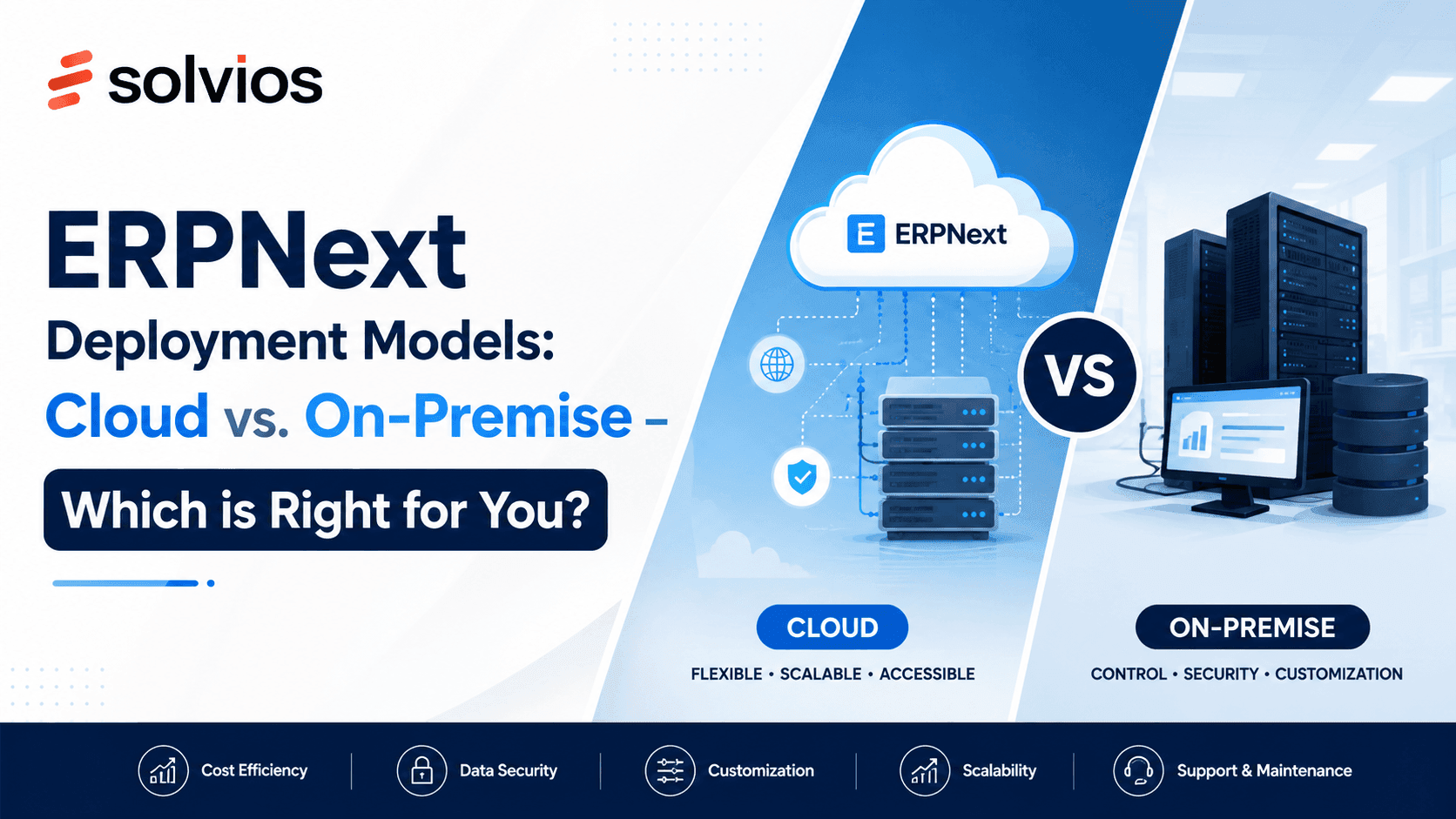
Cloud ERPNext (Frappe Cloud) is faster to launch and easier to maintain. Frappe handles updates, backups, and scaling, making it ideal for startups and small to mid-sized businesses that want predictable costs and zero infrastructure hassle.
On-premise ERPNext gives full control over data, security, and customization. It suits enterprises with strict compliance needs, complex integrations, or an in-house IT team ready to manage the stack.
The right choice depends on three things: how fast you need to go live, how much customization you truly need, and whether you have the IT capacity to self-host. Speed and simplicity point to cloud; control and compliance point to on-premise.
Cloud means lower upfront cost and steady subscriptions, while on-premise demands a higher initial investment but can prove cheaper long-term for large, stable operations.
Introduction
Choosing between cloud and on-premise ERP isn’t just a software change – it’s a strategic call that shapes scalability, security, and how smoothly your core operations run.
Choosing the right model helps you determine:
How fast can you open new locations
How you manage upgrades
True long-term cost of ownership.
Interestingly, ERPNext fits well into this decision.
It’s a modern, open-source ERP that spans accounting, inventory, manufacturing, CRM, HR, and more. More importantly, it’s flexible, making it ideal for any ERPNext implementation strategy.
Organizations can leverage ERPNext deployment models in the cloud or on-premises, aligning the platform with industry expectations.
In this post, we take a closer look at the two sides of ERPNext deployment models for your operations—cloud and on-premise. Continue reading as we learn more about trade-offs in control, performance, and other aspects in the following sections.
ERPNext Deployment Models – Cloud Vs. On-premise
Choosing between cloud vs on premise ERP isn’t just a software change, it’s a strategic call that shapes scalability, security, and how smoothly your core operations run. Therefore, this section takes a closer look at the different deployment models. Let’s have a closer look:
Cloud Deployment (Frappe Cloud)
Frappe Cloud is the official, fully managed ERPNext hosting option. It helps businesses manage their workflow by introducing routine administration, allowing teams to focus on other core aspects of their operation.
Key Features
Ease of use: Spin up new sites in minutes with guided setup, preconfigured services, and no command-line work for most scenarios.
Managed services: Automatic core updates, security patches, backups, and proactive monitoring are included, reducing day-to-day IT overhead.
Scalability: Adjust the frameworks in line with your business growth. You have the option to expand storage, add to the memory, and increase usage alongside operations—all without having to restructure things from scratch. For more insights, explore our ERPNext Complete Guide for Businesses.
Security: Frappe Cloud provides enterprise-grade security measures for organizations, eliminating the need to maintain their firewalls. Additionally, it also provides SSL certificates and disaster recovery protocols for robust security.
Who is it Ideal for
Businesses planning to switch to an ERP that doesn’t require much maintenance and offers streamlined scalability.
Organizations focused on going live and switching to a system that delivers actionable insights into the workflow.
On-Premise Deployment (Self-Hosting)
Self-hosting places ERPNext on company-owned hardware or a private cloud (e.g., dedicated VMs or Kubernetes in your tenancy). Your IT team can manage end-to-end integration operations, from installation to upgrades, as per your set milestones and regulatory needs.
Key Features
Complete control: Set up times for networking, access, performance optimization, and maintenance that follow your company’s regulations and processes.
Enhanced Customization: Better Customization: Make changes to or improve current apps, add custom actions, and set a new standard for how you operate.
Data Privacy: Safeguard the critical data within your frameworks. Opting for on-premise deployment helps you align your operations with the confidentiality agreements.
Cost Considerations: Hardware, storage, backup tools, monitoring, and professional IT staff all incur higher costs both upfront and over time. Budgeting must also consider lifecycle management.
Who is it Ideal for
Ideal for businesses with a strong IT/DevOps team or those requiring complex integration and customization.
Companies that already have private cloud footprints or that are standardizing their governance systems via in-house ERPNext security features.
Want to choose the best ERPNext model for your business?
Still confused about choosing between the cloud and the on-premise version of ERPNext? Let’s get an overview of the selection with a detailed comparative analysis that highlights key ERPNext cloud vs on premise differences.
Feature
Cloud (Frappe Cloud)
On-Premise (Self-Hosting)
Setup Time
Quick deployment that requires minimal setup.
It takes more time to set up due to the hardware configuration.
Maintenance
Managed by the Frappe team, including updates and maintenance.
Handled by your IT team internally.
Scalability
Flexible, scales along with your business.
Requires manual hardware extension as you scale.
Security
Standard security firewalls managed by Frappe.
Security can be customized as per your requirements.
Decision-Making Guide: Which Deployment Model is Right For Your Business?
Assess Business Needs
Start with an internal snapshot rather than a feature wishlist. Gain a first-hand understanding of your firm’s size, field operations, in-house IT team, its specialization, and the expected growth following the integration.
Additionally, clarify the non-negotiables in your operation, such as auditing operations, management changes, and data storage locations. Undergoing the assessment helps you determine the costs that come with the decision.
Teams working with experienced ERPNext consultants — whether based in the USA or operating across multiple regions — often find this assessment step significantly reduces decision risk.
Considerations for Cloud Deployment
Does your team have the required experience to launch the deployment seamlessly? Having a managed platform for your operations reduces operational risk. Additionally, you also need to consider the role of quick deployment, where users can launch rollouts in shorter periods.
ERPNext helps youscale your Business operations effortlessly. You can add memory, data, and storage as your business expands. Therefore, if ERPNext clicks all the check boxes, it’s a good option.
Considerations for On-Premise Deployment
If you already operate a private cloud or data-center stack (VMware/KVM, Kubernetes, centralized logging) with admins on staff, running ERPNext in-house lets you reuse that spend and tooling instead of paying for another platform.
When you own the stack, your policies and change board apply end-to-end. Data-residency rules, unusual integrations, and deeper code changes are easier to enforce without third-party limits.
Cost–Benefit Analysis
If internal IT allocation (people time) is modest and growth is uncertain, the cloud line typically remains lower and more predictable in most cloud vs on premise ERP decisions.
If you already operate a private cloud at scale, have strict data controls, and plan deep customizations, on-prem can be competitive after the initial operations (provided you budget realistically for upgrades).
Organizations working with a knowledgeable ERPNext implementation partner — one with experience across both the USA and international markets — are better positioned to model these costs accurately before committing.
Real-World Case Studies of ERPNext Deployment Models
Case Study 1: Manufacturing Company A – Frappe Cloud
A mid-sized precision components maker with three plants (Pune, Nashik, Hosur) replaced a decade-old ERP with ERPNext on Frappe Cloud.
With one sysadmin, the team prioritized managed updates, backups, and quick scaling. The pilot to go-live took eight weeks, covering BOM/MRP, Inventory, Purchase, Accounts, and barcode issuance on tablets.
In two quarters, “ERP down” tickets decreased by 48%, and new line onboarding reduced from 3–4 weeks to 5 days. The firm adopted predictable subscriptions and cleared ISO audit checks on access logging and backup evidence.
Case Study 2: Retail Chain B – Self-Hosted
A national specialty retailer with 120 stores and 38,000 SKUs chose self-hosted ERPNext on its private cloud to keep data in-country and control promotions logic.
Rollout by region finished in 16 weeks using blue/green cutovers. Integrations spanned POS, WMS, payments, loyalty, and eCommerce; admins used SSO/MFA, with a hot standby in a second zone.
Within six months, the store was able to publish promotions from 2 days to 3 hours, and the transfer mismatch was streamlined more effectively.
These outcomes reflect patterns seen consistently across ERPNext deployments worldwide — from businesses in the USA and Canada to organizations across the UK, Australia, and India, etc.
Conclusion: Making the Right Choice for Your Business
Choosing where to host your ERP is a long-term business decision. The objective is to build a strong and dependable basis for your manufacturing activities, whether you prefer the ease of Frappe Cloud or the control of self-hosting while evaluating ERPNext cloud vs on premise differences.
However, choosing between a cloud or on-premise version is directly proportional to your expectations from the ERP. If you want quick, connected operations, the cloud is the option. Similarly, if you wish to pair operations with better security and scalability, on-premises could do the job for you. However, if you’re still confused about the right approach for your business, connect with our consultants at Solvios today!
Frequently Asked Question
ERPNext Cloud is hosted and managed by Frappe, offering quick setup, automatic updates, backups, and scalability with a subscription model. On-Premise ERPNext runs on your own servers or private cloud, giving you complete control, deeper customization, and stricter data security, but it requires more IT resources and higher upfront costs.
For small to mid-sized businesses, ERPNext Cloud is usually more cost-effective due to predictable subscription pricing and low IT overhead. For large enterprises with in-house IT teams and infrastructure, On-Premise can be cost-effective in the long run, especially if deep customization or strict compliance is required.
Yes. ERPNext Cloud provides SSL certificates, enterprise-grade firewalls, backups, and disaster recovery. However, businesses in regulated industries like healthcare, finance, or government may choose On-Premise deployment to maintain full control over data residency and compliance requirements.
Yes. ERPNext Cloud allows basic customizations such as workflows, reports, and minor app tweaks. On-Premise deployment offers full flexibility, including source-code level modifications, integrations with third-party apps, and custom business logic.
Choose Cloud if you need fast setup, easy maintenance, predictable pricing, and scalability without heavy IT investment. Choose On-Premise if you need full control, strict data privacy, or deep customization. Many businesses start with Cloud and later move to On-Premise as their IT capabilities and compliance needs grow.
Like What You See? Share with a Friend
About Author
Dhwani Shah
Co-Founder
Dhwani Shah is the Co-Founder of Solvios Technology. She focuses on building strong relationships, guiding teams, and helping businesses move forward with clear direction. Her perspective comes from real-world experience, thoughtful leadership, and a genuine passion for creating long-term value for clients and partners.
We'd love to understand what you want to build. The more context you share, the faster we can give you a useful response not a sales pitch, but a genuine assessment of how we can help and what working together would look like.
Join our community and get updates, insights, and ideas delivered right to your inbox. Stay connected!
We respect your privacy. Unsubscribe anytime.
Solvios is a leading software development company crafting innovative solutions for businesses. We Specialize in custom software, web & mobile app development, and digital marketing. Partner with us to transform your vision into reality and achieve digital success.

 Startups
 Fintech
 Healthcare
 Manufacturing
 Marketplaces
 Mortgage
 Real Estate
 Retail
 Sports and Fitness
 Telecom and IT
 Logistic
 SaaS Product
 About Us
 Blog
Blog Careers
 Become A Partner
 Contact


 About Us
 Blog
Blog Careers
 Become A Partner
 Contact