 Startups
 Fintech
 Healthcare
 Manufacturing
 Marketplaces
 Mortgage
 Real Estate
 Retail
 Sports and Fitness
 Telecom and IT
 Logistic
 SaaS Product


 About Us
 Blog
Blog Careers
 Become A Partner
 Contact



UI / UX / CX
Brand-aligned digital experiences designed for specific audiences from first impression to conversion.
Learn More about UI / UX / CX
 About Us
 Blog
Blog Careers
 Become A Partner
 Contact
Connecting People With Technology
Solvios is the leading IT company in the business to give you growth, revenue, and a global platform.
The client set out to build a marketplace connecting everyday consumers with home service providers, cleaning, repair, maintenance and more, through one connected system. Booking, payment and provider coordination had no unified web or mobile presence yet. They needed a platform that could serve four distinct user roles without turning into four different products.
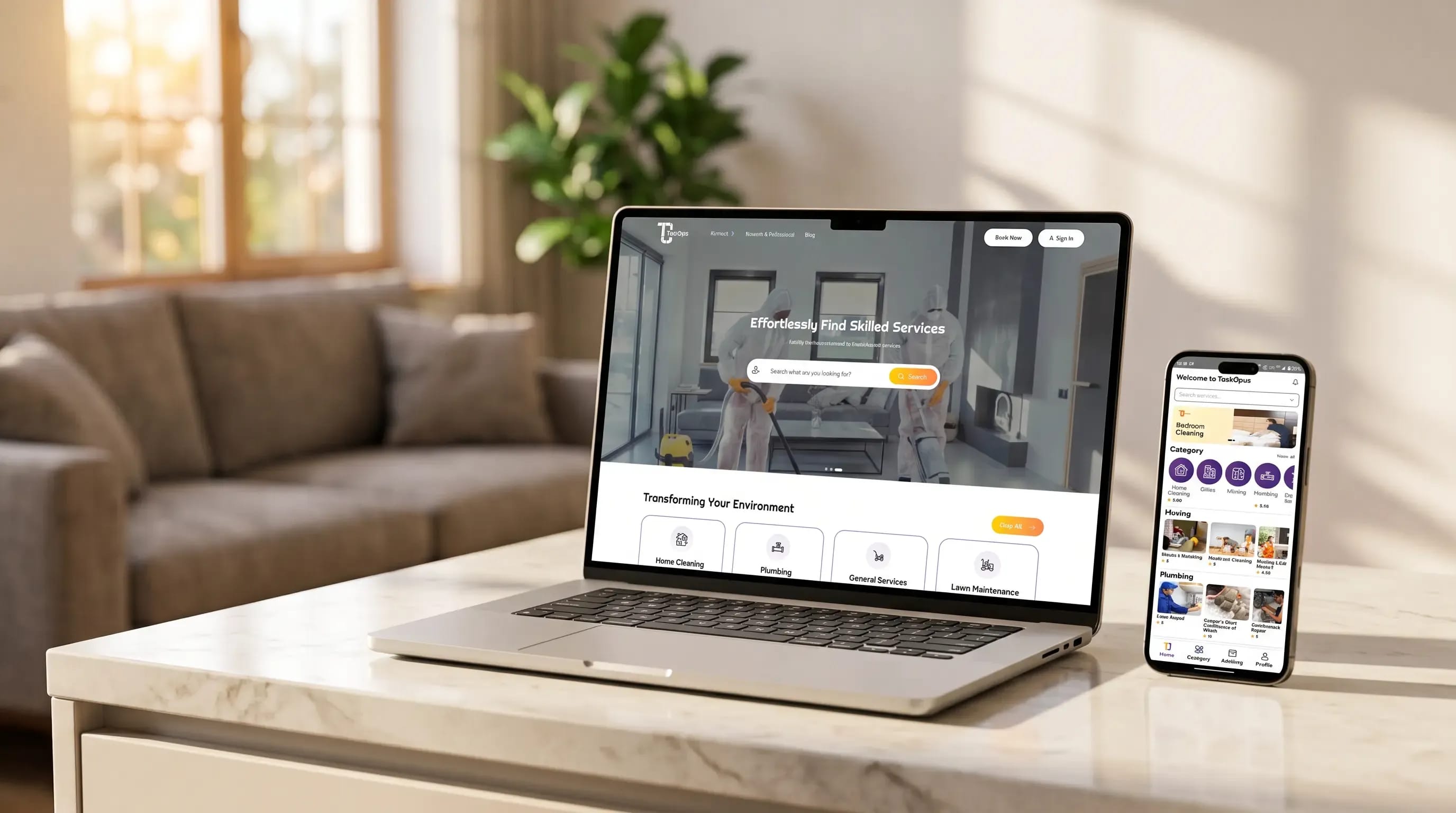
A home services booking and provider management platform
Ongoing engagement (initial build through current support)
Home Services
Not specified in available source material — confirm before publishing
The client needed a single platform to connect consumers with home service providers across categories like cleaning, repair and maintenance. Solvios built a website, a hybrid mobile app and an admin panel on one backend, supporting four separate user roles: consumers, service providers, managers and administrators. The result is a platform where booking, payment, communication and reporting run through one connected system instead of four disconnected tools.
Needed one product covering web and mobile, not two separate builds
Four user roles, consumer, provider, manager, admin, each needed a distinct but connected experience
Booking, order tracking and feedback had to work the same way across every device
Payment processing needed to be secure enough for a two-sided marketplace
Service providers needed tools to manage availability and orders without confusion
Administrators needed full visibility and control without slowing anyone else down
The client came in with a clear vision for a home services marketplace and no working product yet. There was no website, no mobile app and no admin system, just a plan for how consumers, providers, managers and administrators would eventually interact.
No existing web application or hybrid mobile app to build on
No backend architecture designed to support four different user roles at once
No payment infrastructure in place for consumer-to-provider transactions
No system for service providers to manage their own availability or profiles
No admin panel for managing users, permissions or platform-wide settings
No real-time communication layer between consumers, providers and managers

Building one more booking app wasn't the hard part. Building an architecture that could serve four different types of users, on two platforms, from one backend, without becoming a maintenance problem six months later, was.
One Backend, Two Front Ends
Consumers and providers needed a website and a hybrid mobile app that behaved consistently. That meant one backend had to serve a Next.js web client and a React Native mobile client without duplicating business logic or drifting out of sync between platforms.
Four Roles, One Coherent System
Consumers, service providers, managers and administrators each needed different permissions, dashboards and workflows. Designing that without the platform feeling like four separate products stitched together was the real interface challenge.
Payments That Had to Hold Up
A two-sided marketplace lives or dies on trust in its payment flow. Transactions needed to process securely, reconcile correctly and give both consumers and providers confidence that money was moving where it should.
Real-Time Without the Lag
Booking status, provider availability and order updates all needed to reflect in real time across web and mobile. Any delay in that loop shows up immediately as a bad experience for whoever is waiting on the other end.
We started with the backend, not the interface. Once the API layer could cleanly serve both a website and a hybrid mobile app, everything downstream, design, features, roles, became a matter of building on a foundation that wouldn't need rebuilding later.
Node.js and Express.js formed the core API layer, built to serve web and mobile clients identically. Getting this right early meant the frontend teams could work in parallel without waiting on backend rework.
Consumer, provider, manager and administrator permissions were designed into the data model and API structure from the start, not bolted on afterward. Each role gets its own view without four separate codebases underneath.
Next.js powered the website, React Native powered the hybrid mobile app, and both drew from the same design system and API contracts. That kept feature parity between web and mobile from becoming a constant chasing game.
RabbitMQ handled background work, notifications, order processing, status updates, so the user-facing app stayed responsive even when the task queue had more to do. Socket.io layered real-time updates on top for booking status and messaging.
Stripe handled payment processing and Firebase handled authentication and data synchronization, both chosen because building either in-house would have meant reinventing infrastructure that already exists at production quality.

The final platform runs as one system with four distinct entry points. Each role gets the tools it needs, and every action, a booking, a payment, a status update, flows through the same backend.

Registration, service browsing, appointment booking and Stripe-secured payment, built for someone who wants to book a service in a few taps, not navigate a form. Order history and feedback submission close the loop after the service is done.

Providers manage their profile, service listings, availability and incoming orders from one dashboard. Reviews and ratings feed back into their visibility, and communication with managers happens without leaving the platform.

Managers allocate service requests, track orders in progress and generate reports on platform activity. The console is built for someone coordinating multiple providers and bookings at once, not reviewing one transaction at a time.

Administrators manage platform-wide settings, user roles and permissions and system configuration. This layer keeps the other three roles operating within consistent rules without constant manual oversight.

Socket.io powers live updates on booking status, provider availability and order changes, so nobody's refreshing a page to find out what happened. Notifications reach the right role at the right moment.

Strapi.io runs the headless CMS layer for flexible content management, and Swagger documents the API so integration points stay clear as the platform grows past its initial feature set.
The platform launched with all four roles operating on one connected system. Whether these results hold up over the longer run is something an ongoing engagement keeps testing, but here's what changed early.

4 Roles - One Platform, Four Coordinated User Types
Consumers, providers, managers and administrators each work from role-specific dashboards without needing four separate systems to maintain.

1 Backend - One API Layer Serving Web and Mobile
The website and hybrid mobile app share the same backend and business logic, cutting down on the duplicate work that usually comes with running two platforms.

Real-Time - Live Status Updates Across the Platform
Socket.io keeps booking status, availability and order updates current across devices without manual refreshing or polling delays.

Secure - Stripe-Backed Payment Processing
Consumer-to-provider transactions run through Stripe's payment infrastructure, giving both sides of the marketplace a payment flow they can trust.

Scalable - Architecture Built to Add Categories Without a Rebuild
The role-based backend structure means new service categories or provider types can be added without redesigning the core system. None of this solves the marketplace's harder, ongoing problem, getting enough consumers and providers on the platform for the network effect to kick in. What it does is make sure the product itself isn't the thing standing in the way of that growth.
“Solvios Technology not only created a new website, but a logo and its marketing campaigns as well. They had well-established management that understood all of the client's needs, big or small. The team also commendably understood the client's industry.”
— Mayank, Founder, a home services booking and scheduling platform
If your platform needs to serve multiple types of users, consumers, providers, managers, admins, from one connected system, that's the kind of architecture problem we like starting with. Response within 24 hours. No commitment required.

This wasn't a fixed-scope build with a hard stop. The team worked in phases, then stayed on to support the platform as it evolved.

We mapped what each of the four user roles actually needed to do, not just what the client assumed they'd need, before writing a line of backend code.

Node.js, Express.js and MongoDB formed the core system, with RabbitMQ and Socket.io layered in for async processing and real-time updates before either frontend was built.

Next.js and React Native development ran in parallel against the same API contracts, with Swagger documentation keeping both frontend teams aligned to the same backend behavior.

Stripe and Firebase were integrated and tested against real transaction and authentication scenarios before either was exposed to live users.

The platform launched across web and mobile with an active DevOps and QA function still attached, since this is an ongoing engagement rather than a one-time delivery.
Timelines depend on how many user roles the platform needs to support and how complex the payment and real-time requirements are. A four-role marketplace like this one, consumers, providers, managers and administrators, sharing one backend across a website and a hybrid mobile app, typically needs several months for the initial build before it's ready for real users. Getting the backend architecture and role permissions right early matters more than the calendar time; a rushed data model tends to cost more time later than it saves upfront. Ongoing support and feature additions continue well past the initial launch, which is why this kind of engagement often runs as a longer-term partnership rather than a single fixed-scope project.
React Native lets one codebase power both iOS and Android, which matters most when a platform's mobile experience needs to move at the same pace as its website. For a marketplace with four user roles, maintaining native iOS and native Android codebases alongside a web app would triple the surface area for bugs and feature drift. React Native, paired with a shared backend and API contracts, keeps consumer and provider experiences consistent across platforms without a proportional increase in engineering overhead. The trade-off is occasional native module work for platform-specific features, which is a fair exchange for most marketplace use cases.
Payment processing runs through Stripe rather than a custom-built payment layer, since building PCI-compliant infrastructure from scratch rarely makes sense for a marketplace at this stage. Stripe handles the transaction processing, card data storage and compliance requirements, while the platform's backend manages the business logic around when a charge happens, how refunds work and how funds are tracked against specific bookings. This split keeps sensitive payment data out of the platform's own database entirely. For consumers and service providers on either side of a transaction, that means a payment flow backed by infrastructure built for exactly this purpose, not a workaround.
The key is designing role-based permissions into the backend and data model before building any interface, not layering access control on top of a generic app afterward. Consumers, service providers, managers and administrators all interact with the same underlying system, but each role's dashboard, permissions and workflows are scoped specifically to what that user actually needs to do. Shared design system components across web and mobile keep the visual experience consistent even as the functionality diverges by role. The result is a platform that feels coherent to build on and to use, rather than four disconnected tools sharing a login screen.
Yes, as long as the scalability groundwork gets laid during the initial architecture rather than retrofitted later. Because the backend was built around role-based permissions and a shared API layer rather than hardcoded assumptions about specific service categories, adding new categories, provider types or even geographic regions is a matter of extending the data model, not rebuilding the core system. MongoDB's flexible schema and the RabbitMQ-based async processing layer both support this kind of incremental growth without downtime. Whether the business itself scales is a separate question, but the platform isn't the constraint.
Didn't Find What You Were Looking For?
Get In Touch With Our Experts



We'd love to understand what you want to build. The more context you share, the faster we can give you a useful response not a sales pitch, but a genuine assessment of how we can help and what working together would look like.


Solvios is a leading software development company crafting innovative solutions for businesses. We Specialize in custom software, web & mobile app development, and digital marketing. Partner with us to transform your vision into reality and achieve digital success.


