
03
Oct
Technology
10 Min Read

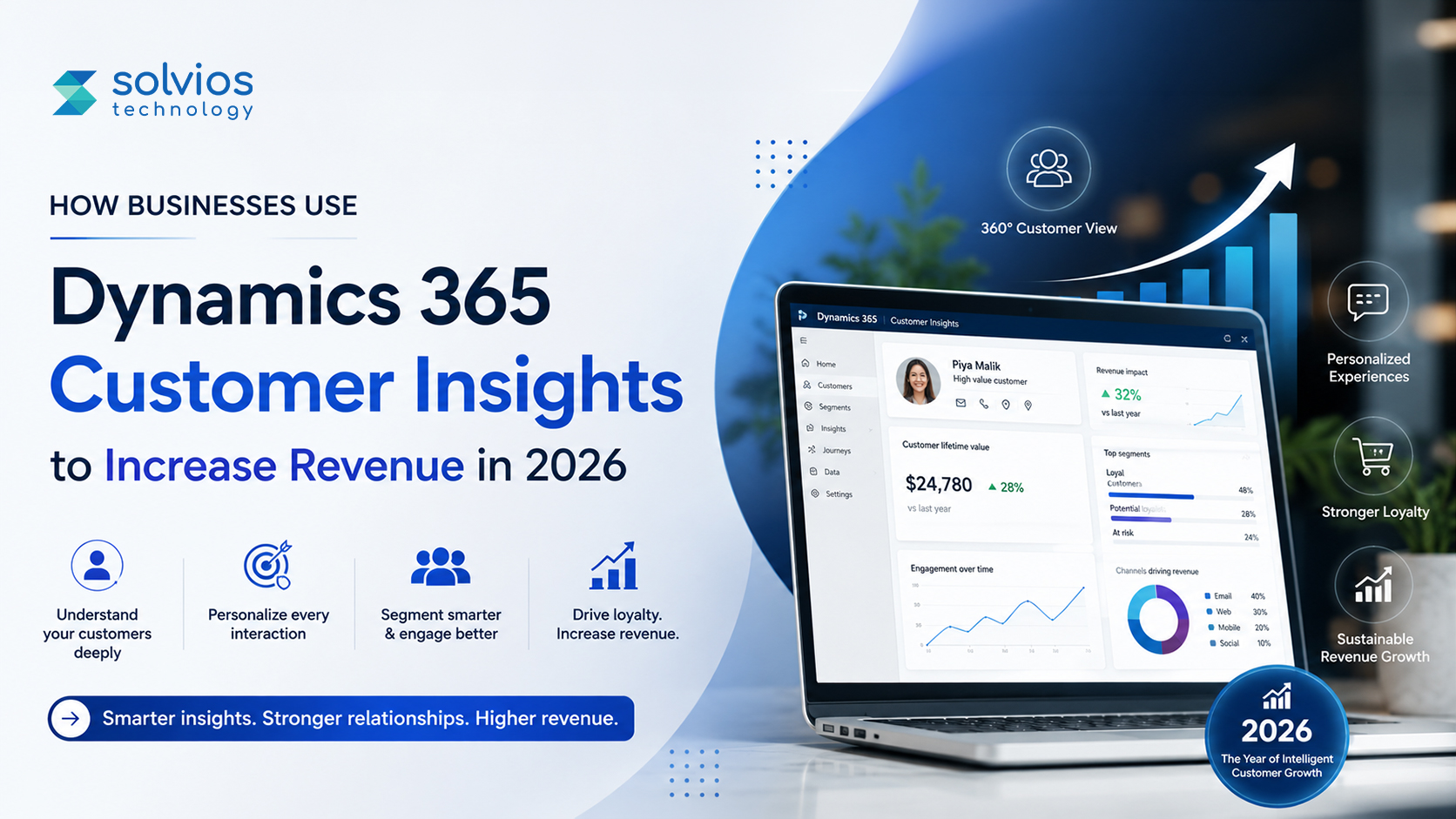
Dynamics 365 Customer Insights is Microsoft’s customer data platform that brings information from multiple systems into a unified customer profile. It helps businesses with a critical function: turning scattered customer data into revenue opportunities by extracting insights for real-time decision-making.
Data from McKinsey suggests that organizations that use data for decisions are 23x more likely to acquire customers. Yet the majority of businesses struggle to turn customer data into revenue.
However, the challenge in 2026 isn’t collecting more data. Most organizations already have plenty of it.
The real challenge is turning existing data into useful information before revenue-generating opportunities are lost. Businesses whose customer data isn’t segregated lose opportunities to upsell and cross-sell their customers, losing opportunities over time.
That’s why more businesses are turning to Dynamics 365 Customer Insights to connect their workflows at scale. The platform allows business owners to get clear insights into customers, explore opportunities, and personalize operations at scale.
In this article, we’ll take a closer look at how businesses use D365 to accelerate growth, improve customer engagement, and become smarter in 2026. We’ll also explore how Dynamics 365 implementation services will help you reach your next level of success.
A unified customer profile combines customer information from different sources into a single record.
Most companies already have customer data. The problem is that nobody is looking at the same version of it. Marketing sees campaign engagement, sales sees opportunities, and support sees service history. Put three teams in a room, and you might get three different stories about the same customer.
Dynamics 365 Customer Insights tries to solve that disconnect. By matching records across systems, it builds a profile that more fully reflects the customer journey. It sounds simple, but having one version of the truth often changes how teams work together.
Real-time segmentation allows customer audiences to update as behavior changes.
Customer segments tend to become outdated faster than people expect. Someone who looked interested last month may have already purchased, moved on, or stopped engaging altogether.
Instead of relying on lists that slowly lose relevance, Customer Insights adjusts audiences using current activity. That means teams spend less time questioning whether a segment is still accurate and more time deciding what to do with it.
AI-powered Copilot lets users explore customer data through natural language prompts.
Not every useful insight starts with a dashboard. Sometimes it starts with a question.
A marketer might want to find customers who recently engaged but did not purchase. A sales manager may want to understand which accounts are showing stronger buying signals. Instead of building filters from scratch, Copilot helps surface answers through conversation. The experience feels closer to asking a colleague than operating a reporting tool.
Microsoft ecosystem integration connects Customer Insights with other Microsoft business applications.
This feature tends to matter most after implementation and explore microsoft dynamic 365 implementation guide. On paper, integrations rarely sound exciting. In practice, disconnected systems create extra work every day.
Customer Insights integrates seamlessly with Dynamics 365, Dataverse, and Power Platform, so data can flow between teams. It sustains ecosystem unity and team alignment, providing a real-time version of the truth.
Privacy and consent management help organizations track the collection and use of customer information
Most businesses want personalization, while customers want privacy. The challenge is finding a balance between the two.
It’s the challenge of being a business owner, juggling between privacy, consent, and evolving regulations around different regions. Dynamics 365 provides a platform that helps teams manage data under governance. It helps the team navigate data usage under different regulations.
Having Dynamics 365 Customer Insights on your platform replaces bottlenecks with efficiency. Here’s a detailed look at some commonly asked questions around how the platform manages data to increase sales.
Customer personalization allows teams to create personalized offers, recommendations, and patterns that improve chances of sale.
A customer who has been looking at running shoes for two weeks probably doesn’t need an email about formal footwear. That sounds obvious, but businesses get this wrong all the time.
Dynamics 365 Customer Insights brings teams closer to authentic customer behavior, rather than broad assumptions, often resulting in more meaningful interactions.
Better segmentation improves conversions by helping businesses connect with people based on what they’re doing now, not what they did months ago.
Customer lists tend to lose potential when you take no action. A person interested in a product last quarter may have already bought it or moved on. Keeping people in the loop makes for a more relevant campaign and typically stronger engagement.
Dynamics 365 Customer Insights helps reduce churn by identifying changes in customer behavior before they become bigger problems.
Most customers don’t leave without warning. They buy less often, stop opening emails, or simply engage less than they used to. Those signals are easy to miss when information is spread across different systems.
The platform helps sales teams identify opportunities that deserve attention before time is spent in the wrong places.
In many businesses, every lead looks important at first glance. The reality is that some customers are much closer to making a decision than others. Having that visibility changes how teams prioritize their day.
Real-time journey optimization helps businesses respond to customer behavior in real time.
Customer journeys rarely move in a straight line. Dynamic 365 implementation pricing disappears for a week, and then returns through a campaign. Static workflows struggle with that. Real-time insights make those shifts easier to spot.
Omnichannel customer experience connects interactions across sales, marketing, service, and digital channels.
Customers don’t think about departments when they interact with a business. They simply expect continuity. Repeating the same information to three different teams is frustrating, and most people have experienced it at some point.
Customer data already exists inside most organizations. The challenge is turning scattered information into something teams can actually use. Customer Insights Dynamics 365 helps bring those pieces together, making it easier to spot opportunities that support growth.
AI is one of the biggest reasons Dynamics 365 Customer Insights looks very different in 2026 than it did a few years ago. Businesses already have customer data. The challenge is understanding what that data is telling them and acting on it before the opportunity passes.
Copilot in Microsoft Dynamics 365 allows teams to create customer segments using natural language instead of manually building complex rules.
Not long ago, creating an audience often meant digging through filters and conditions. A marketer might spend time identifying which customers recently purchased but hadn’t engaged with a campaign in the last month. Now the request can be written almost like a sentence. Copilot translates that intent into an audience, making segmentation feel less like a technical task and more like a business conversation.
Agentic AI helps businesses identify the next action most likely to improve a customer outcome.
Imagine a customer who suddenly starts interacting less frequently. Before D365, you might have missed the change, but today AI can identify such changes, offer suggestions, and help teams win back those customers. This way, Dynamics 365 enables businesses to analyze reports themselves rather than waiting for professionals, so they can act on signals while they still matter.
Conversational SMS allows businesses to move beyond one-way messages and create more interactive customer conversations.
Most people are more likely to reply to a text than fill out a form. That simple behavior is changing how brands communicate. AI capabilities extend well beyond messaging and segmentation.
Companies are using predictive lead scoring to focus on higher-quality opportunities and churn prediction to identify customers who may be drifting away. AI-powered messaging further helps manage responses, keep conversations going, and help guide customers toward the next step, without making every interaction feel Dynamic 365 power automated.
Customer data means different things depending on the industry. A retailer is looking for buying patterns. A hospital is trying to improve patient communication. A B2B manufacturer may be tracking relationships that take months to convert. The common thread is that customer information becomes more useful when it is connected.
A customer buys running shoes in January. In February, they start looking at fitness trackers. By March, they’re browsing training accessories.
Individually, those actions don’t say much. Together, they tell a story. Retailers use AI in Dynamics 365 Customer Service Insights to connect those moments and understand what customers are actually interested in. That information often shapes loyalty offers, product recommendations, and campaign timing in ways that feel more relevant than broad seasonal promotions.
Every online store has customers who reach the checkout page and disappear. Sometimes they come back. Sometimes they don’t.
The difficult part is knowing the difference. One shopper may simply need a reminder, while another may be waiting for a discount. By understanding the customer intent, purchase history, and engagement patterns, sales teams have a better chance at deciding whom to follow up with.
A customer researching home loans might visit a website several times before speaking with an advisor. Another customer may be comparing investment products across different channels. Neither journey looks exactly the same.
Financial organizations often use customer insights to understand patterns, identify offers, and spot changes in purchase behavior. These small signals help brands make a major difference in how they present themselves to customers.
Missed appointments are rarely just scheduling problems.
Sometimes patients stop responding to messages. Sometimes communication arrives through the wrong channel. Sometimes people simply forget.
Healthcare providers use customer insights to understand those patterns and adjust communication accordingly. A small change in timing or outreach can make a noticeable difference when patient engagement starts dropping.
B2B buying journeys can stretch across months. Occasionally, even longer.
A prospect attends a webinar, downloads a product guide, talks to sales once, and then disappears. Six months later, they return with a new requirement.
Without historical context, that account can appear to be a completely new opportunity. With connected customer data, sales teams can see the full journey and understand where the relationship actually stands before restarting the conversation.
Most businesses don’t have a shortage of customer information. What they often lack is context.
When customer activity spans multiple systems, important signals are easy to miss. Dynamics 365 Customer Insights helps bring those signals together, making it easier to spot opportunities that might otherwise stay hidden.
At some point, most customer data platform evaluations start looking similar. The shortlist usually includes a few familiar names, and Dynamics 365 Customer Insights often ends up being compared with Salesforce to dynamic 365 implementation and Data Cloud and Adobe Real-Time CDP.
The platforms solve similar problems, but they don’t always fit the same type of business.
| Feature | Dynamics 365 Customer Insights | Salesforce Data Cloud | Adobe Real-Time CDP |
| Native ecosystem | Microsoft | Salesforce | Adobe |
| AI capabilities | Copilot, predictive insights | Einstein AI | Adobe Sensei |
| Data connectivity | Strong across Microsoft products | Strong across Salesforce products | Strong across Adobe products |
| Pricing approach | Often aligns with existing Microsoft investments | Salesforce licensing model | Enterprise-focused pricing |
| Best fit | Microsoft-centric organizations | Salesforce-centric organizations | Experience-led enterprises |
For example, a business already working inside Dynamics 365, Power Platform, and Microsoft tools will usually have a different experience than a company running most of its operations on Salesforce.
The comparison is often less about which platform has more features and more about where customer data already lives. That’s usually the factor that shapes the decision.
Most organizations don’t start looking for a customer data platform because they’re excited about customer data. They start looking because something feels disconnected.
Maybe marketing has one view of the customer and sales has another. Maybe customer information exists in five different systems, and nobody is completely sure which version is correct. Over time, those gaps start creating friction.
That’s one reason Microsoft Dynamics 365 for customer service has gained attention in recent years.
Most businesses already have valuable customer data. The challenge is making it useful. Dynamics 365 Customer Insights helps connect those pieces so teams spend less time searching for context and more time acting on it.
Customer data isn’t hard to find anymore. Most businesses are surrounded by it. The real challenge is figuring out what actually matters and acting on it before the moment passes.
That’s where Dynamics 365 Customer Insights helps. It pulls data from multiple systems so that teams can spend less time gathering context and more time making decisions.
In a world where customer expectations are changing, understanding customer behavior can be a real differentiator.
Change the way your business runs. Get in touch with our team of Dynamics development experts at Solvios today!
Dynamics 365 Sales is for managing leads, accounts, and opportunities; Customer Insights is about pulling customer data together from different sources to get a better view of the customer.
There’s not a single price. Pricing is based on licensing, data needs, and what Microsoft products are already in place.
Yes, you can use Dynamics 365 Customer Insights with other Microsoft products. The platform allows seamless integration with other non-Microsoft products, databases, and third-party apps.
Some of the most common industries using Dynamics 365 are retail, eCommerce, financial services, healthcare, manufacturing, and other B2B companies.
Every timeline is unique, and implementation depends on the business’s specific requirements. Some projects move fast, some take longer, depending on integrations and business needs.
Planning something next? Let’s turn ideas into action.

Join our community and get updates, insights, and ideas delivered right to your inbox. Stay connected!
 We respect your privacy. Unsubscribe anytime.