11
May
Salesforce
23 Min Read

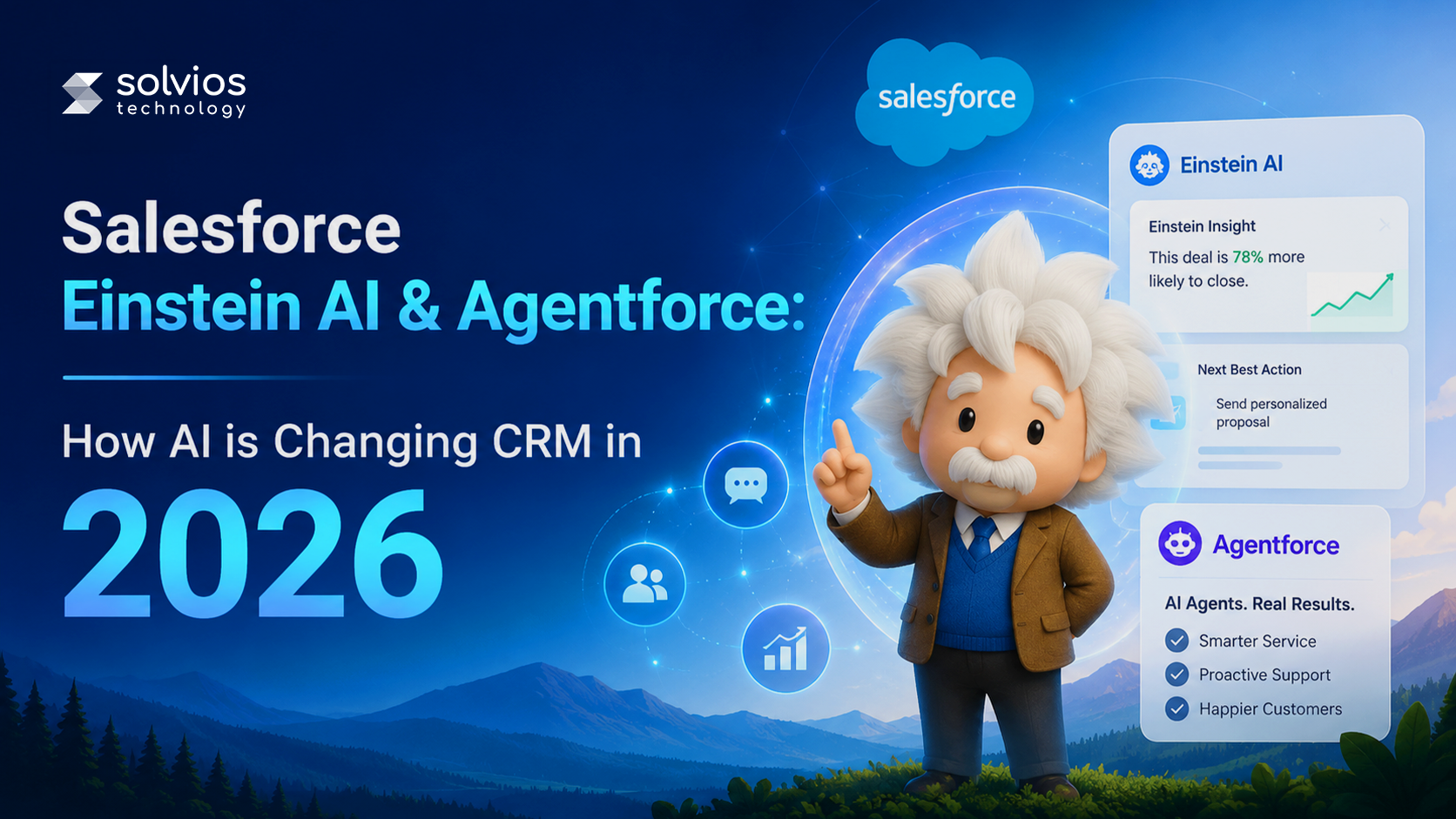
Salesforce Einstein AI and Agentforce are changing how businesses manage customer relationships in 2026 with smarter automation, predictive insights, and autonomous AI agents that reduce manual work and improve sales efficiency.
From AI-powered lead scoring to real-time forecasting and personalized customer interactions, modern CRM is shifting from simply storing data to helping teams take faster and better actions.
Want to future-proof your CRM strategy? Discover how Salesforce AI can help your business work smarter, sell faster, and scale with confidence.
Sales teams already have enough dashboards, reports, and notifications to deal with.
The bigger problem now is deciding what actually deserves attention:
That’s one reason AI is showing up differently in CRM platforms in 2026. It’s no longer limited to suggestions on a screen. With Salesforce Einstein AI and Salesforce Agentforce, businesses are starting to use AI in ways that go beyond mere information tracking.
The focus is slowly shifting from managing customer data to helping teams act on it faster.
This blog takes a closer look at AI’s role in changing CRM in 2026. Let’s get started.
Back in 2016, Salesforce Einstein AI entered the picture to help teams make better use of the information already sitting in CRM systems. At that stage, it mostly focused on predictions and recommendations. Things look quite different now. By 2026, it will have moved much further into everyday CRM activity and quietly sit behind a lot of what teams already do.
A few years ago, most CRM systems were mainly used to store information. Contacts, opportunities, customer details; everything stayed there, but teams still had to figure out what to do with it.
That approach has been changing. CRM platforms are now expected to do more than hold information. They’re increasingly expected to help people decide what deserves attention first.
Some of this work is happening quietly in the background:
Many of these are fast becoming common Salesforce AI Benefits in 2026 discussions, as teams want less manual work and faster decision-making.
Instead of being a separate tool, Einstein is integrated into the Salesforce CRM Platform, where data, AI capabilities, and business information work together inside the same environment.
A simple example
Imagine a Mumbai-based NBFC that gets a large number of loan inquiries every week. Sales teams could still review every lead manually, but that usually takes time. Einstein Forecasting can help surface opportunities with stronger intent first, so teams are spending less time sorting and more time talking to customers.
| Capability | Traditional CRM | Salesforce Einstein AI | Salesforce Agentforce |
| Lead Scoring | Manual / Rule-based | AI-powered predictive scoring | Autonomous agent triggers action |
| Sales Forecasting | Spreadsheet-driven | Einstein Forecasting (ML) | Real-time adaptive forecasting |
| Customer Follow-ups | Rep-dependent | Suggested next-best action | Fully automated follow-up agents |
| Query Resolution | Human-only | Einstein Bots and case routing | Autonomous AI agents (24/7) |
| Data Entry & Logging | 100% manual | Auto-capture via Einstein Activity | Zero-touch via Agentforce agents |
| Personalization | Segment-based | Individual AI recommendations | Hyper-personalized at scale |
| Integration | API-heavy | Native Einstein 1 Platform | Built on the Einstein 1 Platform |
When Salesforce introduced Salesforce Agentforce at Dreamforce 2024, the discussion around AI inside CRM shifted a bit. Einstein had already helped teams predict outcomes and surface insights, but Agentforce took a different approach. Instead of helping people decide what to do next, the idea was to let AI start handling parts of the work itself. By 2026, that approach will have begun to be part of everyday workflows.
The simplest way to think about autonomous AI agents is this: they don’t just provide suggestions and wait. They can observe information, make decisions within defined rules, and perform actions without someone having to press a button each time.
A Salesforce Agentforce setup can take on work that usually sits with sales or service teams, such as:
This is also where Salesforce AI agents differ from older chat systems. A chatbot may answer a question and stop there. Agentforce works across several steps.
These salesforce AI agents for sales teams data also pull context from the Salesforce Einstein 1 Platform and Salesforce Data Cloud, so actions are driven by real-time business information. Large IT services firms and BPO teams in India are already testing these workflows to reduce repetitive SDR work.
CRM systems are changing quietly. Earlier, most of the work happened after information was entered into the system. Teams reviewed data, followed processes, and manually advanced opportunities. That gap is starting to shrink as AI moves closer to everyday workflows.
For many sales teams, getting leads is no longer the difficult part. The bigger challenge is deciding where to direct attention first. A CRM can have hundreds of contacts, but not every lead has the same intent.
Earlier, scoring often depended on simple actions. Opening an email, downloading a document, or filling out a form added points. The problem was that activity and buying intent did not always mean the same thing.
The Salesforce Einstein Impact
With Salesforce Einstein AI Guide, the process starts by looking more deeply into behavior patterns. Through Predictive analytics, CRM capabilities, and Machine learning in CRM, the system analyzes past interactions and engagement signals to highlight stronger opportunities.
Instead of spending time sorting through everything manually, sales teams can focus on the conversations more likely to move forward.
There was a time when sales teams moved opportunities one step at a time. A lead came in; someone checked the details, sent a reply, updated the records, scheduled a meeting, and then passed things to the next person. None of these tasks looked big on their own, but together they consumed a surprising amount of time.
That’s where Salesforce Agentforce begins to change the flow. Instead of waiting for someone to manually trigger every action, Autonomous AI agents can handle connected tasks in sequence.
The Salesforce Einstein Impact
A prospect submits an inquiry, an agent identifies intent, schedules a meeting, updates CRM information, and sends follow-up communication without stopping after the first step.
That difference matters because Salesforce AI automation are moving beyond answering questions. For many AI agents for sales teams, the goal is slowly shifting from assistance to execution.
Customer information rarely sits in one place. Sales data lives in CRM, service interactions live elsewhere, and marketing activity often sits inside another system. Teams spend more time connecting information than they realize.
The Salesforce Einstein 1 Platform was built around reducing that separation. Rather than treating CRM, AI, and business data as separate layers, it brings them closer together within a single environment.
Information from Salesforce Data Cloud becomes part of that process, helping systems work with the current customer context instead of isolated records.
The Salesforce Einstein Impact
The result is less switching between systems and fewer situations in which teams make decisions with incomplete information. Small changes like that usually become noticeable over time rather than immediately.
A few years ago, AI often sounded like something primarily built for large enterprises with dedicated teams and large budgets. Smaller businesses mostly watched from the outside.
That picture has started changing. Salesforce AI for small-business conversations is becoming more common as automation is no longer limited to large organizations. Smaller sales teams are also dealing with repetitive work: follow-ups, lead prioritization, customer communication, and CRM updates.
The Salesforce Einstein Impact
The difference is that they usually have fewer people handling those responsibilities. AI is beginning to fit into these situations by reducing routine work rather than adding another layer of complexity.
The first question around AI is rarely “Can it do the work?” It usually turns into “What happens to customer data?” Businesses are becoming more comfortable with automation, but trust still sits in the middle of the conversation.
CRM platforms handle information that teams don’t want floating around without control over: customer records, conversations, deal history, financial information, and internal activity.
The Salesforce Einstein Impact
That’s one reason AI in CRM discussions now involves security and governance almost as much as automation itself.
As AI becomes more integrated into customer workflows, businesses want clearer visibility into permissions, access, and the use of information. Technology may be changing quickly, but trust still determines how far companies are willing to go.
CRM administrators used to spend a lot of time manually creating rules and workflows. Small changes often meant another setup task, another configuration, or another process sitting in the queue.
That routine has started changing. Instead of building every action step by step, teams now work more around guidance and automation. AI can help surface recommendations, suggest workflow changes, and reduce repetitive administrative work that usually sits behind the scenes.
The Salesforce Einstein Impact
This is also where many businesses begin working with Salesforce consulting services or an expert Salesforce consulting company. Once AI workflows start connecting with larger CRM & ERP Solutions, the focus often shifts toward making systems work together rather than simply adding features.
The first reaction many businesses have to AI is not excitement. It’s caution. The question usually isn’t “Can AI automate this?” It’s more “What happens to our customer information if it does?”
CRM systems already hold a lot of sensitive information: customer conversations, purchase history, sales activity, support records, and internal notes.
Once AI starts working inside that environment, trust becomes part of the discussion. Businesses want to know who can access information, how data is being used, and whether decisions remain transparent.
That’s one reason AI in CRM conversations now includes governance and compliance almost as often as automation. Companies are becoming more open to AI, but they also want clearer boundaries.
Many businesses imagine AI implementation as a large project that changes everything at once. In reality, that usually isn’t how it starts. Most teams begin with one repetitive process rather than rebuilding the entire CRM system.
For some businesses, it could be lead scoring while others may require automation for their workflows. Once they trust the system, business owners start adding more layers to their operation.
Additionally, this is also where they reach out to professional Salesforce consulting Pricing implementation. For larger organizations using connected CRM & ERP solutions, implementation often becomes less about adding technology and more about making different systems work together in a practical way.
CRM platforms are gradually moving beyond storing customer information and generating reports. The shift happening in 2026 is more about action than data collection.
Salesforce Einstein AI is helping teams understand patterns and make quicker decisions, while Salesforce Agentforce is moving a step further by handling parts of the work itself.
The bigger change is not really AI replacing people. It’s reducing repetitive work and giving teams more time for conversations that need attention.
Businesses that successfully adopt AI usually do not replace processes overnight. They’re starting small, learning what works, and building from there.
Think of it this way: Einstein mostly helps with predictions and recommendations. Agentforce moves closer to action. Einstein can tell teams what looks important, while Agentforce can actually perform tasks across workflows.
Agentforce AI is the latest addition to Salesforce’s tools, which leverages AI to automate different parts of your daily operations.
Salesforce Einstein AI is an intelligence layer that helps teams maximize the use of customer data. It’s a great option for lead scoring, forecasting, and conversations.
No, AI is becoming a significant part of CRM, allowing businesses to leverage the latest technology to run their operations.
Yes, if you’re managing customers at any kind of scale. AI can augment decisions and automation, but without a CRM, information still gets spread across emails, spreadsheets, and disparate systems.
Planning something next? Let’s turn ideas into action.
Join our community and get updates, insights, and ideas delivered right to your inbox. Stay connected!
 We respect your privacy. Unsubscribe anytime.