 Startups
 Fintech
 Healthcare
 Manufacturing
 Marketplaces
 Mortgage
 Real Estate
 Retail
 Sports and Fitness
 Telecom and IT
 Logistic
 SaaS Product


 About Us
 Blog
Blog Careers
 Become A Partner
 Contact


SEO Services
AI-integrated SEO across Google, ChatGPT, Perplexity, Gemini and Claude technical SEO, content SEO, link building and AI search optimization engineered for compounding organic growth.
Learn More about SEO Services
 About Us
 Blog
Blog Careers
 Become A Partner
 Contact
Connecting People With Technology
Solvios is the leading IT company in the business to give you growth, revenue, and a global platform.
The client is a media advertising company that generates its revenue by running online ad campaigns for its own portfolio and its media buyers across Facebook and Google Ads. Before this engagement, campaign creation ran through separate platforms with no shared source of truth, which meant slow turnaround and no reliable way to see which campaigns were actually performing.
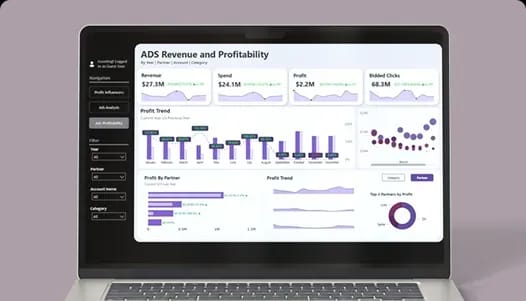
Media advertising company running performance campaigns on Facebook and Google Ads
Ongoing engagement
Advertising
United States
The client's media buyers were building Facebook campaigns by hand across multiple disconnected platforms, which stretched a simple campaign launch into a multi-step, multi-tool process. Solvios built a single web application that pulls together the Facebook Marketing API, Domain Active API and Google Keyword Planner into one interface, auto-generates campaign names, syncs campaign state back from Facebook, and models Adset data to recommend budgets. Media buyers now launch campaigns in minutes from one screen instead of stitching data together across platforms by hand.
Campaign creation depended on switching between Facebook, domain tools and spreadsheets for every launch.
No single interface existed for media buyers to log in and manage campaigns end to end.
Facebook ad data wasn't being analyzed or converted into a usable visual format.
Budget decisions for ad sets were made without a predictive, data-backed model.
Campaigns edited directly on Facebook could drift out of sync with the client's internal records.
Keyword research for campaigns lived in a separate workflow disconnected from campaign creation.
When Solvios came in, the client's media buying operation was running entirely on manual coordination. Every campaign meant working across Facebook's ad interface, domain and keyword tools separately, with no shared system tying the pieces together. There was no internal tool built for the team's actual workflow, so the team was working around Facebook's own interface rather than through a purpose-built one.
No internal application existed for campaign creation, only Facebook's native ad interface used directly.
Media buyers repeated the same manual steps across Facebook, Domain Active and keyword tools for every campaign.
There was no automated naming convention, so campaign names were typed manually and inconsistently.
Ad set performance data sat inside Facebook with no export into a format the team could analyze.
There was no mechanism to detect when a campaign changed on Facebook outside of the client's own tool.
Budget allocation across ad set categories relied on manual judgment rather than historical performance data.

None of this was solvable with a single integration or a quick script. The team needed one interface that could talk to multiple APIs, stay in sync with a platform it didn't control, and turn raw ad data into numbers a media buyer could act on.
Manual, Multi-Platform Campaign Creation
Launching a single Facebook campaign meant moving across separate tools for the ad setup, the domain configuration and the keyword research. That handoff between platforms was the biggest drag on turnaround time, and it didn't scale as campaign volume grew.
Ad Performance Data Locked Inside Facebook
Facebook's native reporting wasn't built for the kind of cross-category analysis the client needed. Ad set data existed, but nothing converted it into the graphs and comparisons media buyers actually needed to make a call.
Budget Allocation With No Predictive Backbone
Deciding how much budget to put behind an ad set category was a judgment call, not a data-backed one. There was no model connecting historical Adset performance to a recommended, profit-maximizing budget.
Data Integrity Gaps Between Facebook and the Internal Tool
Media buyers could still edit campaigns directly inside Facebook. Any tool the team built had to detect and reconcile that drift, or it would quietly become the wrong source of truth the moment someone made a change outside it.
The first call we made was architectural: build one interface on top of the Facebook Marketing API and Domain Active API rather than a thin wrapper around Facebook's own console. Everything after that, sync, budget modeling, keyword search, got layered onto that single interface instead of living as separate tools.
We integrated the Facebook Marketing API and Domain Active API behind one login and one workflow, so media buyers could set up and launch a campaign without switching tools mid-task.
We built a naming engine that generates the campaign name automatically from the selection criteria a media buyer chooses in the interface, removing a manual, error-prone step from every launch.
We wired in Google Keyword Planner so keyword research happened in the same screen as campaign setup, instead of a separate workflow the media buyer had to context-switch into.
Because media buyers could still edit campaigns directly on Facebook, we built a sync layer that pulls those changes back and flags any campaign that's drifted out of sync with the tool, so the mismatch is visible instead of silent.
We trained a model on historical Adset data across categories, using multiple performance parameters to recommend a budget aimed at maximizing profit, then surfaced that output through Linear, Bar and Scatter visualizations the team could actually read.

What shipped is a single web application media buyers log into to create, name, launch and monitor Facebook campaigns, backed by a budget model and a sync layer that keeps it honest against what's actually running on Facebook.

A unified integration layer over the Facebook Marketing API and Domain Active API, so campaign creation happens through one interface instead of two separate tools.

Keyword search and selection built directly into the campaign creation flow, using Google Keyword Planner data to add keywords without leaving the tool.

An automated naming module that builds a consistent campaign name string from the selection criteria a media buyer picks on the interface, removing manual naming entirely.

A sync process that pulls campaign state back from Facebook and flags any campaign edited outside the tool, so data integrity holds even when Facebook is touched directly.

A model trained on historical Adset performance across categories that recommends a budget aimed at maximizing profit for each category.

A dashboard that renders Adset and campaign performance as Linear Graphs, Bar Graphs and Scatter Plots, turning raw ad data into a format media buyers can act on quickly.
The client didn't just get a new tool, they got a single place where campaign creation, budget decisions and performance review all happen without switching platforms.

Single Interface - One Tool Replaces a Multi-Platform Workflow
Campaign creation, keyword research and naming now happen in one application instead of across Facebook, domain tools and manual spreadsheets.

Minutes, Not Hours - Faster Campaign Turnaround for Media Buyers
Media buyers can log in and launch a Facebook campaign in a few minutes, down from a process that previously spanned multiple tools and manual steps.

Single Source of Truth - Reliable Campaign Data for Owners and Media Buyers
The sync layer means campaign data inside the tool reflects what's actually live on Facebook, closing the gap that opened whenever someone edited a campaign directly.

Data-Backed Budgets - Budget Decisions Grounded in Adset Performance
Budget recommendations for ad set categories now come from a trained model instead of manual judgment, aimed at the categories most likely to return profit.

Visual Performance Review - Ad Data Turned Into Decisions, Not Spreadsheets
Linear, Bar and Scatter visualizations give the team a fast read on ad set performance that raw Facebook exports never provided. None of this replaced the media buyers' judgment, it gave them a faster, more reliable base to make that judgment from. The tool that started as a way to speed up campaign creation ended up becoming the client's single system of record for how their Facebook advertising actually performs.
They've been able to help us build our in-house technology and processes across a variety of languages. We were very satisfied with the final product. The team was able to deliver the project on time.
— Chris Rupp, President, Media Advertising Company
If your media buying or ad operations team is still stitching together multiple platforms to launch a single campaign, this is exactly the kind of problem we build for. Tell us how your workflow runs today and where it breaks down. Response within 24 hours. No commitment required.

This engagement has run as an ongoing dedicated team rather than a fixed-scope project, with the team adding capability in phases as the client's campaign volume and data needs grew.

We mapped the client's manual campaign workflow, then set up the Facebook Marketing API and Domain Active API connections that everything else would sit on top of.

We shipped the single interface for campaign setup, including the automated campaign naming module, so media buyers could launch campaigns without leaving the tool.

We added Google Keyword Planner into the same workflow and built the sync process that reconciles campaigns edited directly on Facebook.

We analyzed historical Adset data across categories and trained the budget prediction model, then built the graph-based dashboard to surface it.

The engagement continues as a dedicated team model, with the backend developers and project manager iterating on the tool as the client's advertising operation evolves.
The core campaign creation interface, covering the Facebook Marketing API and Domain Active API integration along with automated campaign naming, was built and shipped first as the foundation of the tool. Keyword Planner integration, the Facebook sync layer and the Adset budget prediction model were added in subsequent phases. The engagement has continued as an ongoing dedicated team rather than closing after a single release, with the team adding capability as the client's campaign volume and reporting needs have grown.
Facebook's native ad manager wasn't built around this client's specific workflow, which combined domain configuration, keyword research and campaign naming into a single decision made repeatedly by media buyers. A custom tool let Solvios unify those steps into one interface, add automated naming and keyword search, and layer in a budget prediction model that Facebook's own console has no equivalent for. The result is a workflow shaped around how this team actually works, not around a generic ad platform interface.
Media buyers can still make changes directly inside Facebook, and the tool accounts for that instead of assuming it won't happen. A sync process pulls campaign state back from Facebook on a regular basis and compares it against what the internal tool has on record. When a mismatch shows up, meaning a campaign was changed outside the tool, it's flagged so the team knows their internal data is out of sync rather than silently trusting a number that's gone stale.
The model was trained on historical Adset data across the client's different campaign categories, using multiple performance parameters tied to profitability rather than a single metric like click-through rate. That output feeds into the tool's dashboard as a recommended budget per category, aimed at the allocation most likely to return profit. The recommendations are visualized alongside the underlying performance data through Linear Graphs, Bar Graphs and Scatter Plots so the media buying team can see the reasoning, not just the number.
This particular engagement runs on a dedicated team model, with a project manager and backend developers embedded ongoing rather than delivering a fixed scope and closing out. That fit made sense here because the client's campaign volume and data needs kept evolving, and the tool needed to grow with them. Solvios also delivers fixed-cost and time-and-material engagements for teams with a clearly scoped build, the right model depends on how settled the requirements are going in.
Didn't Find What You Were Looking For?
Get In Touch With Our Experts


We'd love to understand what you want to build. The more context you share, the faster we can give you a useful response not a sales pitch, but a genuine assessment of how we can help and what working together would look like.


Solvios is a leading software development company crafting innovative solutions for businesses. We Specialize in custom software, web & mobile app development, and digital marketing. Partner with us to transform your vision into reality and achieve digital success.


