28
May
Salesforce
11 Min Read

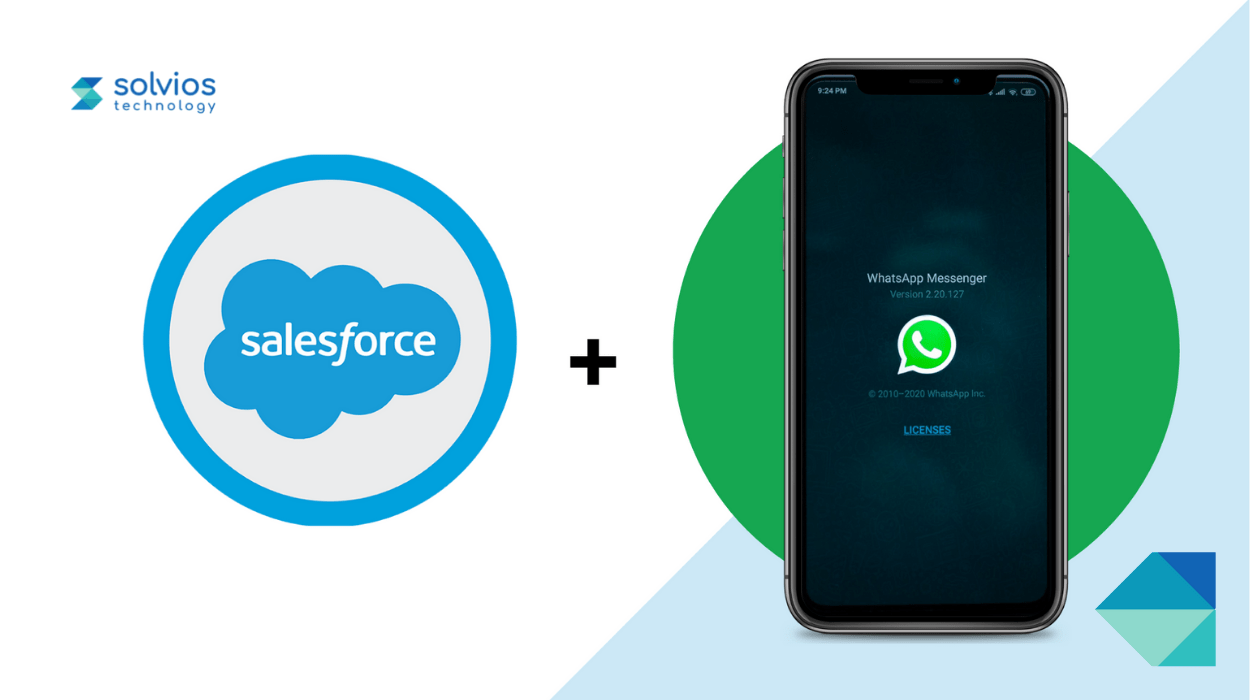
Since WhatsApp has become the most accessed communication platform, the ability to use it and connect with them has also been leveraged a lot. Also, since Salesforce is the main CRM framework in the software business niche, WhatsApp with Salesforce Integration was long anticipated.
With WhatsApp being utilized by 2 billion individuals in more than 180 nations, it has effectively one of the biggest client bases. WhatsApp likewise has dedicated business applications and enterprise solutions intended to help small-scale and large-scale organizations with client support and sales processes. Tech enthusiasts all around the world foresee WhatsApp being utilized as the essential source of communication within the enterprise-level niche.
The broad use of WhatsApp as a preferred channel across the globe has increased the need of having WhatsApp installed in big businesses’ journeys. Therefore, it was obvious when Salesforce acquired the capability to establish connected customer experience and WhatsApp integration as a component of the Spring ’20 release.
As WhatsApp continues to become a necessity for organizations to communicate with customers, Salesforce and WhatsApp integration would likewise extend your CRM platform of the database by benefiting it for data consolidation, data generation, and personalized campaign management. If you want to learn or implement how to integrate Salesforce with WhatsApp messenger, do connect with our Salesforce Integration Consultant at Solvios Technology, who can assist you in solving your concern.
When it comes to integrating WhatsApp with Salesforce, basically there are two ways to integrate WhatsApp with Salesforce API integration and finding an app from AppExchange. Let’s discuss the same.
By using the WhatsApp Business API provider, you would be able to integrate with SOAP or REST APIs. All the transactions occur through API calls between WhatsApp and Salesforce.
There are numerous API libraries accessible to connect WhatsApp with applications that can be utilized by users to build up a connection.
However, this option might be useful if your need requires use cases specific to your business or if there are security issues to be adhered to. WhatsApp API Integration has a low text message price, but in the long term, it becomes pricier when other development processes are included.
You can install an application from AppExchange into Salesforce to get the features that you are searching for and automate everything in a couple of hours. There are very few Apps accessible in the AppExchange though for Salesforce. The plus points of this method are
ValueText App is most likely one of the most outstanding apps out there in AppExchange, in case you integrate WhatsApp with Salesforce. ValueText App has many features and provisions that can fit any industry or domain. In less than 60 minutes, you will be able to install and configure basic use cases. ValueText App has the following great features:
Salesforce’s Unified Conversations feature consolidates all WhatsApp activity into a single, uninterrupted thread. It streamlines customer interaction by sending messages through a single chat window, rather than having customers receive different messages from different departments at every touchpoint.
So whether it began as a marketing broadcast, a sales follow-up, or a support reply, Salesforce Unified Conversations ensures that everything sits inside a single chat window. It’s one conversation, not three separate channels pretending to talk to the same person. That’s the core idea.
With unified threads, every interaction lands in the same window inside Salesforce.
A sales rep can see the last support complaint. A service agent can check what offers marketing sent earlier. And the marketing team can confirm whether a deal is already active before pushing a new message.
The impact is simple but powerful:
For most teams, this solves the daily headache of scattered data and mixed communication trails. Agents respond faster because they’re not piecing together stories across five different screens.
Unified Conversations are strong on their own, but Salesforce Data Cloud turns them into a strategic advantage.
Data Cloud builds a real-time customer profile: purchase history, open cases, browsing signals, marketing engagement, and more, feeding that context directly into WhatsApp.
With Data Cloud working as a part of their operations, businesses can:
When Data Cloud and Unified Conversations are part of your workflow, WhatsApp becomes more than a messaging channel; it becomes a fully informed customer experience hub.
You can also explore how Salesforce is evolving with AI automation here.
Digital Engagement is Salesforce’s built-in messaging layer that brings WhatsApp directly into Service Cloud. No external connector, no jumping between tools. Agents reply to customers inside the console, and every message is logged the same way a case comment or email would be. It keeps the messaging channel native rather than bolted on.
Step I – Setting up WhatsApp is fairly direct once the prerequisites are in place.
Step II – Open Messaging Settings and turn on WhatsApp as a supported channel.
Step III – Connect your WhatsApp Business Account (WABA).
Add phone numbers, complete the verification, and confirm ownership inside Meta Business Manager.
Once this is done, the number appears as a live channel inside Service Cloud.
Salesforce now distinguishes between standard and enhanced WhatsApp channels. Standard channels still work, but they were built for lighter routing and minimal automation. Enhanced channels, on the other hand, were designed for modern-scale messaging: larger teams, high-volume queues, and workflows that depend on automation.
Why teams are shifting to enhanced channels today:
For any team planning long-term scaling, enhanced channels have become the safer baseline.
Once WhatsApp is active, messages can be routed directly to the right agent through Omni-Channel. Each incoming chat is assigned based on skill, availability, or workload, just like a case or chat session.
Automation comes through Flow Builder, where you can set up:
This keeps WhatsApp from becoming an isolated inbox and turns it into a predictable, completely governed service channel.
For deeper efficiency insights, see how businesses benefit from Salesforce ERP integration.
Looking to optimize automation, routing, or Data Cloud workflows?
Contact us for a personalized Salesforce consultation.
Integrating WhatsApp into Salesforce looks simple on paper, but it works best when each step is handled slowly and in the correct sequence. The walkthrough below reflects how most admins set it up during real projects, not the stripped-down help articles you find online.
Start by switching on the messaging framework. Here’s how you do it:
Once this toggle is active, the rest of the configuration finally shows up across the console. Without this, nothing else loads; it’s the base layer.
Now Salesforce needs to know which WhatsApp Business Account you plan to use.
You’ll enter the WABA details, add the official phone number, and complete the verification inside Meta Business Manager. The number becomes available only after Meta confirms ownership, so don’t skip that step.
This is where the channel becomes real.
Give it a name, pick the routing configuration, and add the templates you intend to send. Enhanced channels matter because they support heavier routing, automation, and large-volume queues, something standard channels struggle with.
With the channel live, you can start shaping its behavior.
Most teams begin with:
Flow Builder handles most of this, letting you test and adjust without code.
Before you hand anything to agents, run a quick test from an external number.
Send a message, then watch how it travels: does it route to the correct queue, appear cleanly in the console, and log without gaps? If all three behave as expected, the setup is stable enough for production.
Need help integrating WhatsApp with Salesforce?
Get in touch with us Now
When a WhatsApp message arrives through the enhanced channel, Salesforce stores it as an entry inside the Message object.
Every WhatsApp session record includes:
From there, the message is linked back to the right CRM entity: Lead, Contact, Case, Opportunity, or even a custom object, based on the matching phone number or the routing rules you’ve set. This keeps the entire communication chain tied to the customer record rather than floating freely in the console.
All messages appear in the Activity Timeline once logged in. Agents don’t need to jump across tabs or trace older exchanges; they see the entire discussion in one scroll.
Every reply, every template, and every automated message stays in that same thread, so context is preserved long after the chat ends. This is especially helpful for handoffs between sales and support teams.
Some industries rely heavily on custom workflows. Insurance firms deal with claim records; lending teams track loan requests; field service teams maintain job sheets.
Salesforce enables business owners to link WhatsApp messages with custom objects.
Routing rules help you determine where individual messages should land. Once connected, conversations become streamlined. This allows teams to operate with transparency and avoid losing chats outside the primary workflow.
WhatsApp doesn’t charge per message. It charges per conversation window, and the price depends on the type of interaction. Meta defines four categories:
Each category has its own rate, and the billing begins the moment the first qualifying message is delivered.
Once a customer messages your business, a 24-hour session opens.
During this period, your team can send free-form replies; no templates, no restrictions.
After the window closes, WhatsApp requires an approved template message to restart the conversation. This rule keeps the platform clean and prevents businesses from sending unsolicited messages.
On the Salesforce side, WhatsApp is covered by the Digital Engagement license. That license gives you the messaging framework and access to the channel.
WhatsApp usage itself is billed separately by Meta. Those are the actual conversation charges, deducted from your WhatsApp Business Account. Salesforce doesn’t control those rates; it simply logs the messages and routes them through the console.
Before anything goes live, Meta requires full business verification. However, if verification is delayed due to mismatched details or missing documents, the entire WhatsApp setup will be put on hold.
Meta must approve WhatsApp templates before you can send them. Some go through in minutes; others take days without a clear reason.
If a team hasn’t planned buffers for approval time, marketing launches or service notifications can get blocked at the last minute. It’s a small but common bottleneck.
WhatsApp demands explicit customer opt-in. This isn’t optional. If a user hasn’t agreed to receive messages, you can’t legally initiate a conversation, template or not.
The WhatsApp API caps message throughput.
If you’re sending large batches, such as renewal reminders, order updates, or service alerts, you may hit Meta’s rate limits.
When this happens, the message queue slows down or fails silently unless proper monitoring is in place. High-volume senders need a plan for this long before they scale.
WhatsApp works well inside Salesforce, but the automation layer requires careful build-out:
When any of these layers are misconfigured, agents lose context, or messages land in the wrong queue, issues that are visible to customers almost immediately.
When a case is closed in Salesforce, there will be an automatic WhatsApp or SMS will reach the customer based on the configuration setup. Use Case – Bots have features such as a single messages component where one can send text, use a chat window, and view record history.
From the above ways mentioned for Salesforce to WhatsApp integration, AppExchange is one of the quickest options you can go for. Moreover, it has minimal customization requirements and also has the ability to leverage predefined app features.
So, if you require any assistance in the integration process, do connect with our Salesforce integration consultants at Solvios Technology. We are an expert team of certified Salesforce Consultants who can integrate your organization’s existing system into one centralized platform. Our Salesforce support services will help you get the right level of assistance. From monitoring and maintenance to user assistance, our expert guide will give you a proactive service.
Want smoother customer communication with Salesforce?
Talk to our team for the right solution.
Salesforce WhatsApp Integration connects WhatsApp Business with Salesforce, enabling real-time messaging, automated workflows, and unified customer conversations across sales, service, and marketing teams.
Marketing Cloud enables automated WhatsApp campaigns, personalized offers, reminders, and transactional alerts, helping businesses improve engagement, conversions, and customer journey personalization.
Yes. Salesforce WhatsApp uses end-to-end encryption, secure APIs, opt-in rules, and GDPR-compliant data handling to ensure safe, compliant customer communication.
Businesses gain faster response times, unified conversations, automated workflows, improved personalization, and enhanced customer experience across sales, service, and marketing functions.
Use cases include customer support, order updates, lead qualification, campaign messaging, appointment reminders, and automated notifications across multiple industries.
The future includes unified conversations, AI-powered personalization, Data Cloud insights, and advanced chatbots that automate multi-step workflows and improve customer engagement.
Planning something next? Let’s turn ideas into action.
Join our community and get updates, insights, and ideas delivered right to your inbox. Stay connected!
 We respect your privacy. Unsubscribe anytime.