hero banner background

AI Powered Angular Development Services

We're an Angular development company helping startups, scale-ups and enterprises build web applications that perform in production, not just in demos. Custom dashboards, enterprise portals, AI-powered interfaces and large-scale SPA architectures engineered by senior Angular developers who've shipped real products under real constraints.

AI Powered Angular Development Services
14+

Years of Experience

50+

Experts in Our Team

40+

Happy Customers Worldwide

250+

Projects Delivered Successfully

rating platform logostar rating

4.9/5 ratings

rating platform logostar rating

5/5 ratings

filter list background

The Full Spectrum of Angular Development Services, Delivered as One Practice

Whether you're launching your first Angular SPA, rebuilding a legacy AngularJS application, building an enterprise-grade portal or wiring AI capabilities into an existing Angular product, our Angular development services cover every layer of the framework. Architecture, components, state management, performance tuning, AI integration and long-term maintenance delivered by engineers who treat Angular as a production discipline, not a project tool.

Custom Angular Application Development

Custom Angular Application Development

Most Angular projects get the basics right and quietly accumulate the problems that matter: components that can't be tested, change detection cycles nobody can explain, a bundle size that got out of control in quarter two and a module structure that made sense on day one and makes maintenance hard on day three hundred. We build custom Angular applications with the architecture decisions made upfront standalone components or NgModules depending on what fits, OnPush change detection applied where it earns its keep, lazy-loaded feature modules that keep the initial bundle honest and a folder structure your team can actually navigate at scale.

Angular Enterprise Application Development

Angular Enterprise Application Development

Enterprise Angular applications have a different set of problems than a startup MVP. Role-based access controls spanning dozens of user types, component libraries that stay consistent across fifty-plus screens, design systems maintained across multiple teams, micro-frontend architectures that let business units ship independently without stepping on each other and the kind of state management strategy that doesn't collapse when the product manager adds feature number forty. Our Angular application development services for enterprise clients are built around those real constraints, not the textbook version of them.

Angular Migration & Modernization Services

Angular Migration & Modernization Services

AngularJS to Angular 17+ is not a trivial rewrite and any company that tells you otherwise hasn't done enough of them to know where the sharp edges are. Legacy interceptors, scope inheritance patterns, digest cycles and $http wrappers all need to land somewhere new, and the migration has to happen while the application keeps shipping. We run Angular migrations incrementally using the ngUpgrade hybrid approach where it makes sense, rewrite where it pays back faster and give you a migration plan that's honest about timelines, risk and the effort the assessment actually found. Not the estimate written to win the project.

AI-Powered Angular Development

AI-Powered Angular Development

Angular sits in a strong position for AI-integrated development. The component model makes streaming LLM interfaces straightforward to build, RxJS handles the observable data flows that AI features produce naturally and the Angular service layer gives you a clean place to wire in AI SDKs without polluting component logic. As an AI-powered Angular development company, we build AI features that belong in the architecture: conversational interfaces, agent-driven workflows, real-time AI outputs rendered through Angular's change detection and the kind of AI API integration that doesn't break the rest of the application when the model changes.

Angular UI/UX Component Development

Angular UI/UX Component Development

UI components that look good in Figma and fall apart when users hit them with real data are not components, they're design deliverables with extra steps. We build Angular component libraries where accessibility is engineered in from the start, where responsive behaviour is tested against actual viewport constraints, where dynamic data doesn't break layout and where the design system stays consistent without requiring a platform team to police every PR. Angular Material where it fits, custom design systems where the product demands it.

Angular Performance Optimization

Angular Performance Optimization

Slow Angular applications have predictable root causes: change detection running far more often than it needs to, bundles pulling in dependencies the page never uses, images loaded without strategy and API calls fired without caching. We audit Angular performance against what's actually happening in the profiler, not what the documentation says should be slow. Lighthouse scores improved with concrete engineering changes, not configuration tricks. Core Web Vitals tuned so the numbers in the report reflect what users on real hardware actually experience.

We Architect Angular Applications for AI from the Start

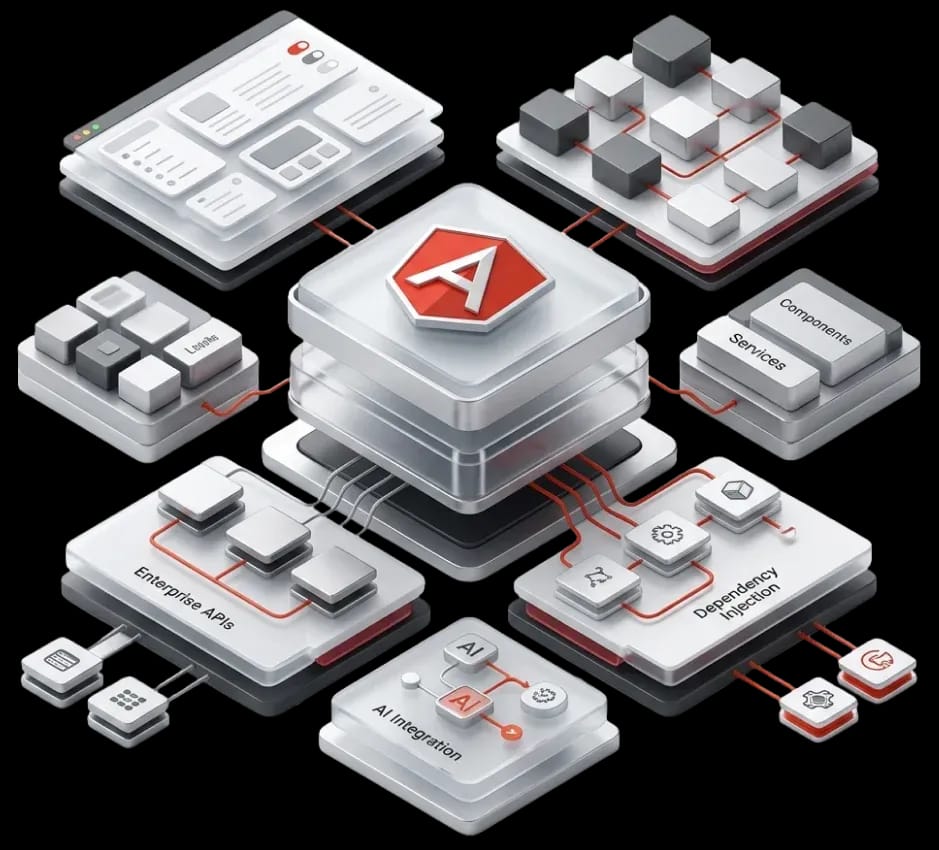
Most Angular shops treat AI as a POST request to an API with a loading spinner in front of it. We treat it as a first-class architectural layer in the Angular application, engineered where it runs best, whether that's a server-side AI service, an on-device model or a streaming LLM interface rendered through Angular's reactivity model. Every block below is production engineering, not a feature flag.

AI Interface Engineering
01

Streaming AI responses rendered natively through Angular's component model

Conversational interfaces, streaming completions, token-by-token rendering and real-time AI outputs wired through RxJS observables into Angular components that update correctly, perform under load and degrade gracefully when the AI service is slow.

Highlights:

  • Streaming LLM interfaces
  • Real-time AI output rendering
  • Graceful degradation patterns
AI Interface Engineering
01

Streaming AI responses rendered natively through Angular's component model

Conversational interfaces, streaming completions, token-by-token rendering and real-time AI outputs wired through RxJS observables into Angular components that update correctly, perform under load and degrade gracefully when the AI service is slow.

Highlights:

  • Streaming LLM interfaces
  • Real-time AI output rendering
  • Graceful degradation patterns

Angular Development Capabilities We Deliver Across Every Layer of the Stack

Angular development isn't one skill. It's a category that spans architecture, state management, performance engineering, component design, testing strategy and the AI integration layer that modern web products increasingly depend on. Here's what we deliver and the engineering bar we hold on each one.

Angular Architecture & Application Design

Angular Architecture & Application Design

Standalone component architecture or feature-module structures are decided based on your team size, your deployment model and your long-term maintainability requirements. Lazy loading strategies, dependency injection patterns, Angular Router configuration that handles complex navigation without leaking state and the kind of architecture documentation your team can actually use when the original engineers aren't in the room.

State Management with NgRx  Signals

State Management with NgRx Signals

NgRx for complex, event-driven state management in large Angular applications where the audit trail of actions and reducers pays for its complexity. Angular Signals where reactivity is local and the simpler model earns its keep. Component stores where global state is overkill. The right state management tool for the shape of your data, not the one the most popular blog post recommended in 2022.

Angular Component Library Development

Angular Component Library Development

Reusable, accessible and documented component libraries built on Angular CDK or Angular Material with brand-aligned styling, WCAG 2.1 AA compliance built in from the first component, Storybook documentation that teams actually use and the kind of API design that makes the components composable without requiring every consumer to read the source.

RxJS & Reactive Programming

RxJS & Reactive Programming

RxJS is powerful and famously difficult to get right at scale. We build Angular applications where observable chains are readable, where subscriptions are properly managed and don't leak, where higher-order observables are used deliberately and where the reactive architecture fits the product's actual data flow instead of imposing a reactive model on data that doesn't need it.

Angular Testing & Quality Engineering

Angular Testing & Quality Engineering

Unit tests that test behaviour, not implementation. Integration tests with Angular Testing Library that validate what users actually interact with. Cypress or Playwright end-to-end tests covering critical user journeys. Test coverage that means something because it's tracking behaviour coverage, not just line coverage metrics that look good in the CI dashboard.

Angular SSR & Performance Optimization

Angular SSR & Performance Optimization

Angular Universal for server-side rendering where SEO and initial load performance justify the complexity. Static pre-rendering for content-heavy applications where the data doesn't change per request. Hydration configured correctly. Core Web Vitals tuned against real user data, not Lighthouse scores from an empty cache on a developer's laptop.

Angular Micro-Frontend Architecture

Angular Micro-Frontend Architecture

Module Federation through Webpack 5 for Angular teams that need multiple squads shipping independently without shared deployment coupling. Shell applications that load remote modules from separate CI/CD pipelines. Shared state patterns that work across micro-frontends without requiring every team to understand every other team's architecture. Built for the organizational complexity that makes micro-frontends worth the overhead.

Angular Security Engineering

Angular Security Engineering

Content Security Policy configured and tested. XSS protections understood and not circumvented by template workarounds. Angular's DomSanitizer used correctly, not bypassed. Authentication flows wired through Angular's HTTP interceptors with token refresh handled properly. OWASP Top 10 for web applications verified against your Angular build before it ships to production users.

Why Modern Product Teams Hire Us as Their Angular Development Company

Explore how we help businesses build Angular applications that perform in production, scale without re-architecture and integrate AI capabilities that users actually notice.

why solvios background

Senior Angular Engineers. AI-First Architecture. No Bench Warmers.

We're not just another Angular development agency. We're the AI-first engineering partner you bring in when the Angular application has to perform, the AI features have to ship and "we'll fix it after launch" isn't an acceptable delivery plan.

AI-First Angular DNA

AI-First Angular DNA

AI integration, agent workflows, RAG pipelines and LLM interfaces are built into how we architect Angular applications, not added as a "we do AI too" tagline. We build Angular for the AI-era product stack from the first architecture decision.

Senior Angular Engineers, No Bench Warmers

Senior Angular Engineers, No Bench Warmers

You get Angular engineers who've shipped complex applications at production scale, debugged change detection edge cases in live environments and navigated major framework migrations without stalling product roadmaps. Not juniors learning NgRx on your timeline.

Full-Stack Angular Depth

Full-Stack Angular Depth

Angular frontend to Node.js or .NET backend, from component library design to CI/CD pipeline configuration. We close the gap between what the Angular layer needs and what the backend and infrastructure have to provide.

Architecture First, Code Second

Architecture First, Code Second

Every Angular engagement starts with an architecture review. The decisions made in week one determine whether your Angular application scales to fifty developers or becomes a liability at twenty. We get those decisions right before the first component ships.

Security, Accessibility & Compliance Built In

Security, Accessibility & Compliance Built In

WCAG 2.1 AA, OWASP Top 10, HIPAA-aware data handling and PCI-DSS-aligned frontend patterns are engineered into Angular builds from day one, not audited at the end of the project when remediation costs far more than prevention.

Built for What's Next in Angular

Built for What's Next in Angular

Standalone APIs, Angular Signals, server-side rendering improvements, zoneless change detection and the AI-native frontend patterns shaping the next generation of web products. We architect for where Angular is going, not just where it's been.

Our Angular Development Process

Most Angular project failures aren't technical failures. They're process failures: architecture decisions made without enough information, scope that expanded without the timeline adjusting, performance problems discovered in UAT that were baked into the component design in week two. Our Angular development services follow a structured, AI-assisted delivery methodology built to catch those problems early, when they're cheap to fix.

Here's exactly how it works.

Discovery & Architecture Planning
01

Discovery & Architecture Planning

We map your business goals, your existing technical context, your team's Angular maturity and the performance and compliance requirements your product has to meet. The deliverable is an architecture decision record that documents what we're building, what we're not building and why.

Stakeholder alignmentAngular maturity assessmentArchitecture decisions documentedRisk registerAI integration scope
UI/UX Design & Component Specification
02

UI/UX Design & Component Specification

Design validation in real Angular builds before the component library starts. Figma-to-Angular translation reviewed by engineers who know where pixel-perfect design creates performance problems and where design system decisions create maintenance problems six months later.

Component specificationsDesign system architectureResponsive behaviour validatedAccessibility auditAngular Material or custom system decision
Angular Foundation Build
03

Angular Foundation Build

We stand up the Angular project with the structure, tooling and CI configuration that will hold up at scale: routing architecture, state management approach, HTTP layer, authentication skeleton, shared component library baseline and a test infrastructure that's used from the first component, not added before launch.

Project scaffoldingRouting architectureState management configuredAuth skeleton liveCI/CD pipelineTest infrastructure
Feature Development & AI Integration
04

Feature Development & AI Integration

Feature development runs in iterative sprints with working software demonstrated at the end of every sprint. AI integrations are built concurrently with product features, not as a separate phase that lands after the core product is shipped.

Sprint delivery cadenceAI integration parallel to featuresArchitecture review checkpointsPerformance budget monitoringAccessibility validation per sprint
Performance Optimization & Hardening
05

Performance Optimization & Hardening

Core Web Vitals tuned against real device data. Bundle analysis run and the results acted on. Change detection audited in the profiler, not estimated from code review. Security posture validated against OWASP. Accessibility verified against WCAG 2.1 AA with real assistive technology, not just automated scanners.

Core Web Vitals improvement passBundle optimizationSecurity hardeningWCAG 2.1 AA verificationPerformance regression suite live
Deployment & Ongoing Support
06

Deployment & Ongoing Support

Deployment to production through the CI/CD pipeline with staging validation, rollback capability and monitoring wired in before the first real user hits the application. Ongoing support structured around your Angular application's version cadence and your team's operational needs.

Production deploymentMonitoring liveSLA-defined supportAngular version upgrade cadenceQuarterly architecture reviews

Flexible Engagement Models to Hire Our Angular Development Company

Your Angular engagement doesn't fit a template and your contract shouldn't either. The right way to hire Angular developers depends on your project shape, your timeline and your in-house team depth. Three models, all built for AI-era delivery speeds.

You need Angular engineers who know your product as well as your in-house team, building for your roadmap and not splitting attention across five other clients. The Dedicated Team model gives you a fully embedded Angular unit working exclusively on your stack, your sprint cadence and your delivery goals.

  • Right for you if

    You're building a complex Angular product over six months or more, scaling platform engineering across business units or augmenting your in-house Angular team without the cost and lead time of full-time hires.

  • What you get

    Hand-picked Angular engineers, a QA specialist and a technical lead all working only on your product. Sprint planning, standups and architecture reviews run on your calendar and your tooling. AI-assisted Angular engineering is built into how the team ships, not bolted on later.

  • Economics

    Monthly retainer. No surprise invoices, no scope-creep billing. Team composition flexes as your roadmap demands.

Typical profile
  • 3 to 10 engineers

  • 6-month minimum

  • Scales with 30-day notice

Not sure which model fits your Angular project?

Most mid-market teams start with one and evolve into another as their Angular product matures. Let's figure out the right starting point together.

Ready to Build Angular Applications that Don’t Need Rebuilding?

Building Angular Foundations for the Businesses That Will Define the Next Decade. The teams that invest in properly architected Angular applications now won't be the ones explaining performance regressions, re-platforming after a migration, or explaining to the board why the AI features take two more quarters to ship.

Talk to Our Angular Architects
Ready to Build Angular Applications that Don’t Need Rebuilding?
industries-block-background

Industries We Build Angular Applications For

Angular challenges look different across industries. The compliance posture, the user base complexity, the performance requirements and the data sensitivity all shape the engineering decisions. These are the verticals where we've shipped Angular applications in production and know what the work actually looks like.

Healthcare
HIPAA-compliant Angular applications, PHI-aware component patterns, EHR and clinical workflow interfaces, accessibility engineered for diverse patient populations and the kind of performance discipline that telehealth and point-of-care applications demand when connection quality is unreliable. We've shipped Angular in regulated healthcare environments. We know what compliance looks like in a live clinical product, not just in the architecture review document.
Explore More
Healthcare
HIPAA-compliant Angular applications, PHI-aware component patterns, EHR and clinical workflow interfaces, accessibility engineered for diverse patient populations and the kind of performance discipline that telehealth and point-of-care applications demand when connection quality is unreliable. We've shipped Angular in regulated healthcare environments. We know what compliance looks like in a live clinical product, not just in the architecture review document.
Explore More
filter list background

Frequently Asked Questions

Honest answers to the questions every CTO, head of engineering and product lead asks before they hire an Angular development company. If something isn't covered here, our solution architects will walk you through it on a discovery call. No sales pitch, no fluff.

Look beyond the portfolio of polished screenshots. The right Angular development company asks more questions than it answers in the first conversation: about your existing tech stack, your team's Angular depth, your deployment constraints and what a bad Angular architecture would actually cost you eighteen months from now. Evaluate on the quality of the discovery conversation, the engineering depth in the assessment and whether they push back constructively when they disagree. Any Angular agency that recommends a technical approach before they've understood your product isn't the right partner.

End-to-end Angular development services cover product strategy and architecture planning, UI/UX design and component specification, Angular application development, state management implementation, AI integration, testing and quality engineering, performance optimization, security hardening, accessibility compliance, deployment and CI/CD configuration and post-launch support. The best engagements also include an architecture review before any code is written, because the decisions made in week one shape the application for years.

A focused Angular MVP or feature build: $25,000 to $80,000. A mid-complexity Angular application with backend integrations and AI features: $100,000 to $300,000. An enterprise-scale Angular platform or large-scale migration: $300,000 to $1M+. The cost depends heavily on architecture complexity, AI integration scope and the current state of any existing Angular codebase. We provide detailed estimates after an architecture review. We won't give you a number before we can stand behind it.

A focused Angular MVP: 8 to 14 weeks. A mid-complexity Angular application with integrations: 3 to 6 months. An enterprise Angular platform or large-scale AngularJS migration: 6 to 18 months, executed in phases. We provide milestone-based timelines in writing before development begins and we don't pad timelines to absorb scope we haven't assessed yet.

Three models: Dedicated Angular Team (for long-term, evolving products and roadmaps), Time & Material (for iterative builds and evolving scope) and Fixed Cost (for well-scoped, budget-defined Angular projects). When you hire Angular developers from us, we recommend the model based on your situation, not based on which one is most profitable for us.

Yes. AngularJS to Angular migration is one of our core Angular development services. We start with a codebase audit covering scope complexity, dependency inventory, test coverage, custom directive patterns and the accumulated architecture debt no one has documented. We give you an honest picture of what a migration actually takes, the difference between the estimate designed to win the project and the estimate you can hold us to. Most migrations run 6 to 12 months for production AngularJS applications of meaningful scale. Anyone quoting significantly less without a detailed audit hasn't done enough of them.

AI-powered Angular development means building Angular applications where AI capabilities are part of the product architecture from day one, not retrofitted after launch. Streaming LLM interfaces, agent-driven workflows, RAG over your internal knowledge, predictive UI personalization and the kind of AI integration that runs through Angular's reactivity model cleanly. Whether you need it depends on your product category and your competitive landscape. In most mid-market segments in 2026, the question isn't whether to integrate AI, it's whether to do it properly or to do it later at twice the cost.

Angular when you need a complete, opinionated framework with built-in solutions for routing, forms, HTTP, testing and dependency injection, when your team is building large enterprise applications where conventions matter more than flexibility, or when TypeScript-first development and structured architecture are priorities. React when you want maximum flexibility to choose your own stack, your team is more JavaScript-native than TypeScript-native, or your product benefits from the larger React ecosystem. The answer depends on your team, your product and what you're optimizing for over a three-year horizon. We'll tell you which one fits after we understand both.

Yes. We run a codebase audit first, covering Angular version, component architecture, state management approach, test coverage, dependency health, performance baseline and accumulated technical debt. We give you an honest picture of what you've inherited and a realistic plan for what to do about it. Sometimes the right answer is to refactor incrementally. Sometimes it migrates to a newer Angular architecture. Sometimes the existing codebase is better than it looks and the right move is to build on it cleanly.

Performance optimization starts with measurement. We run Angular DevTools profiling, Lighthouse audits against real device conditions and Core Web Vitals analysis against real user data, not synthetic benchmarks. The actual causes of Angular performance problems are change detection running on too broad a scope, bundles carrying dependencies no page uses, images loaded without strategy and API response times absorbed into perceived Angular performance. We fix the actual causes, not the symptoms, and we verify the improvements with before/after metrics that hold up to scrutiny.

Yes. Managed Angular support covers version upgrades on a managed cadence, dependency security audits, performance regression monitoring, feature development continuations, bug fix SLAs and quarterly architecture reviews. You can hand the application over entirely after launch or run ongoing Angular development alongside your in-house team. SLAs are defined and reported on every month.

Didn't Find What You Were Looking For?

Get In Touch With Our Experts

Insights on Angular Development

Curated technical writing, framework comparisons and engineering deep-dives on Angular architecture, performance optimization, AI integration and the practices shaping how high-performing frontend teams ship in 2026 and beyond.

Explore All

Need Project Consultation? Let’s Talk

We'd love to understand what you want to build. The more context you share, the faster we can give you a useful response not a sales pitch, but a genuine assessment of how we can help and what working together would look like.