Solvios Technology successfully delivered the project within the agreed timeline and budget, while maintaining a strong transaction success rate and reliable reporting accuracy. Their team demonstrated a high level of commitment, focus, and results-driven execution throughout the engagement. What stood out most was their ability to identify and resolve challenges quickly, making them a dependable and efficient technology partner.
Years of Experience
Experts in Our Team
Happy Customers Worldwide
Projects Delivered Successfully
4.9/5 ratings
5/5 ratings

End-to-End .NET Development Services From Architecture to Production
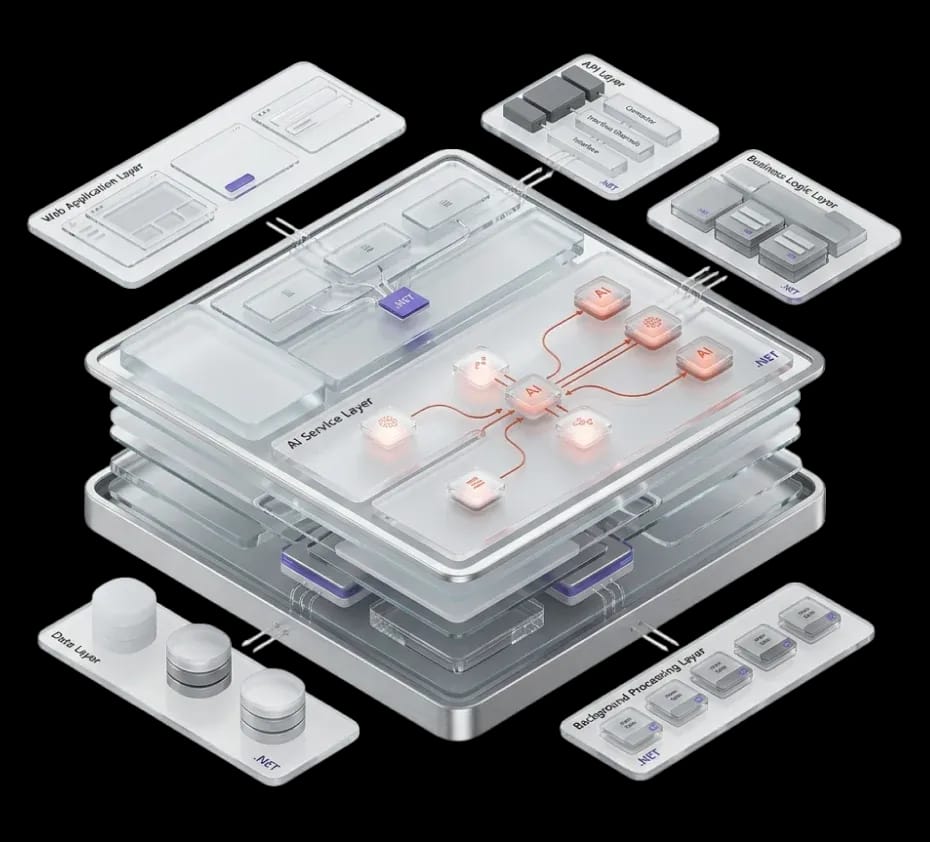
Whether you are building a greenfield enterprise platform, rescuing a .NET Framework app that has accumulated five years of debt, modernizing to .NET 8 or integrating AI capabilities into an existing ASP.NET stack, our dot net development services cover every layer of the Microsoft ecosystem. Custom development, cloud-native .NET architecture, API engineering, AI integration and the migration work that turns legacy into sustainable delivered by engineers who treat your codebase like they own it long-term.
Custom .NET Application Development
Off-the-shelf software rarely fits the business logic worth building for. We design and develop custom .NET applications on .NET 8 and the latest LTS releases — web applications through ASP.NET Core, enterprise backends, workflow engines, data processing platforms and the category-defining products that need an architecture opinionated enough to support five years of features. Clean architecture, CQRS where it earns its keep, domain-driven design on the right bounded contexts and the engineering discipline that makes your codebase a place your engineers want to work, not avoid.
ASP.NET API Development & Integration
Modern businesses run on APIs. We design and build ASP.NET APIs that hold up under enterprise integration demands: versioned endpoints, OpenAPI documentation your partners actually use, rate limiting that protects downstream systems, authentication through OAuth 2.0 and Azure Active Directory, webhook delivery engineered for reliability and the API-first architecture that turns your platform into something other products can build on. REST where it fits, gRPC where performance demands it, GraphQL where query flexibility earns its cost.
.NET Modernization & Migration Services
A .NET Framework 4.x application running in production is a risk — security patches running out, hosting options narrowing, the talent pool shrinking. We migrate .NET Framework to .NET 8 with the discipline the transition actually requires: side-by-side upgrade strategies for large codebases, NuGet dependency resolution handled before the first PR, WCF migration to gRPC or REST, Entity Framework upgrades with query performance benchmarked and the kind of migration pace that keeps your production environment stable while the architecture improves sprint by sprint.
Cloud-Native .NET Development
We build .NET applications designed for the platforms they run on — containerized on Docker and Kubernetes, serverless on Azure Functions or AWS Lambda, distributed through Azure Service Bus, Event Grid or RabbitMQ, deployed through Azure DevOps or GitHub Actions CI/CD pipelines and monitored through Application Insights or OpenTelemetry. The .NET cloud-native patterns that pay back the cloud bill: autoscaled correctly, cost-governed from day one and observable before the first production incident.
AI-Integrated .NET Development
AI is becoming a first-class engineering surface in enterprise .NET applications, not a side experiment. We integrate AI into .NET systems through Azure OpenAI Service, Semantic Kernel, Microsoft Copilot extensions, LLM API orchestration and the kind of AI-native .NET architecture that makes intelligent features reliable, cost-controlled and safe to ship to production users. RAG pipelines over enterprise data, AI-assisted workflow automation, intelligent document processing and agentic .NET services built on the Microsoft AI stack your organization already trusts.
.NET Enterprise Application Development
Enterprise .NET development is a different discipline from startup development — the scale of the data, the complexity of the integrations, the audit requirements and the political reality of brownfield systems all change the engineering. We build enterprise .NET applications with the patterns that enterprise environments actually demand: multi-tenant architecture, distributed transactions handled correctly, SAML and OpenID Connect identity federation, ERP and CRM integrations that don't accumulate technical debt and the governance controls your architects and your security team will both sign off on.
AI-First .NET Development. Not AI Bolted On After Code Review
Most .NET development shops treat AI as a feature to add once the core platform is built. We treat it as an architectural decision that shapes how the application processes data, surfaces intelligence and scales with the models your organization ships next quarter. Every layer below uses AI and the Microsoft AI stack to accelerate delivery, improve reliability and put real intelligence into your .NET applications.

Production AI features inside .NET applications, not prototype demos
We architect LLM-powered features using Microsoft Semantic Kernel, Azure OpenAI Service and the Copilot extensibility patterns that turn your .NET application into an AI-native platform. Prompt versioning, output validation, token cost governance and the kind of AI integration that survives a production incident review.
Highlights:
- Semantic Kernel orchestration
- Azure OpenAI Service integration
- Prompt versioning and cost governance

Production AI features inside .NET applications, not prototype demos
We architect LLM-powered features using Microsoft Semantic Kernel, Azure OpenAI Service and the Copilot extensibility patterns that turn your .NET application into an AI-native platform. Prompt versioning, output validation, token cost governance and the kind of AI integration that survives a production incident review.
Highlights:
- Semantic Kernel orchestration
- Azure OpenAI Service integration
- Prompt versioning and cost governance
.NET Capabilities We Deliver Across Every Layer of the Stack
Dot NET development is not one capability it is a category spanning web application development, API engineering, enterprise integrations, cloud-native architecture, AI integration and the mobile and cross-platform surfaces that modern businesses ship on. Here are the .NET capabilities we deliver, and the engineering standard we hold ourselves to on each one.

The .NET Development Partner Worth Hiring
We are not just another dot net development company. We are the AI-first .NET engineering partner you bring in when the architecture has to last, the compliance requirements are real and "we will refactor it later" stopped being a credible plan two sprints ago.
AI-First .NET DNA
Semantic Kernel, Azure OpenAI, Copilot extensibility and agentic .NET architecture are built into how we approach new development not added after the MVP ships. If your .NET application will need AI capabilities in the next two years, we design for it from the first sprint.
Senior .NET Engineers, No Bench Warmers
You work directly with .NET architects and ASP.NET engineers who have shipped regulated applications, executed .NET Framework to .NET 8 migrations at scale and debugged production performance issues under real load. Not graduates running through their first Entity Framework tutorial on your retainer.
Microsoft Ecosystem Depth
Azure, Entra ID, Microsoft 365, Dynamics 365, Power Platform, Cosmos DB, Azure AI certified deep across the Microsoft stack. The architectural recommendation you get is based on your workload and your organization's existing investments, not which service we have a quota to push.
Production-First Engineering
Clean architecture, SOLID principles, automated test coverage that actually runs in CI, observability baked in from day one and code reviews where the reviewer asks the hard questions. We ship .NET software built to the standard you would set if you were keeping the codebase long-term because you are.
Security and Compliance as Default
HIPAA, SOC 2, PCI-DSS and GDPR compliance controls are engineered into ASP.NET applications from the architecture phase, not bolted on before the audit. Secrets management through Azure Key Vault, identity through Entra ID and the audit trail your regulators will eventually request.
Built for What Is Coming in .NET
We architect for .NET 9 and beyond, for Blazor United, for .NET MAUI maturity, for AI-native application patterns and for the Copilot extensibility model shaping how enterprise software will be built over the next five years. Not just what the current .NET documentation describes.
Why Our Clients Love Working With Us
We build long-term partnerships through transparent communication, technical excellence, and consistent delivery aligned with business goals.
Our .NET Application Development Process
Most .NET development failures are not technical; they are process failures that surface as scope drift in month three, performance regressions in production or a codebase nobody wants to maintain six months after the project closes. Our dot net development services follow a structured, AI-assisted delivery methodology designed to catch those problems early, when they are cheap to fix.
Here is exactly how it works.
Discovery & Technical Assessment
We audit your existing codebase, architecture decisions, technical debt, integration landscape, security posture and the performance baseline your production environment actually operates at. If you are starting greenfield, we assess your business requirements, your team's .NET depth and the compliance environment the application will run in.
Architecture & Solution Design
We design the target .NET architecture application structure, data access patterns, API design, cloud hosting model, AI integration approach, DevSecOps pipeline and the observability strategy and map the trade-offs honestly before a line of code is written. No architecture documents that gather dust: this is the plan your engineers build from.
Proof of Concept or Foundation Build
We validate the critical architectural decisions on a contained workload or feature set before committing to full rollout. For new builds, this is the foundation sprint: project structure, CI/CD pipeline, authentication, observability baseline and the first working slice of business logic. The architectural risks are cheapest to find here.
Agile Development & Delivery
Two-week sprints, working software in every sprint, internal builds deployed continuously through the CI/CD pipeline, sprint reviews where you see what was built, not status slide decks. Our engineers write code your team can review, understand and own. Pair programming on complex domains, architecture decisions documented, automated tests committed with every feature.
QA, Security & Performance Hardening
Unit tests, integration tests, contract tests, performance benchmarks under realistic load, security penetration testing before launch, OWASP Top 10 validation and the accessibility checks your enterprise clients will eventually ask for. Quality built into the pipeline, not reviewed manually at the end of the sprint.
Deployment & Knowledge Transfer
Production deployment through the CI/CD pipeline with release strategies blue-green, canary, feature flags matched to your risk tolerance and downtime requirements. Full codebase documentation, architecture decision records, runbooks for the operations team and the knowledge transfer that means your team can own the application confidently from day one.
Flexible Engagement Models to Hire Our .NET Development Company
Your .NET engagement does not fit a template and the contract should not either. The right way to hire .NET developers depends on your scope, your timeline and your in-house team's depth. Three models, all built for AI-era delivery speeds.
You need .NET engineers who know your codebase as well as your in-house team building for your roadmap, not splitting attention across five other clients. The Dedicated Team model gives you a fully embedded .NET engineering unit working exclusively on your product, your architecture and your delivery goals.
- Right for you if
You are building a complex enterprise .NET platform over six months or more, scaling a product team across multiple workstreams or augmenting your in-house .NET engineers without the cost and lead time of full-time hires.
- What you get
Hand-picked .NET architects, ASP.NET engineers, QA specialists and a technical lead all working only on your product. Sprint planning, standups and code reviews run on your calendar and your tooling. AI-assisted engineering is built into how the team ships, not introduced later.
- Economics
Monthly retainer. No surprise invoices, no scope-creep billing. Team composition adjusts as your roadmap evolves.
3 to 10 engineers
6-month minimum
Scales with 30-day notice

Ready to Build .NET Software That Earns Its Maintenance Budget?
Building AI-first .NET Foundations for the Businesses That Will Define the Next Decade. The organizations that invest in well-architected .NET applications now won't be explaining technical debt and failed migrations to their boards in two years. The ones shipping AI-integrated .NET platforms today are setting the pace.

Industries We Build .NET Applications For
.NET development challenges look different across industries; the compliance posture, the integration landscape, the performance requirements and the regulatory obligations all change the engineering. These are the verticals where we have shipped .NET applications in production and know what real-world .NET development actually looks like.

Frequently Asked Questions
Honest answers to the questions every CTO, VP of Engineering and head of product asks before they hire a .NET development company. If something is not covered here, our solution architects will walk you through it on a discovery call, no sales pitch, no fluff.
Look past the technology logos on the services page. The right .NET development company asks more questions than it answers in the first conversation about your existing architecture, your team's .NET depth, your compliance requirements and what a poorly-built application would actually cost your business to maintain or replace. Evaluate engineering depth in the discovery phase, honesty about trade-offs, willingness to push back constructively and whether their engineers talk about your problem or their solutions. Anyone who scopes a .NET project before they have read the codebase is not the right partner.
End-to-end dot net development services cover technical assessment and architecture design, custom .NET application development, ASP.NET Core web application and API development, .NET microservices architecture, cloud-native .NET deployment on Azure or AWS, AI integration through Semantic Kernel and Azure OpenAI, .NET Framework to .NET 8 migration, DevSecOps pipeline setup, performance engineering, QA and security testing, store or platform deployment and ongoing support and maintenance. The best engagements also include an architecture and codebase review before any development begins, because decisions made in the first sprint shape the application for years.
A focused .NET project a new ASP.NET API, a Blazor web application or a .NET MAUI mobile app: $30,000 to $100,000. A mid-complexity .NET platform with integrations, multi-tenancy and cloud infrastructure: $100,000 to $350,000. An enterprise .NET modernization or AI-integrated platform: $350,000 to $1M+. The number that matters is not the engagement cost it is the total cost of ownership over three years, including the maintenance burden of technical debt accumulated during a poorly-executed build. We provide detailed estimates after a scoping assessment. We will not give you a number we cannot stand behind.
A focused .NET MVP or targeted application: 8 to 14 weeks. A mid-complexity web platform or enterprise integration: 4 to 8 months. A full enterprise .NET platform or AI-integrated system: 9 to 18 months, executed in phases with working software shipped throughout. We provide milestone-based timelines in writing before development begins and build against them honestly.
.NET 8 is the current Long Term Support release and the right default for any new production development performance improvements over .NET 6 are significant, the security support timeline is well-defined and the tooling has matured. ASP.NET Core is the web framework that runs on .NET 8 your web application and APIs are built with ASP.NET Core, running on the .NET 8 runtime. .NET MAUI is the cross-platform mobile and desktop framework that replaces Xamarin.Forms the right choice when you need iOS and Android from one codebase and your team is already in the Microsoft ecosystem. We recommend the correct combination based on your target platforms, your performance requirements and your team's existing depth.
Three models: Dedicated .NET Team for complex, long-running products and platforms; Time & Material for iterative development, modernization phases and evolving scope; and Fixed Cost for well-scoped .NET projects with defined deliverables. When you hire our dot net development services, we recommend honestly based on your situation not based on which model generates the most revenue for us.
Yes. and it is most of what our modernization practice does. The .NET Framework to .NET 8 migration is genuinely complex: WCF services that need to move to gRPC or REST, NuGet packages with no .NET 6+ equivalents, Entity Framework 6 migrations to EF Core, System.Web dependencies that have no direct replacements and the deployment model shift from IIS to containerized hosting. We approach every migration with a side-by-side strategy where practical running new and old versions in parallel while the codebase migrates incrementally so production keeps running while the architecture improves sprint by sprint.
Yes, and we treat it as an architectural decision rather than a feature add-on. We integrate Azure OpenAI Service, Semantic Kernel, Microsoft Copilot extensions, RAG pipelines over enterprise data, intelligent document processing and agentic .NET workflows into production .NET applications. If your roadmap includes AI features in the next two years and most enterprise .NET roadmaps do we design the architecture to support them from day one rather than retrofit them into a system that was not built for it.
Security is built into the ASP.NET pipeline, not reviewed at the end of the sprint. OWASP Top 10 mitigations in the middleware stack, authentication through Azure Entra ID with OIDC, role-based and resource-based authorization patterns, secrets management through Azure Key Vault, dependency vulnerability scanning through Dependabot and Snyk, SAST through Roslyn analyzers and SonarQube, penetration testing before production launch and compliance controls for HIPAA, PCI-DSS, SOC 2 and GDPR as your industry requires. Evidence is produced as a byproduct of the development process, not assembled manually before the audit.
Yes. enterprise ASP.NET development is a distinct discipline from startup development and we treat it that way. Multi-tenant architecture with proper data isolation, enterprise identity federation through SAML 2.0 and Azure AD, complex ERP and CRM integrations, CQRS and event sourcing patterns for audit-intensive domains, distributed transaction handling and the governance controls your enterprise security team will need to sign off before the application goes into production. We have built enterprise .NET systems for organizations in financial services, healthcare and logistics where the compliance requirements are real and the architecture choices have long-term consequences.
Yes. Post-launch support is one of our standard offerings bug fixes and incident response on defined SLAs, .NET SDK upgrades as new versions release, NuGet dependency maintenance, Azure infrastructure monitoring, performance tuning as usage patterns evolve, feature development on the platform we built and the quarterly architecture reviews that surface technical debt before it compounds into a full rewrite. You can hand over the operational load entirely or run it alongside your in-house team.
ASP.NET is the original Microsoft web framework, running only on .NET Framework on Windows, the technology behind most enterprise web applications built before 2016\. ASP.NET Core is the complete rewrite: cross-platform, runs on Linux and macOS as well as Windows, containerized-first and significantly faster. ASP.NET Core is the active platform where all new investment happens; ASP.NET on .NET Framework is in maintenance mode. New ASP.NET development should always be on ASP.NET Core. Existing .NET Framework applications should have a migration plan. We deliver both greenfield on ASP.NET Core and migrations from ASP.NET Framework for organizations still running the legacy stack.
Didn't Find What You Were Looking For?
Get In Touch With Our ExpertsInsights on .NET Development
Curated insights, architecture comparisons and best practices from our .NET engineering team written to help you build cleaner .NET systems, migrate confidently and stay ahead of where the Microsoft platform is heading next.