Solvios Technology successfully delivered the project within the agreed timeline and budget, while maintaining a strong transaction success rate and reliable reporting accuracy. Their team demonstrated a high level of commitment, focus, and results-driven execution throughout the engagement. What stood out most was their ability to identify and resolve challenges quickly, making them a dependable and efficient technology partner.
Years of Experience
Experts in Our Team
Happy Customers Worldwide
Projects Delivered Successfully
4.9/5 ratings
5/5 ratings

End to End Custom Python Development Services
Whether you're building your first Python backend, wiring AI and machine learning into an existing product, replacing a fragile data pipeline or shipping a new SaaS platform, our Python development services cover the full spectrum. From architecture through delivery, maintained by engineers who treat Python as a professional engineering discipline, not a scripting shortcut.
Custom Python Application Development
Off-the-shelf platforms stop fitting somewhere between your third customization request and your fifth edge case. We design and build custom Python applications from scratch, architected around your business logic, your scale requirements and your team's capacity to operate what gets shipped. Django and FastAPI for production web backends, Flask where a lighter footprint earns its keep, async Python where concurrency matters and the kind of clean, testable codebase that doesn't turn into a maintenance liability six months later.
Python AI and Machine Learning Development
Python is the de facto language of AI and machine learning, and we use it as exactly that. We build production AI systems using PyTorch, TensorFlow, scikit-learn, Hugging Face Transformers, LangChain and the AI ecosystem your product roadmap actually needs. Predictive models, recommendation engines, NLP pipelines, computer vision systems and the LLMOps infrastructure that keeps AI workloads running reliably in production, not just in a Jupyter notebook. If you're building something that learns, infers or generates, Python is where it starts.
Python Web Development
Python web development has come a long way from the days when it meant Django templates and server-rendered pages. We build modern Python web backends, REST APIs, GraphQL endpoints and real-time data services using Django REST Framework, FastAPI, Starlette and the async-native patterns that production web services need at real load. The frontend stack is yours to choose. We deliver the Python layer that keeps it fast, consistent and easy to extend.
Python API Development and Integration
APIs are the connective tissue of modern software, and Python's ecosystem makes them unusually fast to build and unusually dangerous to build badly. We design and develop REST, GraphQL and gRPC APIs with the production discipline that API architecture actually demands: versioning strategy, authentication done right, rate limiting that protects downstream systems, comprehensive documentation engineers actually read and the kind of error handling that turns 'the API call failed silently' from a production incident into a monitored, alerted, automatically-logged event.
Python Data Engineering and Pipeline Development
Most data teams have a pipeline problem. Data that gets ingested but never lands cleanly. Transformations that break quietly. Reports that were right last Tuesday. We build Python data pipelines using Apache Airflow, dbt, Prefect, Dagster, Pandas and PySpark that handle real-world data quality issues and real-world operational load. From raw ingestion through transformation, validation and delivery to the analytics layer, built to run unattended and alert loudly when something actually needs human attention.
Python for Generative AI and LLM Applications
Building with LLMs requires a different kind of Python engineering. Token-level cost monitoring, prompt versioning, output validation, semantic caching, fallback model routing, RAG pipeline architecture and the evaluation harness that tells you whether model changes made your product better or just different. We build generative AI applications using OpenAI, Anthropic Claude, Google Gemini, Hugging Face and the AI SDK ecosystem your team is already working with, with the production engineering discipline that makes AI features reliable enough to ship to real users.
AI-Native Python Development, Not AI-Added Python
Most Python shops treat AI as a service you call once the product exists. We treat it as a first-class engineering layer from day one, wired into the architecture before the first sprint plan is written. Every layer below reflects how AI-powered Python development actually works in production, not in the conference talk.

LLM-powered products built on production-grade Python foundations
We design AI application architecture that treats Python's AI ecosystem as the operational environment it is. LangChain, LangGraph, LlamaIndex, Haystack and the custom orchestration patterns that get built when the framework stops fitting. AI features that ship to production users, not to demo environments.
Highlights:
- LLM orchestration and routing
- Agent and tool-use architecture
- Streaming response engineering

LLM-powered products built on production-grade Python foundations
We design AI application architecture that treats Python's AI ecosystem as the operational environment it is. LangChain, LangGraph, LlamaIndex, Haystack and the custom orchestration patterns that get built when the framework stops fitting. AI features that ship to production users, not to demo environments.
Highlights:
- LLM orchestration and routing
- Agent and tool-use architecture
- Streaming response engineering
Python Development Capabilities We Deliver Across Every Layer
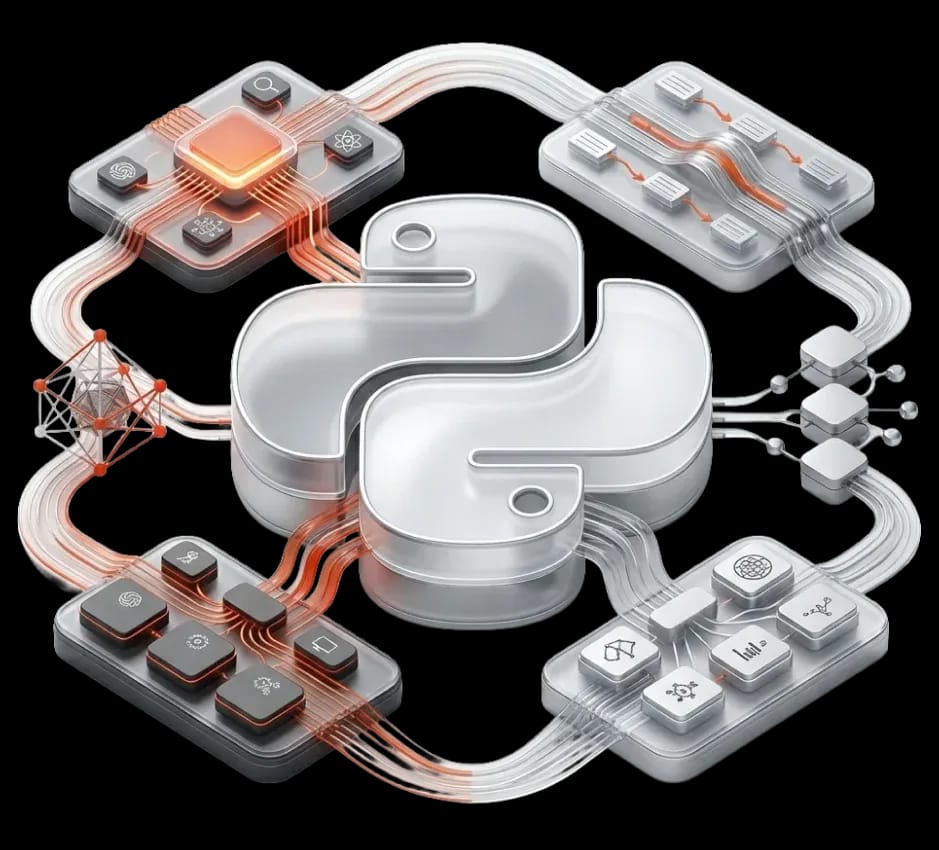
Python development isn't one capability. It's a category spanning web backends, AI and ML systems, data engineering, API architecture, automation and the production infrastructure that keeps all of it running. Here are the Python capabilities we deliver and the engineering bar we hold ourselves to on each one.

The Python Development Partner Worth Hiring
We're not just another Python development agency. We're the AI-first Python engineering partner you bring in when the system has to perform reliably in production, the AI capabilities have to ship to real users and the code has to be maintainable by the team that inherits it.
AI-First Python DNA
LLM integration, RAG pipelines, ML production systems, LLMOps and the AI Python ecosystem are wired into how we design and build, not bolted on as a 'we do AI too' line in our services list. We run AI-powered Python systems in production. We know what production AI engineering looks like.
Senior Python Engineers, No Bench Warmers
You get Python engineers who've shipped production systems at real scale, debugged async performance issues at 3 a.m. and migrated Django apps across major version changes without taking the product down. Not juniors learning pytest on your retainer.
Architecture Depth, Not Framework Advocacy
Django, FastAPI, Flask, Celery, PySpark, PyTorch, LangChain. We reach for the right tool based on your problem, not the one we happen to be most comfortable presenting. The recommendation you get reflects your requirements, not our preferences.
AI and ML as Core, Not Optional
Machine learning, generative AI and intelligent automation aren't services we added to a Python portfolio. They're where a meaningful portion of our Python work lives. When your roadmap reaches into AI, you're not briefing a generalist; you're working with engineers who've shipped that work.
Security and Compliance as Default
OWASP, HIPAA, PCI-DSS, SOC 2, GDPR-aware Python development is built into how we architect, not reviewed before launch. Security testing, dependency hygiene, secrets management and compliance documentation are deliverables, not afterthoughts.
Built for What Python Is Becoming
Python's trajectory runs straight through AI, agentic systems, real-time data infrastructure and the production ML patterns shaping the next five years. We architect Python systems for where the language and ecosystem are heading, not just where they've been.
Why Our Clients Love Working With Us
We build long-term partnerships through transparent communication, technical excellence, and consistent delivery aligned with business goals.
Our Python Development Process
Most Python project failures aren't technical. They're process failures that surface as unmaintainable codebases six months post-launch, AI features that work in staging but break in production or data pipelines that nobody understands well enough to fix when they go wrong. Our Python development services follow a structured, AI-assisted delivery methodology designed to surface those problems early, when they're still cheap to fix.
Here's exactly how it works.
Discovery and Technical Assessment
We audit your existing codebase, architecture, data flows, integration landscape and team capacity to understand what you actually have versus what the documentation says you have. The deliverable is an honest technical picture, not a flattering one.
Architecture and Technology Design
We design the target Python architecture, framework and library selection based on your actual requirements and map the trade-offs honestly. No framework advocacy, no technology for its own sake. A design your team can build against and maintain after we're done.
Foundation Build and Proof of Concept
We validate critical assumptions on a contained surface before committing to full build. Core patterns proved, key integrations tested, performance benchmarks run against real data. Proof of value before full investment.
Iterative Development
We build in short sprints with working software shipped to staging at the end of every sprint. Architecture review checkpoints, code quality gates, test coverage enforced in CI and the kind of agile delivery that keeps you in control of the roadmap, not waiting for a big-bang release.
QA, Testing and Security
pytest suite with unit, integration and end-to-end coverage. Load testing with Locust. Security testing with Bandit and penetration testing before production. Data validation and edge case testing that catches the failures that manual QA never finds.
Deployment, Handover and Ongoing Support
CI/CD pipelines for production deployment, infrastructure-as-code for the environments, comprehensive runbooks and the documentation your team actually needs to operate what we've built. Or we keep operating it alongside you under a managed Python support engagement.
Flexible Engagement Models to Hire Our Python Development Company
Your Python project doesn't fit a template and your engagement shouldn't either. The right way to hire Python engineers depends on your scope, your timeline and your team's existing capability. Three models, all built for AI-era delivery speeds.
You need Python engineers who know your codebase as well as your in-house team, building for your roadmap and not splitting attention across five other clients. The Dedicated Team model gives you a fully embedded Python unit working exclusively on your stack, your sprint cadence and your product goals.
- Right for you if
You're building a complex Python platform over six months or more, your AI and ML roadmap is evolving and you need to scale your engineering team without the hiring cycle, overhead or runway risk of full-time hires.
- What you get
Hand-picked Python engineers, ML specialists, QA engineers and a technical lead all working only on your product. Sprint planning, code reviews and standups run on your calendar and your tooling. AI-assisted Python engineering is built into how the team ships.
- Economics
Monthly retainer. No surprise invoices, no scope-creep billing. Team composition flexes as your roadmap demands.
3 to 10 engineers
6-month minimum
Scales with 30-day notice

Ready to Ship Python That Actually Performs in Production?
Building AI-First Python Foundations for the Businesses That Will Define the Next Decade. The companies investing in production-grade Python engineering now won't be the ones rewriting fragile backends, debugging untested AI integrations and explaining failed data pipelines to stakeholders two years from now.

Industries We Build Python Applications For
Python development challenges look different across industries. The compliance posture, the data sensitivity, the performance requirements and the regulatory obligations all change the engineering. These are the verticals where we build Python systems in production and know what real requirements look like.

Frequently Asked Questions
Questions Engineers and CTOs Ask Before Hiring a Python Development Company
Honest answers to the questions every technical leader asks before they hire a Python development company. If something isn't covered here, our solution architects will walk you through it on a discovery call. No sales pitch, no fluff.
Look past the GitHub profile and the framework logos. The right Python development company asks more questions than it answers in the first conversation, about your architecture, your team's operational maturity, your AI roadmap and what a Python performance failure would cost your business. Evaluate on technical depth in the discovery phase, honesty about trade-offs and whether they push back when they disagree. Anyone who quotes Python work before they've read your existing codebase or understood your requirements isn't the right partner.
End-to-end Python development services cover technical discovery and architecture design, custom Python application development, Python web and API development, AI and machine learning engineering, data pipeline and data engineering, LLM integration and generative AI development, testing and quality engineering, security and compliance hardening, deployment and CI/CD setup and ongoing support and maintenance. The best engagements start with an architecture review before any code is written because the decisions made in the first two weeks shape the codebase for years.
A focused Python engagement, an API build, a single ML model integration or a data pipeline: $15,000 to $60,000. A mid-complexity Python product or AI-integrated platform: $80,000 to $300,000. An enterprise-scale Python system with ML infrastructure, data engineering and ongoing operations: $300,000 to $1M+. We provide detailed estimates after a technical assessment. We won't give you a number before we can stand behind it.
A focused Python engagement, an API or a single AI integration: 6 to 12 weeks. A mid-complexity Python product or ML pipeline: 3 to 6 months. An enterprise Python platform with data engineering and AI infrastructure: 6 to 18 months, executed in phases. We provide milestone-based timelines in writing before development begins.
Python's dominance in AI and ML isn't accidental. PyTorch, TensorFlow, Hugging Face, scikit-learn, LangChain and every major AI framework ship Python-first. The talent pool that can operate production ML systems works in Python. The tooling for MLOps, experiment tracking, data engineering and LLM orchestration assumes Python. When you pick Python for AI, you're picking the language the AI ecosystem actually runs on, not a language you're adapting for a purpose it wasn't built for.
Three models: Dedicated Python Team for long-term, evolving products and AI platforms, Time and Material for iterative builds where scope is still settling and Fixed Cost for well-scoped Python projects with defined deliverables. When you hire Python developers from us, we recommend based on your situation honestly, not based on which model is most profitable for us.
AI-powered Python development means designing your Python architecture with AI capabilities as a first-class concern, not retrofitting them later. LLM integration, RAG pipelines, ML model serving, agent workflows and the LLMOps infrastructure that keeps AI features running reliably in production. Whether you need it depends on your roadmap. If AI features are on your 12-month plan, designing your Python architecture without them in mind makes the integration harder and more expensive than it needs to be.
Yes. We conduct a technical audit first, code quality, test coverage, dependency health, security posture, architectural soundness and accumulated technical debt. We give you an honest picture of what you've inherited and a clear recommendation for what to do about it. Sometimes the answer is refactor. Sometimes it's extend. Sometimes the existing Python code is better than it looks and the right move is to leave the core alone and build around it.
pytest for unit, integration and end-to-end coverage. Hypothesis for property-based edge case testing. Coverage reporting wired into CI with minimum thresholds enforced. Code review on every PR through a defined review process. Linting and formatting through ruff, black and isort. We ship Python code with the test coverage and code quality that makes the next engineer's life better, not something they quietly rewrite over the next six months.
Yes. Docker containerization, Kubernetes orchestration on EKS, AKS or GKE, serverless deployment on Lambda, Azure Functions and Cloud Run, CI/CD pipelines for automated Python testing and deployment, infrastructure-as-code through Terraform and the monitoring and alerting stack that keeps production Python services visible. We don't ship Python applications and walk away. We deliver production-ready deployments with the operational tooling your team needs to run them.
Yes. Compliance controls are built into the Python architecture from the start, not reviewed before the audit. Encryption in transit and at rest, identity and access management, secrets management through Vault or cloud-native equivalents, input validation at the API boundary, comprehensive audit logging and compliance documentation produced as a deliverable. We've built Python applications in healthcare, fintech and SaaS environments where compliance isn't optional.
We make that decision based on your team size, your operational maturity and your actual scaling requirements, not on what's currently fashionable. For most early-stage products and many mid-market systems, a well-structured Django or FastAPI monolith is faster to build, easier to operate and cheaper to run than a microservices architecture that requires three engineers just to keep the service mesh healthy. When microservices genuinely earn their complexity, we design them. We won't recommend them to justify a larger engagement.
For Dedicated Team and Time and Material engagements: 1 to 2 weeks from contract signature to engineers active in your codebase. We run a brief technical onboarding, review existing code and architecture and hit the first sprint milestone within the first two weeks. For Fixed Cost engagements: a 2 to 3 week discovery and scoping phase precedes development start.
Didn't Find What You Were Looking For?
Get In Touch With Our ExpertsInsights on Python Development
Curated technical insights, framework comparisons and engineering best practices on Python web development, AI and ML engineering, data pipeline architecture and the Python patterns shaping how production AI-first products get built.