Startups
 Fintech
 Healthcare
 Manufacturing
 Marketplaces
 Mortgage
 Real Estate
 Retail
 Sports and Fitness
 Telecom and IT
 Logistic
 SaaS Product


 About Us
 Blog
Blog Careers
 Become A Partner
 Contact










Native iOS
Native Swift and SwiftUI apps engineered for App Store featured placement, Apple's Human Interface Guidelines and on-device intelligence through Core ML and Apple Intelligence.
Learn More about Native iOS
 About Us
 Blog
Blog Careers
 Become A Partner
 Contact
Connecting People With Technology
Solvios is the leading IT company in the business to give you growth, revenue, and a global platform.

We're a leading Android app development company helping startups, scale-ups and enterprises ship Kotlin-native and Jetpack Compose applications that perform consistently across the full Android device spectrum, designed for the Play Store and architected with AI integrated Android app development baked in from the first commit.
Years of Experience
Experts in Our Team
Happy Customers Worldwide
Projects Delivered Successfully


4.9/5 ratings

5/5 ratings

Whether you're shipping your first internal test track build or modernizing an Android app that's been running in production for years, our Android app development services cover every layer of the Google ecosystem from native Kotlin engineering to AI integrated Android app development that makes your product genuinely smarter with every release.

The Play Store is forgiving on the way in and unforgiving on the way out. We build native Android applications in Kotlin and Jetpack Compose that don't just meet Google's Material Design 3 expectations but treat them as the floor, not the ceiling. Every app we ship is architected for performance on flagship Pixel and Samsung hardware, optimized for the mid-range devices where most of your global users actually live and engineered to scale well beyond your first release.

An Android tablet isn't a stretched phone, Wear OS isn't a shrunken one and a foldable isn't either. We design products that genuinely belong on each surface adaptive layouts that respond to fold states, glanceable Wear OS complications, large-screen canvases for Pixel Tablet and Galaxy Tab and Android Auto integrations that earn their place on the dashboard. The Android ecosystem rewards depth and we build for it.

If you've inherited a Java codebase or an aging Kotlin app that's accumulated years of architectural debt, you have two real choices: refactor or rebuild. We audit honestly, recommend pragmatically and migrate incrementally Java to Kotlin, XML layouts to Jetpack Compose, MVP to MVVM or MVI so your active roadmap doesn't stall while we modernize the foundation underneath it.

Android has quietly become one of the most exciting platforms for shipping intelligent products. Gemini Nano running on-device through AICore, ML Kit, TensorFlow Lite and direct Gemini API integration mean you can build genuinely AI-native experiences that run privately, instantly and offline. As an AI integrated Android app development company, we wire intelligence into the architecture, not the launch checklist.

Android users notice the things other platforms get away with Material You theming, predictive back gestures, edge-to-edge layouts, accessibility behavior across screen sizes, dark theme parity, dynamic color extraction. Our designers ship in Figma and validate in Android Studio, working directly with engineers so what gets designed actually gets built without the usual translation loss.

Android doesn't stand still. New API levels ship every year, target SDK requirements tighten every August, Play Store policies update without notice and OEM-specific quirks surface on devices you've never held. Our maintenance engagements keep your app current with OS updates, framework deprecations and Google's evolving privacy and data safety rules so you don't wake up to a broken production app the day Android 17 ships.
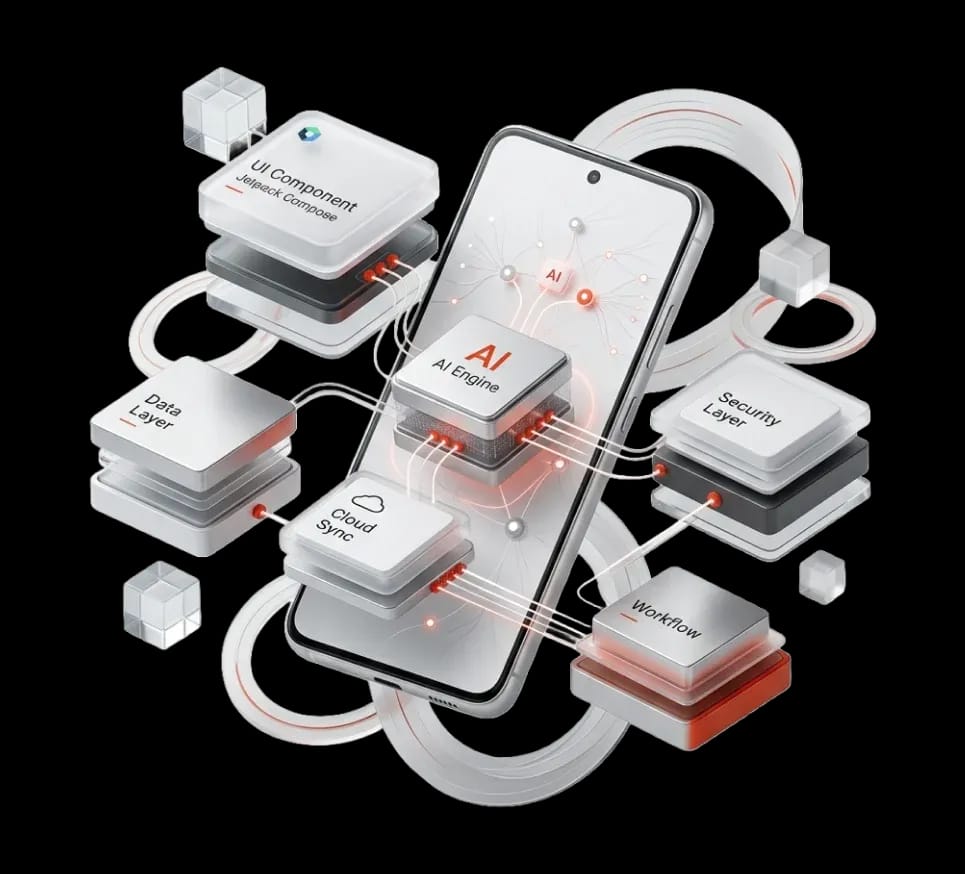
Most Android apps treat AI as a server-side bolt-on that lives behind a loading spinner. We treat it as a first-class Android citizen, running on the NPU, GPU and Tensor cores where it belongs. Every layer below is engineered as a native part of the product, leveraging the parts of Android that genuinely set it apart.

Learns user behaviour locally and adapts content, layout and features without round-tripping data to a server every time.
Highlights:
Learns user behaviour locally and adapts content, layout and features without round-tripping data to a server every time.
Highlights:
Android powers more product categories than any other mobile platform and each one demands a different engineering posture. Our native Android app development services span consumer, enterprise, regulated and AI-first categories, architected for on-device intelligence, foldables, Wear OS and the surfaces emerging next.

Consumer Android Apps
Social, lifestyle, dating, gaming and entertainment apps engineered for Play Store Editor's Choice placement. We design for retention from session one and architect for the kind of viral spikes that break apps built without scale in mind.

Enterprise Android Apps
Internal tools, field service apps, sales enablement platforms and employee productivity products with Android Enterprise integration, Managed Google Play distribution and SSO baked in. Built for the IT teams that have to deploy them and the field users who have to live in them.

Healthcare Android Apps
HIPAA-compliant patient apps, telemedicine platforms, clinical workflow tools and Health Connect integration for unified health data. We've shipped Android in regulated healthcare we know what compliance looks like in production, not just in documentation.

Fintech Android Apps
Banking, trading, lending and payments apps with biometric auth via BiometricPrompt, hardware-backed keystore, Play Integrity API, certificate pinning and PCI-DSS-aligned architecture. Every millisecond, every decimal and every audit trail is engineered to survive the regulator's review.

AR/VR & Spatial Android Apps
ARCore-powered try-on experiences, indoor navigation, training simulations, spatial commerce and immersive brand activations. We build Android phones and tablets in pockets today and architect with Android XR in mind for tomorrow.

AI-Powered Android Apps
Gemini Nano integration through AICore, on-device LLM features, intelligent personalization engines, ML Kit-powered camera and document intelligence and Gemini API-aware product design. The kind of apps that feel smarter with every interaction.

Wear OS & Health Connect Apps
Wear OS companion apps, standalone watch products, fitness tracking platforms, continuous health monitoring tools and Health Services API integrations. Built for the wrist where every byte and every milliwatt matters.

Android SDK & Library Development
Custom Kotlin libraries, white-label Android SDKs, framework engineering for product companies and Maven Central-distributed packages. When other teams are going to depend on what you ship, the quality bar is different and we build to it.

We're not just another Android shop. We're the AI-first Android engineering partner you bring in when the stakes, the device matrix and your Play Store rating actually matter.

Most Android agencies treat each project like their first rodeo. We've been shipping production Android apps since 2012 through 4 major Android architecture overhauls, 3 Jetpack migrations and more OEM-specific bugs than we care to count. That institutional memory is what keeps your app stable across the 24,000+ Android device variants active in 2025\.

Every engineer assigned to your project has personally navigated a Play Store policy strike, debugged a crash isolated to a specific MediaTek or Snapdragon chipset and shipped at least 20 production apps before touching your codebase. Industry data shows that rework from under-qualified Android developers costs teams an average of 23% of total project budget. We eliminate that cost upfront.

Android's market is not one device it's 72.2% of the global smartphone market across thousands of OEM variants. Our pre-launch testing covers 22 device profiles per sprint, including the low-end Snapdragon 4-series devices that represent the majority of users in emerging markets. Your Play Store crash rate reflects this, not just how it runs on a Pixel.

Our average sprint-to-internal-testing cycle runs 20 days. We've maintained a sub 2% production crash rate across client apps by making device-matrix testing, accessibility checks and pre-launch report reviews non-negotiable steps, not optional add-ons you pay extra for. Shortcuts in QA show up as 1-star reviews. We don't take them.
On-device LLMs via AICore are already live on the Pixel 9 series. Android XR is shipping to headsets in 2025. Play Store data safety enforcement tightens every quarter. We architect for these shifts from day one so you're not paying for a full rearchitecture 6-12 months post-launch when Google moves the goalposts. And historically, they always do.

We operate across multiple time zones with overlapping coverage windows meaning scope flags happen the day we see them, not the day we invoice. Clear sprint commitments. Fixed what's fixed. Flagged what changes. Most of our clients extend their engagement beyond the initial contract because predictable delivery builds trust that lasts past launch day.
Most Android project failures aren't technical; they're process failures that surface during the pre-launch report or, worse, in one-star Play Store reviews from real users on devices you didn't test on. Our professional Android app development services follow a structured, AI-assisted delivery methodology designed to surface problems early when they're cheap to fix and maintain engineering quality from the first Kotlin commit to post-launch support.
Here's exactly how it works.

We understand your business goals, your target Android user segments, the device and OS distribution you're entering and the Play Store landscape so we can define the right Android strategy.

We gather, analyze and prioritize functional and technical requirements with Android-specific constraints device fragmentation, API level coverage, manufacturer quirks accounted for from day one.

We design intuitive, Android-native interfaces that respect Material Design 3, support dynamic color and deliver experiences that feel genuinely at home across phones, tablets and foldables.

Our agile Android teams build high-quality, scalable and maintainable Kotlin code in iterative sprints, with internal test track builds shipping continuously.

We ensure reliability, security and performance through Espresso, JUnit, Firebase Test Lab device matrix runs and AI-generated test scenarios that catch the bugs the Play Store pre-launch report would catch first.

We use Gradle Play Publisher, Fastlane and CI/CD pipelines for fast, secure and seamless Play Store deployments with App Signing by Google Play and staged rollouts handled by default.

We provide continuous monitoring, target SDK upgrades and feature enhancements to help your Android app keep pace with Google's release cycle and the Play Store's annual policy tightening.
Your Android project doesn't fit a template and your engagement shouldn't either. The right way to hire Android app development company capacity depends on your scope, your roadmap and your budget reality. Three models, all built for AI-era delivery speeds.
You're building a complex Android product over six months or more, your roadmap is still evolving, or you need to scale your in-house Android team without the cost and lead time of full-time Kotlin hires.
Hand-picked Android engineers, a QA specialist and a technical lead all working only on your product. Sprint planning, standups and retros run on your calendar, your tooling, your definition of done. AI-assisted Kotlin engineering is built into how the team ships, not bolted on later.
Monthly retainer. No surprise invoices, no scope-creep billing. Team composition flexes as your Android roadmap demands.

3-12 Android engineers

6-month minimum

Scales with 30-day notice

Most mid-market companies start with one and evolve into another as their product matures. Let's figure out the right starting point together.

Building AI Integrated Android Apps for the Businesses That Will Define the Next Play Store Decade. The companies that invest in intelligent Android products now won't need to catch up when on-device Gemini becomes the table stakes everyone else is scrambling for.


Android is the dominant mobile platform in most of the world's growth markets and a critical surface in every developed one which is exactly why these verticals trust us as their native Android app development services partner.

Honest answers to the questions every founder, product owner and engineering leader asks before they hire an Android app development company. If something isn't covered here, our solution architects will walk you through it on a discovery call, no sales pitch, no fluff.
Look beyond the portfolio. The right Android app development company asks more questions than it answers in the first conversation about your target user devices, your business model, your existing technical debt and what a one-star Play Store review wave would actually cost you. Evaluate on communication quality, technical depth in Kotlin and Jetpack Compose, Play Store track record and whether they push back constructively when they disagree. Anyone who gives you a fixed Android price before they've understood your requirements isn't the right partner.
End-to-end Android app development services cover product strategy, Android-specific UI/UX design aligned with Material Design 3, Kotlin and Jetpack Compose engineering, ML Kit and Google framework integration, Play Store submission and policy compliance, QA across the Firebase Test Lab device matrix, security testing and post-launch support including target SDK upgrades. The best Android engagements also include discovery and architecture consulting before any Kotlin code is written because decisions made in week one shape the app for years.
A focused Android MVP: $25,000-$60,000. A mid-complexity native Android app with backend integrations: $80,000-$200,000. A full-scale enterprise or AI-integrated Android platform: $200,000-$500,000+. The number that matters isn't the total, it's the ROI per dollar. We provide detailed estimates after a discovery session and we won't quote a number before we can stand behind it.
Focused Android MVP: 8-14 weeks. Mid-complexity Android app with integrations: 3-5 months. Enterprise or AI-integrated Android platform: 6-12 months or more. Play Store review timelines (typically 1-7 days, occasionally longer for first submissions or sensitive permissions) are factored into the launch plan from day one. We provide milestone-based timelines in writing before development begins.
Three models: Dedicated Android Team (for long-term, evolving products), Time & Material (for iterative or exploratory Android builds) and Fixed Cost (for well-scoped, budget-defined Android projects). When you hire Android app development company capacity from us, we recommend honestly based on your situation not based on which model is most profitable for us.
AI integrated Android app development means building intelligence into your Android product's architecture from the start through Gemini Nano via AICore, on-device LLMs, ML Kit, TensorFlow Lite and direct Gemini API integration not adding chatbots as an afterthought. Whether you need it depends on your category, but Android is uniquely positioned for AI: the platform reaches billions of devices globally and Google's on-device intelligence stack is now production-ready. Most mid-market segments already have AI-native Android competitors. The companies that aren't exploring it are quietly falling behind.
Native Kotlin/Jetpack Compose when you need maximum Android performance, deep Google framework integration (Health Connect, ARCore, ML Kit, Gemini Nano), or the kind of polish that earns Play Store editorial features. Flutter when you need a single codebase across Android, iOS and beyond without sacrificing too much native feel. React Native when your team already lives in JavaScript and code-sharing with your web stack matters more than maximum Android depth. We recommend based on your team, performance needs and roadmap not based on what we're trying to sell.
Honestly. Android device fragmentation is real and most agencies underestimate it. We define a target device matrix during discovery based on your user analytics, geography and category and we test against it on every release through Firebase Test Lab. We use Baseline Profiles for startup performance, support a sensible range of API levels based on your actual user base (not just the latest) and account for OEM-specific behavior on Samsung, Xiaomi, Oppo and other manufacturers where it matters. The goal isn't supporting every Android device that's ever shipped, it's supporting the ones your users actually have.
All Android applications are designed for scale from the initial architecture review. Cloud-native backends, microservices where appropriate, database optimization for high-concurrency load, modular Gradle architecture that supports team growth and load testing under realistic peak conditions before Play Store submission. Your Android app should handle 100x your current user base without emergency re-engineering.
Security is designed in, not reviewed at the end. OWASP Mobile Top 10, Android Network Security Config, certificate pinning, biometric auth via BiometricPrompt, hardware-backed keystore, Play Integrity API for tamper detection, ProGuard/R8 obfuscation, mandatory penetration testing before Play Store submission and compliance controls for HIPAA, GDPR, PCI-DSS and SOC 2 as relevant to your industry. Data Safety section disclosures are produced as a deliverable, not an afterthought.
Yes. We conduct a technical audit first of Kotlin/Java code quality, architecture decisions, Play Store policy compliance posture, target SDK status, scalability constraints and accumulated technical debt. We give you an honest picture of what you've inherited and a clear recommendation for what to do about it. Sometimes the answer is refactor. Sometimes it's rebuilt in Jetpack Compose. Sometimes the existing Android work is better than it looks.
Yes. Play Store submission, policy compliance review, Data Safety form completion, store listing optimization, screenshot generation, App Bundle configuration and rejection response are all included in our Android app development services. We've shipped enough apps through Google's review process to know what triggers policy strikes before they happen and how to respond fast when something does come back.
Didn't Find What You Were Looking For?
Get In Touch With Our Experts



Curated insights, framework comparisons and best practices from our Android engineering team to help you build smarter, faster and future-ready Android applications.
We'd love to understand what you want to build. The more context you share, the faster we can give you a useful response not a sales pitch, but a genuine assessment of how we can help and what working together would look like.


Solvios is a leading software development company crafting innovative solutions for businesses. We Specialize in custom software, web & mobile app development, and digital marketing. Partner with us to transform your vision into reality and achieve digital success.