Startups
 Fintech
 Healthcare
 Manufacturing
 Marketplaces
 Mortgage
 Real Estate
 Retail
 Sports and Fitness
 Telecom and IT
 Logistic
 SaaS Product


 About Us
 Blog
Blog Careers
 Become A Partner
 Contact



Cloud Migration Services
End-to-end migration of workloads to AWS, Azure and Google Cloud assessment, strategy, landing zone build and phased cutover delivered by senior cloud engineers.
Learn More about Cloud Migration Services
 About Us
 Blog
Blog Careers
 Become A Partner
 Contact
Connecting People With Technology
Solvios is the leading IT company in the business to give you growth, revenue, and a global platform.

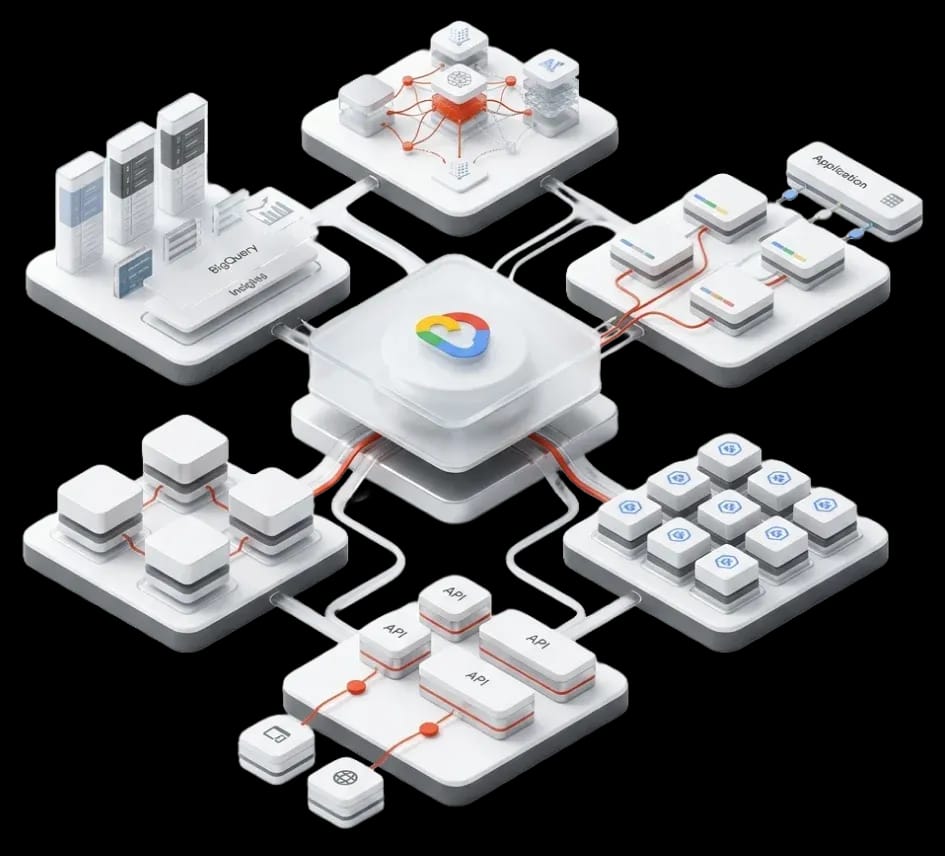
We're a Google Cloud consulting company helping startups, scale-ups and enterprises architect, build and operate production-grade GCP environments that perform under real load, scale with your product and stay within a budget your CFO will actually sign off on. BigQuery, Vertex AI, GKE, Cloud Run, Apigee and the full Google Cloud Platform stack, delivered by senior GCP engineers who treat cloud architecture as a business problem first and a technology problem second.
Years of Experience
Experts in Our Team
Happy Customers Worldwide
Projects Delivered Successfully


4.9/5 ratings

5/5 ratings

Whether you're migrating a legacy stack to Google Cloud, building a data-heavy product on BigQuery and Vertex AI, containerizing workloads on GKE or standing up a production AI platform that needs to ship next quarter, our Google Cloud development services cover every layer of what it takes to run serious workloads on GCP.

Most GCP projects don't fail because the technology doesn't work. They fail because the architecture decisions made in week one don't survive week twelve. Before we write a line of Terraform or spin up a single GKE cluster, we map your workloads honestly what belongs on GCP, what should stay where it is, what should be refactored before it moves and where Google Cloud's native services genuinely out-perform the alternatives. Our Google Cloud Platform consulting engagements deliver architecture blueprints your engineers can execute, not 80-page framework decks that live in a shared drive.

Moving workloads to Google Cloud is rarely just a lift-and-shift. Dependencies nobody documented, licensing constraints that change the economics and compliance requirements that rewrite the network architecture, all surface during execution if you didn't surface them during planning. We migrate workloads to GCP using Cloud Migration Center for discovery, Database Migration Service for the data tier and a phased wave approach with zero-downtime cutover patterns, validated rollback procedures and FinOps tagging baked into the landing zone before the first production workload lands.

GKE is one of the most capable Kubernetes environments in production today and one of the easiest to misconfigure in ways that surface as an incident six months later. We deploy, harden and operate GKE clusters the way Google originally designed the platform to run, multi-zone node pools tuned for the actual workload profile, Workload Identity replacing service account key sprawl, network policies enforced from day one, Autopilot where it earns its keep and a patching cadence that keeps your clusters off the CVE list your security team is about to ask about.

BigQuery is genuinely exceptional for petabyte-scale analytics until you run it like a traditional data warehouse and discover what a poorly-designed query costs on a Friday afternoon. We design BigQuery environments with the economics built in: partitioned and clustered tables that cut scan costs by 70–90%, materialized views for the dashboards that run on every page load, streaming ingestion through Pub/Sub and Dataflow for real-time workloads and the kind of data governance layer that makes your analytics platform something your compliance team can sign off on alongside your CFO.

Vertex AI is where Google Cloud's advantage is clearest for teams building serious ML products. Managed notebooks, custom training jobs, model registry, online and batch prediction endpoints, Feature Store, Pipelines and the Model Garden for foundation model access all on the same platform, with unified IAM, VPC Service Controls and the billing visibility your FinOps team needs. We build Vertex AI environments for product teams who are done running notebooks in production and ready to ship ML that holds up under real user load.

Cloud Build, Cloud Deploy, Artifact Registry, Config Connector, Policy Controller Google Cloud's DevOps-native tooling is mature, opinionated and genuinely powerful when it's architected rather than assembled. We build CI/CD pipelines on GCP's native stack and on GitHub Actions, GitLab and ArgoCD where the use case demands it, with Infrastructure as Code through Terraform or Config Connector, GitOps patterns through Anthos Config Management and the developer platform discipline that lets your engineers ship safely without the platform team becoming the bottleneck.
Most Google Cloud service providers treat Vertex AI as a checkbox and BigQuery ML as a bullet point. We treat GCP as the strongest AI-native cloud platform in production today and we engineer that capability into every layer of what we build. Every block below is how AI and automation run inside your GCP environment before the problem reaches your inbox.
We design and build production Vertex AI workloads that ship: custom training pipelines, online prediction endpoints, foundation model access through Model Garden, RAG architectures over your enterprise data and the LLMOps discipline that keeps generative AI features cost-controlled and reliable.
Highlights:
We design and build production Vertex AI workloads that ship: custom training pipelines, online prediction endpoints, foundation model access through Model Garden, RAG architectures over your enterprise data and the LLMOps discipline that keeps generative AI features cost-controlled and reliable.
Highlights:
Google Cloud Platform consulting isn't one capability. It's a category spanning data engineering, AI and ML, container orchestration, serverless architecture, security, identity and multi-cloud operations. Here are the GCP capabilities we deliver and the engineering bar we hold ourselves to on each one.

BigQuery & Analytics Engineering
Partitioned and clustered table design, materialized views, scheduled queries, streaming ingestion through Pub/Sub and Dataflow, data warehouse migrations from Redshift, Snowflake and on-prem systems, dbt model layers, Looker semantic models and the FinOps discipline that keeps BigQuery scan costs off the quarterly incident list. Analytics engineering that ties data infrastructure to the business decisions it's supposed to drive.

Vertex AI & MLOps
Custom training pipelines through Vertex AI Pipelines, managed notebooks, online and batch prediction endpoints, Feature Store for training-serving skew prevention, model registry and deployment automation, Model Garden for Gemini and foundation model access, evaluation harness execution and the LLMOps layer that production generative AI actually demands. ML in production, not ML in a notebook someone emailed around.

Google Kubernetes Engine (GKE)
Standard and Autopilot cluster provisioning, multi-zone and multi-region architectures, Workload Identity for secretless service authentication, network policies and GKE Dataplane V2, node auto-provisioning and vertical pod autoscaling tuned for actual load profiles, Binary Authorization for supply chain security and the upgrade discipline that keeps clusters current without breaking workloads. Helm, Kustomize and ArgoCD or Flux for GitOps, baked in from day one.

Serverless & Cloud-Native Architecture
Cloud Run for containerized workloads that don't need to run 24/7, Cloud Functions for event-driven logic at the edges of the architecture, Cloud Tasks and Pub/Sub for reliable async processing, Eventarc for event-driven microservices and Workflows for orchestration. Serverless where it genuinely earns its keep, not sprinkled in because the architecture deck had a slot for it.

Google Cloud Security & Compliance
VPC Service Controls and Private Google Access for data exfiltration prevention, Security Command Center Standard and Premium for posture management, Cloud Armor for DDoS and WAF protection, Certificate Authority Service, Cloud KMS and Secret Manager for key and secret lifecycle, Org Policy constraints from day one and the continuous compliance evidence collection for SOC 2, HIPAA, PCI-DSS, ISO 27001 and FedRAMP that means the audit pack is already assembled when the auditor arrives.

Data & AI Infrastructure
Dataflow for batch and streaming data pipelines, Dataproc for Spark and Hadoop workloads, Composer for orchestration, Bigtable for low-latency operational analytics, Spanner for globally distributed transactional workloads, Firestore for document storage at scale and AlloyDB for PostgreSQL-compatible workloads that need Google Cloud's performance infrastructure underneath. Data architectures designed for the analytics team, the ML team and the compliance team simultaneously.

Identity, Networking & Landing Zones
Google Cloud Organization hierarchy, folder structure and project topology designed from day one, Shared VPC for multi-project networking, Cloud Interconnect and Partner Interconnect for hybrid connectivity, Cloud NAT and Private Service Connect, federated identity through Cloud Identity and Workspace, BeyondCorp Enterprise for zero-trust access and the kind of IAM design that enforces least privilege without locking your engineers out of the systems they need to operate.

We're not just another Google Cloud service provider. We're the senior GCP engineering partner you bring in when your BigQuery bill stopped making sense, your Vertex AI pilots need to become production workloads and when the current architecture was chosen because it was familiar, not because it fits the workload.

Vertex AI, BigQuery ML, Gemini API integration, RAG over enterprise data and the LLMOps discipline that production AI demands are built into how we architect GCP environments not added as a 'we do AI too' bullet point.

You get Google Cloud architects and engineers who've operated production data platforms, Vertex AI workloads and GKE clusters through real incidents, real audits and real cost reviews. Not juniors learning BigQuery partitioning on your query bill.

BigQuery, Dataflow, Vertex AI, Dataproc, Pub/Sub, Looker the full Google Cloud data and AI stack, operated as a unified platform rather than a collection of services someone configured once. The recommendation you get is based on your data architecture, not on which service has the freshest documentation.

GCP cost governance isn't a quarterly cleanup. Labeled projects, budget alerts, committed use discount planning, BigQuery cost controls and right-sizing reviews on a defined cadence are how we operate every environment and the savings show up in invoices, not just slide decks.

SOC 2, HIPAA, PCI-DSS, ISO 27001 and FedRAMP compliance controls are operated as a continuous posture, with evidence collected automatically as part of the work. Clear SLAs, honest status, no surprise GCP bills.

Gemini-native applications, agentic AI architectures on Vertex AI Agent Builder, multi-modal workloads, Google's accelerator infrastructure for AI training and the cloud-native patterns shaping the next five years, not just the architecture that was current when your last GCP partner was hired.
Most Google Cloud engagements don't fail technically they fail because the architecture review never surfaced the cost implications, the security posture was left for post-launch and the FinOps baseline was never honestly established before the first production workload landed. Our Google Cloud development services follow a structured, AI-assisted delivery methodology designed to surface those problems early, when they're cheap to fix.
Here's exactly how it works.

We audit your current workloads, data architecture, existing GCP estate (if any), compliance requirements and cost-to-serve baseline. The deliverable is an honest picture of what you actually have and where Google Cloud genuinely earns its place.

We design the target GCP architecture: Organization hierarchy, networking topology, security controls, identity architecture and the FinOps baseline and stand up the landing zone before any production workloads move. The architecture is designed against your workload, your compliance requirements and your budget reality, not against a reference architecture someone liked on a conference slide.

We validate the critical architectural assumptions on a contained workload: query performance against BigQuery, inference latency on Vertex AI, pod scheduling under load on GKE, before committing to full production build. Surprises in a PoC cost sprint time. Surprises in production cost revenue.

Our engineers build the production GCP environment in phased sprints: infrastructure as code through Terraform, CI/CD pipelines deployed, data migration executed with integrity checks at every checkpoint, workloads cutover with tested rollback procedures and observability wired in before the first production traffic hits.

We tune the environment for cost, performance and security: BigQuery partitioning reviewed, GKE node pools right-sized, committed use discounts planned, Security Command Center findings remediated and the compliance evidence pack produced as a byproduct of the work, ready for the first audit.

We run ongoing monitoring, FinOps oversight, security posture management, incident response and quarterly architecture reviews or hand the environment over cleanly to your in-house team with the runbooks, documentation and training to operate it confidently.
Your Google Cloud engagement doesn't fit a template and the contract shouldn't either. The right way to hire Google Cloud consulting company capacity depends on your scope, your timeline and your in-house team's depth. Three models, all built for cloud-era delivery speeds.
You're running a complex GCP migration or data platform build over six months or more, scaling your data and AI engineering capacity across business units or augmenting your in-house cloud team without the cost and lead time of full-time hires.
Hand-picked GCP architects, data engineers, ML engineers, DevOps engineers and security specialists working only on your environment. Sprint planning, standups and on-call rotations run on your calendar and your tooling. AI-assisted engineering is built into how the team ships, not bolted on later.
Monthly retainer. No surprise invoices, no scope-creep billing. Team composition flexes as your GCP roadmap evolves.

3-10 engineers

6-month minimum

Scales with 30-day notice

Most mid-market companies start with one and evolve into another as their GCP footprint matures. Let's figure out the right starting point together.

Building Google Cloud Foundations for the Businesses That Will Define the Next Decade. The companies that invest in production-grade GCP architecture now won't be the ones explaining BigQuery overruns, Vertex AI pilots that never shipped and compliance findings that surface eighteen months after the environment went live.


Google Cloud Platform challenges look different across industries: the compliance posture, the data gravity, the AI maturity and the operational rhythm all change the architecture. These are the verticals where we've delivered GCP solutions in production and know what real cloud engineering looks like.

Honest answers to the questions every CTO, head of data, head of engineering and VP of infrastructure asks before they hire a Google Cloud consulting company. If something isn't covered here, our GCP solution architects will walk you through it on a discovery call, no sales pitch, no fluff.
Look beyond the GCP certification wall and the partner tier badges. The right Google Cloud consulting company asks more questions than it answers in the first conversation about your data architecture, your AI roadmap, your compliance posture and what a BigQuery incident or a Vertex AI deployment failure would actually cost your business. Evaluate engineering depth in the discovery phase, honesty about GCP's trade-offs versus AWS and Azure and whether they push back constructively when the technically correct answer doesn't match what you asked for. Anyone who recommends GCP before they've understood your workload isn't the right partner.
End-to-end Google Cloud consulting services cover GCP strategy and architecture, cloud migration to Google Cloud, BigQuery and data engineering, Vertex AI and MLOps, GKE and container orchestration, serverless and cloud-native development, DevOps and platform engineering on GCP, security and compliance management, FinOps and cost optimization and managed GCP operations. The best engagements start with an architecture audit before any build work begins because decisions made in week one shape your GCP bill for years.
A focused GCP engagement landing zone build, BigQuery migration, GKE deployment typically runs $30,000-$100,000. A mid-complexity GCP program with data engineering, Vertex AI integration and DevOps: $100,000-$350,000. An enterprise-scale GCP transformation across multiple product lines and compliance requirements: $400,000-$1M+. Ongoing managed GCP operations typically run $8,000–$60,000 per month depending on environment scope. The number that matters isn't the consulting fee, it's the BigQuery cost trajectory, the time-to-production for your Vertex AI workloads and the audit findings you're not accumulating.
Google Cloud wins when data and AI are the center of your product, not the sidecar. BigQuery's serverless analytics model, Vertex AI's managed ML platform, Gemini's native integration across GCP services and Google's TPU infrastructure for AI training give GCP a genuine technical lead for data-heavy and AI-native products. For Microsoft-centric enterprises with deep Active Directory dependencies, Azure often makes more sense. For the broadest service catalog and the most mature operations tooling, AWS. We make the recommendation after we understand your workload, not before.
Google Cloud Platform consulting means working with senior GCP architects and engineers who've operated production environments on GCP not just certified their way through the exam to design, build and operate GCP environments that fit your workload, your compliance requirements and your business model. You need it when your GCP architecture decisions carry real cost or compliance consequences, when your in-house team has strong software engineering depth but limited GCP infrastructure expertise or when you're building the kind of data or AI product where the wrong infrastructure choice costs you six months.
Three models: Dedicated GCP Team (for complex, evolving GCP estates and data platform builds), Time & Material (for iterative builds, exploratory Vertex AI work and modernization in waves) and Fixed Cost (for well-scoped, budget-defined GCP projects). When you hire Google Cloud consulting company capacity from us, we recommend honestly based on your situation not based on which model produces the largest retainer for us.
GCP FinOps is operated as a continuous practice, not a quarterly cleanup. Labeled projects and resources from day one, budget alerts with anomaly detection, BigQuery cost controls through slot commitments and query cost attribution, committed use discount planning for Compute and Cloud Run, Cloud SQL and GKE node right-sizing reviews on a defined cadence and the kind of GCP billing visibility that ties spend to the products and teams driving it. Most clients see 25–40% cost reduction within the first six months not from cutting capacity, but from cutting the waste that accumulated before FinOps was treated as an engineering discipline.
Security is designed into the GCP architecture, not reviewed after the first audit finding. VPC Service Controls from day one, Security Command Center for continuous posture management, Cloud Armor for perimeter protection, Binary Authorization for supply chain integrity, Cloud KMS and Secret Manager for cryptographic and secret lifecycle, Org Policy constraints enforced across the organization hierarchy and compliance evidence collected automatically for SOC 2, HIPAA, PCI-DSS, ISO 27001 and FedRAMP as relevant to your industry.
Yes, that's a meaningful share of what we do. We start with a technical audit: project topology, IAM configuration, network architecture, security posture, BigQuery cost trajectory, Vertex AI deployment patterns and the accumulated configuration drift nobody's documented. We give you an honest picture of what you've inherited and a clear recommendation for what to do about it. Sometimes the answer is refactor. Sometimes it stabilizes and extends. Sometimes the existing work is better than it looks.
Vertex AI is where GCP's advantage is clearest for ML teams and we treat it as a production engineering discipline, not an experimental platform. We design Vertex AI environments for teams ready to ship: custom training pipelines, online prediction endpoints with SLOs, Feature Store for training-serving skew prevention, Model Registry for versioning and rollback, Pipelines for orchestration and the LLMOps layer that production generative AI demands token-level cost monitoring, prompt versioning, output validation and fallback routing. ML that ships, not ML that demos.
A standard GCP takeover or new environment build runs 4–8 weeks from contract signature to production-ready state covering environment audit, landing zone deployment, observability stack live, security posture baseline and immediate-impact remediations. Larger, more regulated or more complex environments take longer; focused greenfield builds on a contained workload can move faster. We provide a documented onboarding plan with milestones before any work begins.
Yes. Managed GCP operations is one of our core offerings 24/7 monitoring through Cloud Operations Suite and Datadog, incident response, patch and update management, FinOps oversight, security posture management through Security Command Center and quarterly architecture reviews. You can hand over the full operational load or run it alongside your in-house team. SLAs are defined per engagement and reported on every month.
Didn't Find What You Were Looking For?
Get In Touch With Our Experts


Curated insights, comparisons and best practices on Google Cloud architecture, BigQuery engineering, Vertex AI, GKE operations and GCP FinOps- written to help you build smarter on GCP, spend leaner and stay ahead of where Google Cloud is heading next.
We'd love to understand what you want to build. The more context you share, the faster we can give you a useful response not a sales pitch, but a genuine assessment of how we can help and what working together would look like.


Solvios is a leading software development company crafting innovative solutions for businesses. We Specialize in custom software, web & mobile app development, and digital marketing. Partner with us to transform your vision into reality and achieve digital success.