hero banner background

AI-Driven Manufacturing Software Development Solution

We build custom manufacturing software from MES and production management platforms to IIoT-connected predictive maintenance systems, ERP integrations, supply chain tools, and AI-integrated quality intelligence for discrete manufacturers, process manufacturers, industrial equipment makers, and operations teams that need software that reflects how their production environment actually works, not how a generic ERP module assumes it should. Our manufacturing software development team combines production operations knowledge, industrial systems integration experience, and AI-integrated architecture to build software that improves throughput, reduces downtime, and gives operations leadership the visibility that spreadsheets and legacy systems cannot provide.

AI-Driven Manufacturing Software Development Solution
14+

Years of Experience

50+

Experts in Our Team

40+

Happy Customers Worldwide

250+

Projects Delivered Successfully

rating platform logostar rating

4.9/5 ratings

rating platform logostar rating

5/5 ratings

What We Build for Manufacturing Companies

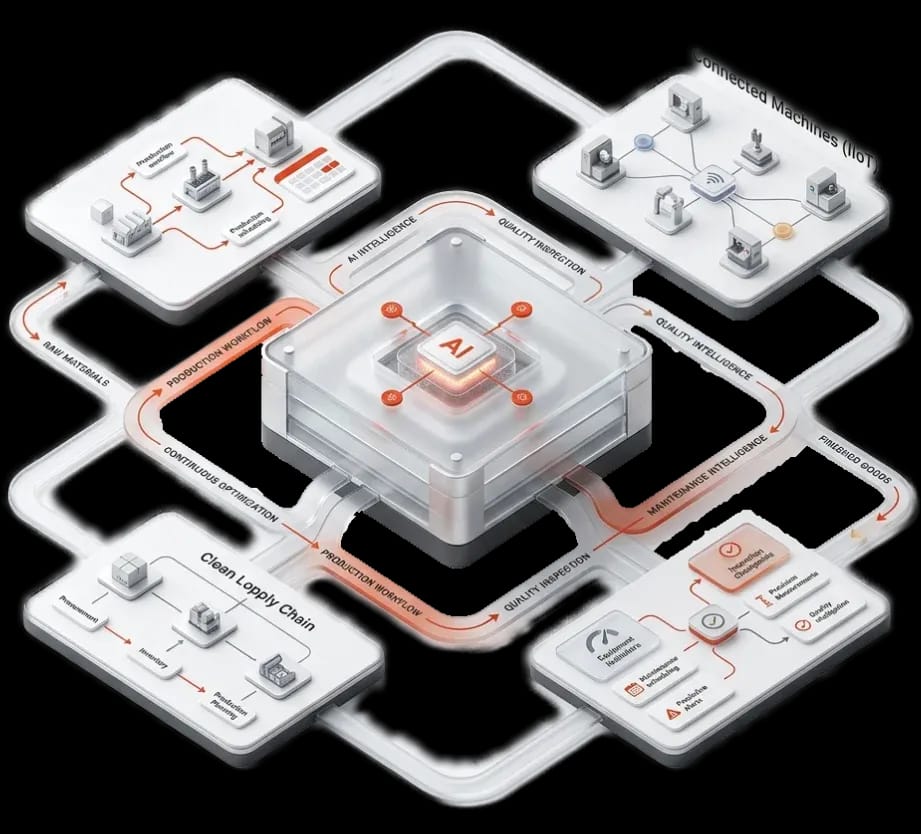
Solvios is a manufacturing software development company building custom MES and production management platforms, IIoT-connected predictive maintenance systems, ERP integration layers, supply chain management tools, quality management software, and AI-integrated production intelligence for discrete and process manufacturers, industrial equipment companies, and manufacturing operations teams. We work across the full manufacturing technology stack from production floor data collection through ERP integration and management reporting with the industrial systems knowledge, real-time data architecture, and AI-integrated engineering that modern manufacturing operations require.

Manufacturing Execution Systems (MES)

Custom MES platforms that connect production scheduling, work order management, machine monitoring, quality data collection, and OEE tracking in a single system giving production managers real-time visibility into what is happening on the floor, not what happened yesterday in a spreadsheet.

ERP Integration & Implementation

ERP system integration, customisation, and implementation for manufacturers connecting production floor data to business systems, bridging the gap between operational technology and enterprise IT, and building the custom modules that off-the-shelf ERP does not cover for specific manufacturing workflows.

IIoT and Predictive Maintenance

Industrial IoT platforms that connect machine sensors and PLCs to cloud-based analytics, surfacing equipment health signals, predicting failures before they cause unplanned downtime, and replacing time-based maintenance schedules with condition-based maintenance that reduces both cost and disruption.

Supply Chain Management Software

Custom supply chain and procurement tools covering supplier management, purchase order workflows, inventory optimisation, inbound logistics visibility, and the demand-supply matching that reduces working capital tied up in excess stock without creating the stockouts that stop production lines.

Quality Management Systems (QMS)

Digital quality management platforms covering incoming inspection, in-process quality checks, non-conformance management, corrective action workflows, and the compliance documentation that ISO 9001, IATF 16949, AS9100, and FDA 21 CFR Part 11 audits require to be maintained continuously rather than assembled before each audit.

filter list background

Why Manufacturing Companies Come to Us

Manufacturing software has a specific failure mode that most other industries do not share: the gap between the operational technology on the production floor and the information technology in the business systems is often measured in decades. Production data lives in PLCs and SCADA systems that were installed in 2008 and were not designed to talk to the ERP that was implemented in 2015 or the analytics platform that the VP of Operations bought last year. The result is manufacturing decisions being made on information that is hours or days old, captured manually from systems that do not communicate with each other. We have worked in this environment and know where the real problems are.

Production Data That Lives in the Machine, Not in the Business

Production Data That Lives in the Machine, Not in the Business

Most manufacturing operations are sitting on enormous volumes of production data cycle times, machine states, defect counts, energy consumption, sensor readings that are either captured in paper logs, locked in proprietary PLC historians that nothing else can read, or aggregated into shift reports that arrive on the plant manager's desk the next morning. The data exists. The architecture to make it useful across the business does not. Every management decision that should be data-driven is being made on gut feel and lagging indicators because the operational data never makes it to the people who need it in time to act on it.

ERP Systems That Don't Speak Manufacturing

ERP Systems That Don't Speak Manufacturing

Generic ERP systems, even well-implemented ones handle finance, HR, and procurement competently. They handle manufacturing execution poorly. Work order routing, labour tracking, machine scheduling, tooling management, real-time WIP visibility, and the shop floor transactions that production control depends on are either missing from the base system or require customisations that the implementation partner either did not build or built badly. The result is manufacturers running their ERP for accounting and running their production floor on a combination of Excel, whiteboards, and institutional knowledge.

Unplanned Downtime That Drains Production Capacity

Unplanned Downtime That Drains Production Capacity

A machine breakdown on a production line is not just the cost of the repair. It is the lost production time, the downstream schedule disruption, the expediting cost to recover the customer delivery commitment, and the labour standing idle while the maintenance team diagnoses the fault. Most manufacturers are managing equipment maintenance by reactively fixing machines after they break or on fixed time-based schedules that replace components that still have useful life while missing the early warning signals that precede actual failures. The data to do better is already coming off the machines. The system to act on it is not there.

Supply Chain Visibility That Ends at the Dock Door

Supply Chain Visibility That Ends at the Dock Door

Manufacturers know what is in their finished goods warehouse. They know what is on their production floor. What most do not have is reliable visibility into what is in transit from suppliers, when it will actually arrive versus when it was promised to arrive, and which incoming deliveries are going to cause a line stoppage if they are late. Supply chain disruptions are expensive in manufacturing because the downstream consequences: production stops, customer delivery failures, expediting costs are immediate and measurable. The visibility to anticipate them rarely exists in the systems currently deployed.

Quality Management That Is Retrospective Rather Than Preventive

Quality Management That Is Retrospective Rather Than Preventive

Most manufacturer quality systems are designed to detect defects after they occur and document the response, incoming inspection, final inspection, customer complaint processing, corrective action reports. The data to identify the process conditions that produce defects, which shifts, which machines, which material lots, which operators, which environmental conditions exist in the production data but are not being connected to the quality outcomes in a way that enables preventive action. The defect pattern that a quality engineer could identify in an hour of data analysis is instead being discovered three months later when customer returns start arriving.

Manufacturing Software Development Services We Deliver

Every manufacturing software engagement starts with the production environment, the operational data landscape, and the integration requirements between shop floor systems and business systems and not with a feature list. The software is built to reflect how the manufacturing operation actually runs, not how a reference architecture assumes it should.

Custom MES platforms for discrete and process manufacturers that need production management software built around their specific production processes, work order structures, quality requirements, and integration landscape rather than adapted from a commercial MES that was designed for a different industry or a different scale of operation. We have built production management platforms for manufacturing operations where the commercial alternatives required more customisation than a custom build and were still less fit for purpose after it.

Work order management and shop floor scheduling

Work order release, routing, and dispatch to production work centres with real-time WIP tracking, work centre queue management, and the scheduling visibility that production control teams need to manage capacity and customer commitments simultaneously.

Machine monitoring and OEE tracking

Real-time machine state collection via PLC and sensor integration distinguishing planned downtime, unplanned downtime, and productive time with OEE calculation, availability and performance trending, and the drill-down capability that identifies which machines, shifts, and products are driving the losses in overall equipment effectiveness.

Labour tracking and production reporting

Operator-level production confirmation, scrap and rework recording, labour routing against standard times, and the shift production report that replaces the paper-based or manually compiled reporting that most plants still depend on to close each shift.

Quality data collection and SPC integration

In-process quality check recording, statistical process control chart display at the work station, out-of-control signal alerting, and the quality data capture that feeds the QMS traceability record without requiring a separate manual data entry step.

ERP integration and implementation for manufacturers building the integration layers that connect production floor data to business systems, customising ERP modules for manufacturing-specific workflows that the base system handles poorly, and implementing the ERP functionality that manufacturing operations actually depend on. We have specific experience with ERPNext implementation and customisation for manufacturing contexts, a real engagement in our case study portfolio as well as integration work connecting custom manufacturing software to ERP systems across multiple platforms.

ERP and MES bidirectional integration

Production order release from ERP to MES, production confirmation and WIP updates from MES back to ERP, quality results integration, and the bidirectional data flow that keeps the business system and the production floor system in sync without manual reconciliation between them.

ERPNext implementation and manufacturing modules

ERPNext implementation covers manufacturing module configuration bill of materials, production planning, work order management, job card tracking, and quality inspection with the customisation work that aligns the standard module to the specific production workflow and data requirements of the operation.

Custom ERP module development

Custom development of manufacturing-specific ERP modules that the base system does not cover tooling management, maintenance work order integration, production scheduling, or industry-specific compliance tracking built on the ERP platform's API and data model to avoid the integration overhead of a separate standalone system.

Legacy system migration and data integration

Migration from legacy manufacturing systems, custom Access databases, spreadsheet-based production tracking, obsolete commercial MES platforms to modern ERP or MES architecture, with data migration, user transition planning, and the parallel running period that de-risks the cutover for an operation that cannot stop production during the transition.

Industrial IoT platforms and predictive maintenance systems for manufacturers that want to move from reactive breakdown maintenance and fixed-schedule preventive maintenance to condition-based maintenance driven by real equipment health data. The architecture spans from edge data collection at the machine PLCs, sensors, condition monitoring equipment through cloud-based analytics and ML model inference, to the maintenance work order integration that turns a predicted failure into a scheduled repair before the breakdown occurs.

Machine connectivity and edge data collection

PLC integration via OPC-UA, Modbus, MQTT, and proprietary protocols, sensor data ingestion from vibration, temperature, pressure, and current monitoring equipment, and the edge computing architecture that handles data pre-processing and local storage where cloud connectivity is intermittent or latency-sensitive.

Equipment health dashboard and alerting

Real-time equipment health visualisation by asset, production line, and site with threshold-based alerts, trend visualisation, and the anomaly detection that surfaces equipment behaviour changes before they progress to failure.

Predictive maintenance ML models

ML models trained on historical failure data and operational sensor readings that score each asset's failure probability over the next inspection window enabling the maintenance planning team to schedule interventions based on actual equipment condition rather than calendar intervals.

CMMS and work order integration

Integration between the IIoT platform and the CMMS or ERP maintenance module automatically generates maintenance work orders from predictive alerts, updating asset health records from completed maintenance, and closing the feedback loop between maintenance execution and model accuracy improvement.

Custom supply chain and procurement software for manufacturers managing complex supplier networks, multi-tier supply chains, and the inventory and logistics challenges that production continuity depends on. We build for the manufacturer's view of the supply chain inbound materials visibility, supplier performance tracking, purchase order management, and the demand-supply balancing that keeps production running without tying up excess working capital in safety stock.

Supplier management and performance tracking

Supplier database, approved vendor list management, purchase order lifecycle tracking, delivery performance scoring, quality performance integration from incoming inspection, and the supplier scorecard reporting that gives procurement teams the data to make supplier development and selection decisions on evidence rather than relationships.

Inventory optimisation and replenishment

Demand-driven replenishment logic, safety stock calculation based on supplier lead time variability, min-max parameter management, and the inventory optimization tools that reduce the working capital tied up in excess stock without creating the line-stopping stockouts that over-optimisation causes.

Inbound logistics and delivery tracking

Purchase order delivery tracking, expected receipt confirmation, advance shipping notice integration where suppliers provide it, and the exception management workflow that flags late deliveries in time to take mitigating action rather than discovering the problem when the line runs out of material.

Demand planning integration

Integration between sales order and forecast data and the supply chain system giving procurement teams visibility into the demand horizon that drives purchasing decisions, and surfacing capacity and supply constraints against the forecast before they create production schedule failures.

Digital quality management platforms for manufacturers operating under ISO 9001, IATF 16949, AS9100, FDA 21 CFR Part 11, or other quality management standards covering the document control, inspection management, non-conformance handling, corrective action, and audit management that quality compliance requires. The distinction between a QMS that satisfies auditors and a QMS that actually improves product quality is whether the system connects quality outcomes back to the process conditions that produced them and that requires the production data integration that standalone QMS platforms typically lack.

Inspection management and results recording

Incoming inspection, in-process inspection, and final inspection plan configuration with mobile-friendly results recording at the inspection station, attribute and variable data collection, automatic pass/fail determination, and the inspection record that feeds the lot traceability system.

Non-conformance and CAPA management

Non-conformance report creation, disposition workflow, root cause analysis recording, corrective action assignment and tracking, effectiveness verification, and the closed-loop CAPA process that satisfies quality standard requirements and demonstrably reduces recurring defects.

Document control and change management

Quality document lifecycle management creation, review, approval, release, and controlled distribution with revision history, acknowledgment tracking, and the audit trail that demonstrates document control compliance without a manual file management system that auditors find gaps in every time.

Compliance and audit management

Internal and external audit scheduling, audit finding management, observation and non-conformance recording, corrective action integration, and the certification evidence reporting that makes an ISO or IATF recertification audit a reporting exercise rather than a fire drill.

Production analytics platforms and operations intelligence tools for manufacturing organisations that want to move from lagging indicator reporting last month's OEE, last quarter's scrap rate to real-time operational visibility and forward-looking production intelligence. The data to do this already exists in most manufacturing operations. What is missing is the architecture to collect it consistently, the analytical layer to turn it into insight, and the dashboards that surface the right information to the right person at the right moment in the production cycle.

Operations dashboards and real-time visibility

Plant-level and line-level production dashboards covering output versus target, OEE, quality yield, and downtime updated in real time from MES and machine monitoring data, visible on shop floor screens, and accessible on mobile for operations managers walking the plant.

Production performance analytics

Trend analysis of OEE components, shift and crew performance benchmarking, product and part-number profitability analysis, and the deep-dive capability that lets operations leadership investigate a performance problem at the level of granularity that the root cause actually requires.

Demand and capacity planning dashboards

Customer order intake visualisation against production capacity, rough-cut capacity planning, bottleneck identification, and the forward-looking load versus capacity view that gives production planning the visibility to manage customer commitments without the firefighting that results from discovering a capacity problem the week before the delivery due date.

Cross-system reporting and data integration

Data integration from ERP, MES, QMS, and IIoT platforms into a unified operations data model with the ETL pipelines, data normalisation, and refresh architecture that gives management reporting a single source of truth rather than three different numbers for the same metric from three different systems.

We Build for Every Manufacturing Stakeholder

Discrete Manufacturers

Discrete Manufacturers

Job shops, make-to-order manufacturers, batch producers, and high-volume discrete manufacturers across automotive components, industrial equipment, electronics, medical devices, and consumer products where work order management, routing, labour tracking, and quality traceability are the core production management requirements. The production floor complexity varies enormously across these sub-segments and the software needs to reflect the specific production model rather than a generic MES reference architecture.

Process Manufacturers

Process Manufacturers

Chemical, pharmaceutical, food and beverage, and specialty materials manufacturers where the production model is recipe-based, batch execution is governed by regulatory requirements, and the traceability requirement extends from incoming raw materials through every production step to the finished product batch record. Process manufacturing software requires a different data model and a different compliance architecture from discrete manufacturing and the development team needs to understand the difference before they design the system.

Industrial Equipment and OEM Manufacturers

Industrial Equipment and OEM Manufacturers

Manufacturers building industrial equipment, machinery, or engineered products where the production process involves complex assemblies, long cycle times, configuration management, and the service and aftermarket dimension that begins the moment the equipment is commissioned. Engineering change management, serialised traceability, and the product configuration data that field service depends on are requirements that most commercial MES platforms handle poorly.

Operations and Plant Management Teams

Operations and Plant Management Teams

Operations directors, plant managers, and production supervisors who need the production visibility, OEE analytics, and real-time floor data that their current systems do not provide and who are trying to build a business case for a manufacturing software investment that will actually improve the metrics their business cares about rather than just digitising a paper process.

Manufacturing IT and Technology Teams

Manufacturing IT and Technology Teams

Manufacturing IT managers, OT/IT convergence teams, and technology leaders managing the integration architecture between shop floor systems and enterprise IT building the data pipelines, integration middleware, and cloud architecture that connects PLC historians and MES platforms to ERP systems and analytics infrastructure.

Contract Manufacturers and Tier 1 Suppliers

Contract Manufacturers and Tier 1 Suppliers

Contract manufacturers and automotive or aerospace tier 1 suppliers operating under customer-imposed quality standards, EDI requirements, and production reporting obligations where the software needs to satisfy both internal operational requirements and external customer interface requirements simultaneously.

Why Modern Teams Choose Us as Their Manufacturing Software Development Company

Explore how we help manufacturing and operations organisations build software that connects the production floor to the business systems, improves operational visibility, and turns production data into decisions that reduce cost and improve throughput.


Building Manufacturing Software? Talk to a Team That Understands the Gap Between the Production Floor and the Business System.

We will map your production data landscape, your integration architecture, and your operational requirements and give you an honest path forward before any development begins. Response within 24 hours.

Schedule a Free Consultation
Building Manufacturing Software? Talk to a Team That Understands the Gap Between the Production Floor and the Business System.
why solvios background

What We Build Into Every Manufacturing Platform

These are the capabilities that manufacturing software requires to operate reliably in a production environment, integrate with the operational technology and business systems that manufacturing operations depend on, and provide the real-time visibility that production decisions actually require.


Real-Time Production Monitoring and OEE

Real-Time Production Monitoring and OEE

Machine state collection via PLC and sensor integration, OEE calculation and trending by machine and production line, downtime classification and reason coding, and the real-time production dashboard that gives operations management current visibility into floor performance rather than yesterday's shift report.

Work Order and Shop Floor Management

Work Order and Shop Floor Management

Work order release, routing, and dispatch, WIP tracking through production operations, operator confirmation and labour recording, tooling and setup tracking, and the shop floor transaction management that production control depends on to maintain schedule visibility and customer delivery performance.

ERP Bidirectional Integration

ERP Bidirectional Integration

Production order release from ERP, WIP and completion confirmation back to ERP, quality results integration, inventory consumption posting, and the real-time data exchange that eliminates the manual reconciliation between production floor systems and business systems.

Predictive Maintenance and Condition Monitoring

Predictive Maintenance and Condition Monitoring

Equipment health data collection from sensors and PLCs, anomaly detection on asset health signals, failure probability scoring by asset, maintenance work order generation from predictive alerts, and the condition-based maintenance architecture that reduces unplanned downtime by addressing equipment issues before they cause production stoppages.

Quality Data Collection and Traceability

Quality Data Collection and Traceability

In-process and final inspection data collection, SPC charting at the work station, non-conformance recording and disposition, lot and serial number traceability through the production process, and the quality record that satisfies customer and regulatory traceability requirements without manual documentation.

Supply Chain Visibility and Procurement

Supply Chain Visibility and Procurement

Purchase order tracking, supplier delivery performance monitoring, inbound materials visibility, inventory replenishment management, and the supply chain intelligence that gives production planning early warning of supply disruptions before they cause line stoppages.

Compliance and Audit Documentation

Compliance and Audit Documentation

Document control for quality and production procedures, batch record management for regulated manufacturing, corrective action tracking, audit management workflow, and the compliance evidence collection that makes regulatory audits and customer quality audits a reporting exercise rather than a documentation scramble.

Mobile and Shop Floor Interface Design

Mobile and Shop Floor Interface Design

Touch-optimised operator interfaces for shop floor use on industrial tablets and rugged devices, offline capability for areas with unreliable connectivity, and the UX design that works for operators wearing gloves in a production environment not just for knowledge workers at a desk.

AI-Integrated Manufacturing Software, Engineered Into Every Layer

AI in manufacturing is not a concept, it is a set of specific, measurable applications that improve throughput, reduce waste, and replace decisions made on gut feel and lagging indicators with decisions made on current data and statistical inference. Predictive maintenance, quality defect prediction, production schedule optimisation, and energy consumption intelligence are all live deployments in manufacturing operations today, and they all depend on a data architecture designed to support them. Every manufacturing platform we build is architected with AI integration as a considered engineering component from the first sprint because the production data infrastructure that AI requires needs to be built correctly from the start.

Predictive Maintenance and Equipment Health Intelligence
01

Replace the breakdown that costs ten hours with the repair that costs two

ML models trained on machine sensor data, operational parameters, and historical failure records that score each asset's probability of failure within the upcoming maintenance planning window. High-risk assets surface in the maintenance dashboard for scheduled intervention. The shift from reactive maintenance to predictive maintenance reduces unplanned downtime, extends equipment life, and decreases the emergency maintenance premium that reactive repairs typically carry. The ROI is measurable and typically significant; one avoided breakdown on a critical production asset can justify the cost of the entire IIoT platform.

Highlights:

  • Vibration, temperature, and current anomaly detection
  • Failure probability scoring per asset
  • Remaining useful life estimation
  • Maintenance work order auto-generation
Predictive Maintenance and Equipment Health Intelligence
01

Replace the breakdown that costs ten hours with the repair that costs two

ML models trained on machine sensor data, operational parameters, and historical failure records that score each asset's probability of failure within the upcoming maintenance planning window. High-risk assets surface in the maintenance dashboard for scheduled intervention. The shift from reactive maintenance to predictive maintenance reduces unplanned downtime, extends equipment life, and decreases the emergency maintenance premium that reactive repairs typically carry. The ROI is measurable and typically significant; one avoided breakdown on a critical production asset can justify the cost of the entire IIoT platform.

Highlights:

  • Vibration, temperature, and current anomaly detection
  • Failure probability scoring per asset
  • Remaining useful life estimation
  • Maintenance work order auto-generation

Our Manufacturing Software Development Process

Manufacturing software projects fail most often not because the engineering is inadequate but because the production environment was not mapped correctly during discovery, the integration complexity between OT and IT systems was underestimated, or the shop floor UX was designed for office users rather than for operators in a production environment. Our manufacturing software development services follow a structured, operations-first delivery methodology designed to surface those problems before they become production incidents.

Here's exactly how it works.

Discovery & Operations Assessment
01

Discovery & Operations Assessment

We map the production environment process flows, machine types and connectivity, existing systems and data sources, ERP and IT architecture, quality and compliance requirements, and the operational pain points that the software investment is intended to address. Output is a project scope that includes a data architecture, integration plan, compliance requirements, and a phased delivery plan that accounts for the operational risk of changes to a live production environment.

Production process mappingMachine and sensor inventoryIT/OT integration assessmentCompliance requirementsRisk register
Architecture & UI/UX Design
02

Architecture & UI/UX Design

Technical architecture designed with the real-time data volumes, OT integration depth, and operational reliability requirements of the manufacturing environment. Shop floor interface design reviewed with production operators where possible because an MES operator screen that works for a developer demonstration but does not work for an operator wearing gloves on a busy production line is a production implementation failure waiting to happen.

OT/IT integration architectureData model designShop floor UX designManagement dashboard designERP integration design
Agile Development Sprints
03

Agile Development Sprints

Two-week sprints with working software delivered each cycle. Machine connectivity, ERP integration, and core production transaction workflows are addressed in the first two sprints not deferred to the end where timeline pressure prevents adequate testing against a real production environment.

Working software every sprintMachine integration earlyERP integration earlyOperations team demosAI model development
Integration & QA
04

Integration & QA

Integration testing against real or representative production machines and ERP systems, performance testing under the transaction volumes that production operations generate at peak, shop floor usability testing with actual operators, and the failure mode testing machine disconnection, network interruption, ERP unavailability that validates operational resilience before the system goes live on a production floor where downtime has a measurable cost.

Machine integration testingERP integration testingPerformance benchmarkingOperator usability testingFailure mode resilience testing
Deployment & Go-Live
05

Deployment & Go-Live

Phased deployment with parallel operation of old and new systems during transition, production operator training, IT/OT infrastructure deployment, post-cutover monitoring, and the cutover sequencing that avoids production disruption. Manufacturing software cutovers require careful coordination with the production schedule avoiding high-output periods and customer delivery windows where operational disruption has direct commercial consequences.

Parallel operationOperator trainingIT/OT infrastructureProduction cutoverPost-launch monitoring
Ongoing Support & Platform Evolution
06

Ongoing Support & Platform Evolution

Post-launch monitoring, production data quality management, AI model retraining as new failure data accumulates, integration maintenance as ERP and machine interfaces evolve, and the feature development cycle that extends the platform as the production operation grows. Most manufacturing software clients maintain a long-term development retainer the production environment evolves continuously and the software needs to keep pace.

SLA-defined supportAI model maintenanceIntegration updatesFeature developmentQuarterly architecture reviews

Flexible Engagement Models to Hire Our Manufacturing Software Development Company

Manufacturing software projects range from a targeted IIoT pilot on a single production line to a multi-site MES and ERP integration programme spanning two years. The right engagement model depends on your operational complexity, your integration architecture, and how well-defined the requirements are before development begins.

You need engineers who understand your production environment, your OT/IT integration architecture, and your operational constraints as well as your in-house team building for your roadmap without splitting attention across five other client environments. The Dedicated Team model gives you a fully embedded manufacturing software development unit accountable to your delivery and operational outcomes.

  • Right for you if

    You are running a multi-quarter MES or ERP integration programme, scaling an existing platform to additional production lines or sites, or augmenting your in-house technology team with manufacturing software engineering expertise without the cost and lead time of full-time hires.

  • What you get

    Hand-picked engineers with manufacturing software experience, a QA specialist, and a technical lead working exclusively on your platform. Sprint planning and production operations demos run on your calendar. MES development, ERP integration, IIoT connectivity, and AI production intelligence modules are all handled in-house.

  • Economics

    Monthly retainer. No surprise invoices, no scope-creep billing. Team composition flexes as your manufacturing technology roadmap evolves.

Typical profile
  • 3–10 engineers

  • 6-month minimum

  • Scales with 30-day notice

Not sure which model fits your manufacturing software project?

Most manufacturers start with one model and evolve into another as the platform scope expands across production lines and sites. Let's figure out the right starting point together.

Why Manufacturing Companies Choose Solvios

Manufacturing software requires a development team that understands the gap between what production data looks like in a PLC historian and what the ERP system needs to see, why a shop floor operator interface is different from an office application, and why the compliance and audit trail requirements of regulated manufacturing cannot be treated as documentation features added before the go-live date. Here is what makes the difference in practice.

01

Real ERP and Manufacturing Operations Delivery

The ERPNext manufacturing implementation in our case study portfolio is a real engagement with a real production operation- not a generic enterprise software case study. We implemented the manufacturing modules, configured the production workflows, and built the customisations that the standard system did not cover for the client's specific operation. That experience shapes how we approach every manufacturing software engagement because we have navigated the gap between what the ERP documentation says the system does and what the production team needs it to do.

02

OT/IT Integration Experience

The gap between operational technology on the production floor PLCs, SCADA, industrial sensors, machine historians and information technology in the business systems is the most technically distinctive aspect of manufacturing software. We understand OPC-UA, MQTT, Modbus, and the edge computing architecture that bridges the two environments. Development teams without OT experience discover this gap during implementation, at the point where the cost of being wrong is highest.

03

AI-Integrated Manufacturing Architecture from Day One

Predictive maintenance, quality defect prediction, production schedule optimisation, and computer vision quality inspection all require a data architecture and ML infrastructure designed to support them from the start of the platform build. We address the AI architecture in the discovery phase so that the intelligence layer is a core component of the manufacturing platform rather than a pilot project that requires rebuilding the data infrastructure before the production deployment can proceed.

04

Shop Floor-Grade UX and Reliability

Manufacturing software runs in environments where office software was not designed for touch interfaces operated by workers wearing gloves, network connectivity that is intermittent in areas of the facility where metal structures interfere with wireless signal, and operational criticality where a system outage means production stops. We design for the shop floor environment from the first wireframe review and architect for the offline capability and graceful degradation that production operations require.

05

Compliance-Aware Engineering

ISO 9001, IATF 16949, AS9100, FDA 21 CFR Part 11, and the other quality and regulatory standards that manufacturing operations in regulated industries must satisfy are engineering requirements, not documentation requirements. The audit trail, the document control architecture, the electronic signature requirements, and the data integrity controls that regulated manufacturing standards impose shape the system design from the data model outward. We address compliance requirements in the architecture phase, not in the documentation phase before an audit.

06

US-Based Communication, Global Engineering Capacity

Project management and client communication run on US business hours. Manufacturing software engagements involve operational decisions, production cutover timing, machine integration sequencing, go-live readiness assessments, that require fast, clear communication when they arise. The timezone alignment matters more in manufacturing than in most software categories because the production floor does not wait for a response to an email sent the previous evening.

filter list background

Frequently Asked Questions

Honest answers to the questions every operations director, plant manager, manufacturing IT lead, and COO asks before choosing a manufacturing software development company. If something is not covered here, our solution architects will walk you through it on a discovery call, no sales pitch, no fluff.

Cost depends on scope and integration complexity. A production monitoring and OEE dashboard integrating with existing PLC systems typically starts at $40,000–$80,000. A full MES with work order management, shop floor tracking, quality data collection, and ERP integration ranges from $100,000 to $300,000 depending on production complexity and integration scope. An IIoT predictive maintenance platform covering a production facility typically starts at $60,000–$150,000 for initial deployment. A custom QMS covering document control, inspection management, CAPA, and audit management starts at $50,000–$120,000. ERP implementation and customisation for manufacturing is typically $80,000–$250,000 depending on module scope and integration requirements. Solvios provides detailed estimates after a production environment and integration discovery phase.

A production monitoring and OEE dashboard takes 3–5 months. A full MES with ERP integration takes 8–14 months. An IIoT predictive maintenance platform for a single facility takes 4–8 months. A custom QMS takes 4–7 months. ERP implementation and customisation for manufacturing takes 5–10 months. The biggest variables are the machine connectivity complexity, the ERP integration scope, and the compliance architecture requirements, all of which are mapped during the 2–4 week discovery phase that precedes every engagement.

An ERP system manages the business processes of the manufacturing company sales orders, purchasing, inventory, finance, HR, and production order management at the planning level. An MES manages the execution of production on the shop floor, work order dispatch, machine monitoring, labour tracking, quality data collection, and real-time WIP visibility. The ERP tells you what to make and when. The MES manages what is actually happening on the production floor in real time. Most manufacturers need both, connected bidirectionally so production plan data flows from ERP to MES and production completion, quality, and consumption data flows back from MES to ERP. The gap between the two systems, unmanaged data flow, manual reconciliation, delayed information is where most manufacturing data problems originate.

PLC and machine integration is typically achieved via OPC-UA for modern machines and PLCs, Modbus TCP/IP for older equipment, and MQTT for IoT sensor devices. Where direct protocol integration is not available proprietary historian systems, legacy SCADA platforms, we use edge computing middleware such as Node-RED or custom edge agents to bridge the data from the machine to the cloud platform. The connectivity assessment, what protocols each machine supports, what data is available, at what frequency is part of the discovery phase that precedes every IIoT or MES engagement. Most production facilities have machines spanning three or four connectivity generations and the integration architecture needs to handle all of them.

AI-integrated manufacturing software development means building systems where machine learning capabilities are core operational tools, not demonstration features. In manufacturing the primary AI applications are predictive maintenance (ML models scoring failure probability from sensor data), quality defect prediction (ML models identifying process conditions that produce defects before they occur), production schedule optimisation (ML-assisted scheduling that incorporates real capacity and material constraints), demand forecasting (ML models improving inventory replenishment decisions), energy consumption optimisation (ML models identifying scheduling patterns that reduce energy cost per unit), and computer vision quality inspection (visual defect detection at machine speed). These capabilities require a real-time data collection architecture and a data model designed for ML workloads both of which are addressed in the production environment assessment before development begins.

Yes. We have implemented ERPNext for a production and operations business configuring the manufacturing module, implementing the procurement, inventory, and financial modules, and building the customisations that aligned the standard system to the specific production workflow and reporting requirements of the operation. ERPNext is a strong choice for mid-size manufacturers that want ERP depth at a cost structure that makes commercial sense for their scale. We can implement ERPNext for manufacturing from the ground up or customise and extend an existing ERPNext instance.

Regulatory compliance in manufacturing ISO 9001, IATF 16949, AS9100, FDA 21 CFR Part 11 is an engineering requirement, not a documentation task. We address the audit trail architecture, electronic signature requirements, document control system design, data integrity controls, and the validation documentation that regulated manufacturing software requires in the architecture phase of the engagement, not as a compliance documentation effort immediately before the system goes live. Software built for regulated manufacturing needs to be designed for compliance from the data model outward. Systems retrofitted for compliance after the fact are a recurring source of audit findings because the data structure was not designed to support the evidence the auditor is looking for.

Three models: Dedicated Manufacturing Development Team for multi-quarter MES, ERP, or IIoT programmes; Time and Material for iterative development where the production environment complexity and integration scope are still being mapped during early phases; and Fixed Cost for well-defined manufacturing software projects where the production processes, machine connectivity requirements, ERP integration scope, and compliance obligations are clearly documented before development begins. We recommend the right model based on how well-mapped the production environment and integration landscape is at the start of the engagement.

Didn't Find What You Were Looking For?

Get In Touch With Our Experts

Need Project Consultation? Let’s Talk

We'd love to understand what you want to build. The more context you share, the faster we can give you a useful response not a sales pitch, but a genuine assessment of how we can help and what working together would look like.