Native Android
Kotlin-native Android apps that perform consistently from flagship Pixel hardware to the mid-range devices that dominate global markets. On-device ML with Gemini Nano and Google ML Kit baked in from day one.
Learn MoreYears of Experience
Experts in Our Team
Happy Customers Worldwide
Projects Delivered Successfully
4.9/5 ratings
5/5 ratings

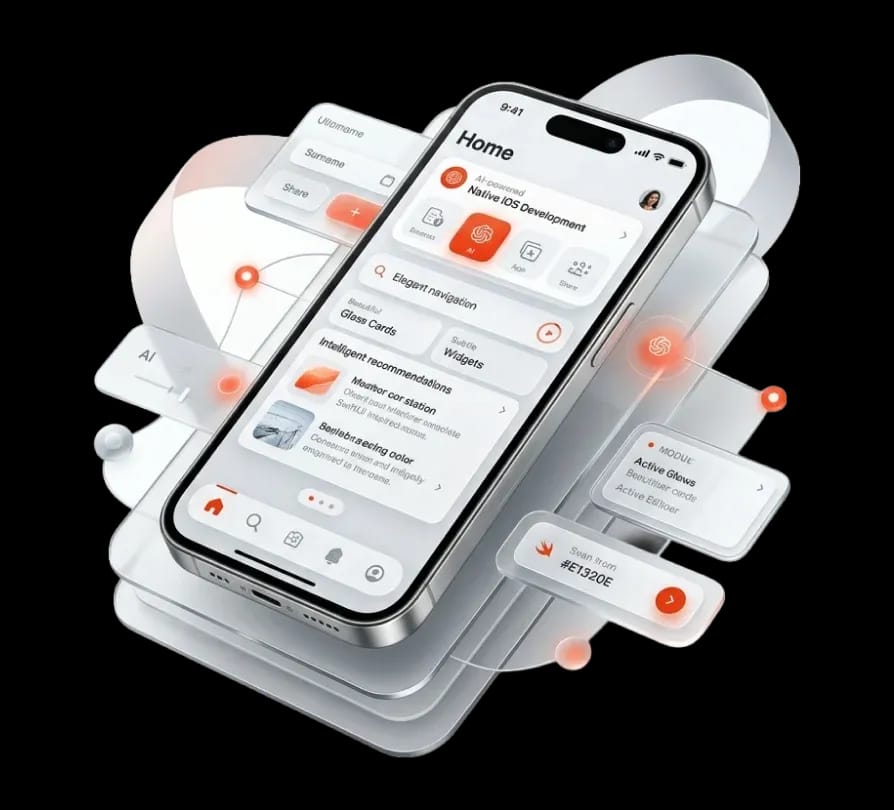
Whether you're shipping your first TestFlight build or modernizing an iOS app running in production for years, our iOS app development services cover every layer of the Apple ecosystem from native Swift engineering to AI integrated iOS app development that makes your product genuinely smarter with every release.
The App Store has a long memory and so do iOS users. We build native iOS applications in Swift 6 and SwiftUI that don't just meet Apple's Human Interface Guidelines, but treat them as the floor, not the ceiling. Every app we ship is architected for performance on the latest iPhones, backwards-compatible where it matters, and engineered to scale well beyond your first release.
The iPad isn't a bigger iPhone and the Apple Watch isn't a smaller one. We design products that genuinely belong on each surface: multi-column iPad layouts, glanceable watchOS complications, Live Activities, widgets, and Continuity flows that move users seamlessly between devices. The Apple ecosystem rewards depth, and we build for it.
If you've inherited an Objective-C codebase or an aging Swift app that's accumulated five years of architectural debt, you have two real choices: refactor or rebuild. We audit honestly, recommend pragmatically, and migrate incrementally so your active roadmap doesn't stall while we modernize the foundation underneath it.
iOS has quietly become the best mobile platform for shipping intelligent products. The Neural Engine, Core ML, on-device LLMs through MLX, and Apple Intelligence integration mean you can build genuinely AI-native experiences that run privately, instantly, and offline. As an AI integrated iOS app development company, we wire intelligence into the architecture, not the launch checklist.
iOS users notice the things other platforms let slide tap targets, easing curves, haptic feedback timing, accessibility behavior, dark mode parity. Our designers ship in Figma and validate in Xcode, working directly with engineers so what gets designed actually gets built without the usual translation loss.
iOS doesn't stand still. New iOS releases ship every September, deprecations land every WWDC, and the App Store review guidelines update without notice. Our maintenance engagements keep your app current with OS updates, framework deprecations, and Apple's evolving privacy rules so you don't wake up to a broken production app the day iOS 19 ships.
Most iOS apps treat AI as a server-side bolt-on. We treat it as a first-class iOS citizen, running on the Neural Engine where it belongs. Every layer below is engineered as a native part of the product, leveraging the parts of iOS that genuinely set it apart.

Learns user behaviour locally and adapts content, layout, and features without sending data to a server.
Highlights:

Learns user behaviour locally and adapts content, layout, and features without sending data to a server.
Highlights:
iOS isn't one kind of app. It's a platform that powers everything from indie consumer hits to mission-critical enterprise tools running on hospital floors and trading desks. Here are the categories of iOS apps we've shipped and the ones we're built to ship next.

We're not just another iOS shop. We're the AI-first iOS engineering partner you bring in when the stakes, the timeline, and the App Store ranking actually matter.
Swift, SwiftUI, Core ML, ARKit, HealthKit our engineers live in the Apple developer ecosystem, not visit it for client projects.
You get iOS engineers who've shipped real apps at scale, navigated App Store rejections, and recovered apps from production incidents not juniors learning Swift on your roadmap.
We architect for what's coming on-device LLMs, Apple Intelligence, visionOS, evolving privacy rules not just what shipped at the last WWDC.
Fast App Store delivery is table stakes. We move quickly because our process is tight, not because we're skipping the test coverage, accessibility, or App Review preparation that matter.
We push back when an iOS approach won't work and bring better Apple-native ideas to the table. You hire a thinking team, not an order-taker.
Clear sprints, honest status, no surprise invoices. You always know what's shipping to TestFlight, what's blocked at App Review, and what it costs.
Most iOS project failures aren't technical; they're process failures that surface at App Review or worse, in App Store reviews from real users. Our iOS app development services follow a structured, AI-assisted delivery methodology designed to surface problems early when they're cheap to fix and maintain engineering quality from first Swift commit to post-launch support.
Here's exactly how it works.
We understand your business goals, your target iPhone and iPad users, and the App Store landscape you're entering to define the right iOS strategy.
We gather, analyze, and prioritize functional and technical requirements with iOS-specific constraints accounted for from day one.
We design intuitive, iOS-native interfaces that respect the Human Interface Guidelines and deliver experiences that feel genuinely at home on iPhone and iPad.
Our agile iOS teams build high-quality, scalable, and maintainable Swift code in iterative sprints, with TestFlight builds shipping continuously.
We ensure reliability, security, and performance through XCTest, XCUITest, and AI-generated test scenarios that catch the bugs App Review will catch first.
We use Xcode Cloud, Fastlane, and CI/CD pipelines for fast, secure, and seamless App Store deployments with code signing handled automatically.
We provide continuous monitoring, OS update management, and feature enhancements to help your iOS app keep pace with Apple's release cycle.
Your iOS project doesn't fit a template, and your engagement shouldn't either. The right way to hire iOS app development company capacity depends on your scope, your roadmap, and your budget reality. Three models, all built for Apple-era delivery speeds.
You're building a complex iOS product over six months or more, your roadmap is still evolving, or you need to scale your in-house iOS team without the cost and lead time of full-time Swift hires.
Hand-picked iOS engineers, a QA specialist, and a technical lead all working only on your product. Sprint planning, standups, and retros run on your calendar, your tooling, your definition of done. AI-assisted Swift engineering is built into how the team ships, not bolted on later.
Monthly retainer. No surprise invoices, no scope-creep billing. Team composition flexes as your iOS roadmap demands.
3-12 iOS engineers
6-month minimum
Scales with 30-day notice

Building AI Integrated iOS Apps for the Businesses That Will Define the Next App Store Decade. The companies that invest in intelligent iOS products now won't need to catch up when Apple Intelligence becomes the table stakes everyone else is scrambling for.

iOS adoption skews toward higher-spend, higher-engagement users across nearly every industry which is exactly why these verticals trust us as their professional iOS app development services partner.

Honest answers to the questions every founder, product owner, and engineering leader asks before they hire an iOS app development company. If something isn't covered here, our solution architects will walk you through it on a discovery call, no sales pitch, no fluff.
Look beyond the portfolio. The right iOS app development company asks more questions than it answers in the first conversation about your business model, your target user, your existing technical debt, and what App Store failure would actually cost you. Evaluate on communication quality, technical depth in Swift and SwiftUI, App Store track record, and whether they push back constructively when they disagree. Anyone who gives you a fixed iOS price before they've understood your requirements isn't the right partner.
End-to-end iOS app development services cover product strategy, iOS-specific UI/UX design aligned with Apple's Human Interface Guidelines, Swift and SwiftUI engineering, Core ML and Apple framework integration, App Store submission and review preparation, QA and security testing, and post-launch support including OS version updates. The best iOS engagements also include discovery and architecture consulting before any Swift code is written because decisions made in week one shape the app for years.
A focused iOS MVP: $25,000-$60,000. A mid-complexity native iOS app with backend integrations: $80,000-$200,000. A full-scale enterprise or AI-integrated iOS platform: $200,000-$500,000+. The number that matters isn't the total, it's the ROI per dollar. We provide detailed estimates after a discovery session, and we won't quote a number before we can stand behind it.
Focused iOS MVP: 8-14 weeks. Mid-complexity iOS app with integrations: 3-5 months. Enterprise or AI-integrated iOS platform: 6-12 months or more. App Store review timelines (typically 24-48 hours, but variable) are factored into the launch plan from day one. We provide milestone-based timelines in writing before development begins.
Three models: Dedicated iOS Team (for long-term, evolving products), Time & Material (for iterative or exploratory iOS builds), and Fixed Cost (for well-scoped, budget-defined iOS projects). When you hire iOS app development company capacity from us, we recommend honestly based on your situation not based on which model is most profitable for us.
AI integrated iOS app development means building intelligence into your iOS product's architecture from the start through Core ML, on-device LLMs via MLX, Vision and Natural Language frameworks, and Apple Intelligence integration not adding chatbots as an afterthought. Whether you need it depends on your category, but iOS is uniquely positioned for on-device AI through the Neural Engine, and most mid-market segments now have AI-native iOS competitors. The companies that aren't exploring it are quietly falling behind.
Native Swift/SwiftUI when you need maximum iOS performance, deep Apple framework integration (HealthKit, ARKit, Core ML), or the kind of polish App Store editorial features. Flutter when you need a single codebase across iOS, Android, and beyond without sacrificing too much native feel. React Native when your team already lives in JavaScript and code-sharing with your web stack matters more than maximum iOS depth. We recommend based on your team, performance needs, and roadmap not based on what we're trying to sell.
All iOS applications are designed for scale from the initial architecture review. Cloud-native backends, microservices where appropriate, database optimization for high-concurrency load, and load testing under realistic peak conditions before App Store submission. Your iOS app should handle 100x your current user base without emergency re-engineering.
Security is designed in, not reviewed at the end. OWASP Mobile Top 10, App Transport Security, certificate pinning, biometric auth via Face ID and Touch ID, secure enclave-backed key storage, mandatory penetration testing before App Store submission, and compliance controls for HIPAA, GDPR, PCI-DSS, and SOC 2 as relevant to your industry. Compliance documentation is produced as a deliverable, not an afterthought.
Yes. We conduct a technical audit first of Swift/Objective-C code quality, architecture decisions, App Store compliance posture, scalability constraints, and accumulated technical debt. We give you an honest picture of what you've inherited and a clear recommendation for what to do about it. Sometimes the answer is refactor. Sometimes it's rebuilt in SwiftUI. Sometimes the existing iOS work is better than it looks.
Yes. App Store submission, review preparation, metadata optimization, screenshot generation, App Privacy details, and rejection response are all included in our iOS app development services. We've shipped enough apps through Apple's review process to know what triggers rejections before they happen and how to respond fast when something does come back.
Didn't Find What You Were Looking For?
Get In Touch With Our ExpertsCurated insights, framework comparisons, and best practices from our iOS engineering team to help you build smarter, faster, and future-ready iOS applications.
We'd love to understand what you want to build. The more context you share, the faster we can give you a useful response not a sales pitch, but a genuine assessment of how we can help and what working together would look like.