Startups
 Fintech
 Healthcare
 Manufacturing
 Marketplaces
 Mortgage
 Real Estate
 Retail
 Sports and Fitness
 Telecom and IT
 Logistic
 SaaS Product


 About Us
 Blog
Blog Careers
 Become A Partner
 Contact



Digital Marketing
End-to-end digital marketing covering SEO, GEO, AEO, content, paid media, social and MarTech engineered as a connected revenue engine that wires cleanly into your CMS.
Learn More about Digital Marketing
 About Us
 Blog
Blog Careers
 Become A Partner
 Contact
Connecting People With Technology
Solvios is the leading IT company in the business to give you growth, revenue, and a global platform.

We’re a production-grade AI performance marketing agency helping startups, scale-ups and enterprises run paid media campaigns that are measured against revenue, not reach. Google Ads, Meta, LinkedIn, TikTok, programmatic, shopping and conversion rate optimization, managed by senior performance marketers who treat your ad budget with the same discipline they’d apply to their own and who report on the metrics your finance team actually cares about.
Years of Experience
Experts in Our Team
Happy Customers Worldwide
Projects Delivered Successfully


4.9/5 ratings

5/5 ratings

Whether you’re launching your first paid search campaign, scaling a Meta funnel that’s hit a performance ceiling, moving into programmatic for the first time or fixing a Google Shopping setup that’s spending confidently on the wrong products, our performance marketing services cover every channel and every stage of the paid media funnel. Strategy through execution through optimization, managed by specialists who’ve run seven-figure ad accounts and know the difference between a campaign that looks good in the dashboard and one that shows up in the revenue report.

Paid search is still where most B2B and high-intent purchase journeys start and where most of the wasted media budget quietly accumulates. We manage Google Ads and Microsoft Bing Ads campaigns with the account architecture discipline that most agencies skip: tightly themed ad groups, match type strategies that balance reach and control, negative keyword programs that actually get maintained, Quality Score optimization that lowers CPCs while improving ad position, smart bidding strategies configured for your actual conversion goals and the landing page alignment that stops sending high-intent clicks to a page that wasn’t built to convert them. Search, Performance Max, Dynamic Search Ads, shopping feed campaigns and YouTube search all managed as part of a unified paid search practice.

Paid social in 2025 means navigating platform algorithm changes faster than most campaign managers can keep up with, building creative that stops a scroll at a speed the old agency model was never designed for and maintaining audience precision on platforms that have deliberately obscured it. We manage paid social across Meta (Facebook and Instagram), LinkedIn, TikTok and Pinterest with creative strategy built into the media buying practice, not separated from it. Audience architecture, creative testing frameworks that produce statistically meaningful results, funnel-stage campaign structures, retargeting audiences built from first-party data and the budget pacing discipline that keeps spend efficient across a full month, not just the first week before the algorithm gets confident.

Programmatic advertising is the channel where the gap between agencies that understand it and agencies that resell DSP access is widest. We run programmatic campaigns through DV360, The Trade Desk, Amazon DSP and platform-native programmatic with the audience architecture, brand safety configuration, frequency management, viewability standards and incrementality measurement that programmatic requires to generate actual business outcomes rather than impressive impression counts. Private marketplace deals for premium inventory, contextual targeting strategies that work without third-party cookies, connected TV and audio programmatic for full-funnel reach and the attribution framework that tells you what your programmatic spend is actually contributing to revenue.

Display and retargeting campaigns that aren’t built around a coherent audience strategy and a creative refresh cadence become wallpaper that burns budget on people who’ve already made their decision. We design and manage performance display and retargeting programs with audience segmentation based on intent signals and funnel position, creative sequencing that moves prospects toward conversion rather than repeating the same banner indefinitely, exclusion lists that remove converted customers and irrelevant audiences, frequency caps that protect brand perception and the landing page continuity that makes retargeting actually convert rather than just remind.

eCommerce paid media is its own discipline. Shopping feed quality determines whether Google surfaces your products to buyers or buries them behind competitors with better titles. ROAS targets have to account for margin by product category, not just blended account averages. Seasonal budget allocation requires a plan three months in advance, not a reactive spend increase the week of the event. We manage eCommerce performance marketing across Google Shopping, Performance Max, Meta Catalog campaigns, Amazon Ads and TikTok Shop with feed optimization baked into the practice, ROAS targets set at the product category level, promotional calendar planning and the inventory-aware campaign management that stops spending confidently on products that are three days from going out of stock.

Media spend without landing page optimization is a leaking bucket. You can improve your ROAS by 30 to 40% with the same ad budget by fixing the conversion experience your campaigns are sending traffic to, and most accounts we audit have never had a structured CRO programme. We run CRO as a data-driven practice: heatmap and session recording analysis, qualitative user research where the volume warrants it, hypothesis-driven A/B and multivariate testing with statistical significance requirements before a winner is declared and the landing page engineering that implements winning variants without a six-week development queue. CRO run alongside paid media, not as a separate engagement that never touches the campaign.

Affiliate and partnership marketing is the performance channel most brands set up and never properly manage. Publisher recruitment without quality standards, commission structures that reward last-click attribution gaming and affiliate content that contradicts the brand positioning your paid media is building. We design and manage affiliate programmes with publisher quality tiers, commission structures matched to your customer acquisition economics, fraud detection, incrementality measurement that separates genuine affiliate-driven sales from last-click attribution that would have happened anyway and the partner relationship management that turns high-performing affiliates into genuine growth partnerships.
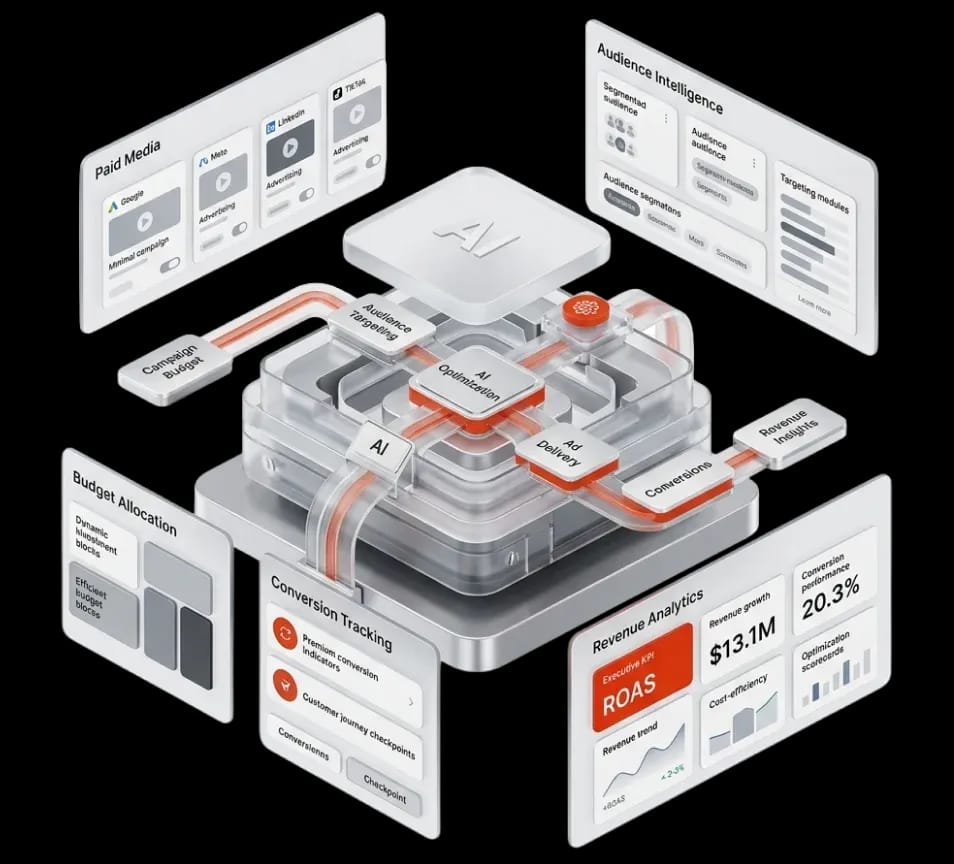
Most performance marketing agencies talk about AI and mean Smart Bidding with Google’s default settings. We mean AI wired into how we research audiences, generate and test creative, predict budget allocation, detect anomalies and attribute revenue, operating as a systematic layer in the campaign management practice, not as a feature we mention in the pitch deck.

First-party data enrichment, lookalike modeling, intent signal clustering and behavioural pattern analysis surface the audience segments and targeting combinations that manual analysis misses, before budget is committed to testing them at scale.
Highlights:
First-party data enrichment, lookalike modeling, intent signal clustering and behavioural pattern analysis surface the audience segments and targeting combinations that manual analysis misses, before budget is committed to testing them at scale.
Highlights:
Performance marketing isn’t one discipline. It spans paid search, paid social, programmatic, display, shopping, CRO, attribution and the data infrastructure that connects campaign spend to revenue outcomes. Here are the capabilities we deliver and the standard we hold ourselves to on each one.

Account Architecture & Campaign Structure
Campaign account structures that scale without becoming unmaintainable and attribution frameworks that survive platform changes. Tightly themed ad groups in paid search, campaign objective alignment across paid social, naming conventions that make cross-account analysis tractable and the account hygiene discipline that means the account a new team member inherits in six months is still comprehensible. Architecture decisions made at setup determine whether a paid media account compounds in value or accumulates complexity that nobody wants to untangle.

Keyword Research & Search Intent Mapping
Keyword strategy built on actual search intent, not keyword volume sorted by descending CPC. We map the full search intent landscape for your category: informational queries that build an audience, consideration queries that warm prospects and transactional queries where purchase intent is explicit. Negative keyword programs maintained on a defined cadence, match type strategies that balance reach and precision and the competitive keyword intelligence that tells you where to fight for position and where conceding is the smarter allocation.

Creative Strategy & Ad Copy Development
Performance creative is where most paid media accounts underinvest and where the biggest performance gains are usually available. We develop ad creative with a systematic testing framework: hypotheses before tests, statistical significance requirements before winners are declared, creative rotation policies that prevent fatigue and the creative brief process that produces variants worth testing rather than minor copy tweaks that produce statistically insignificant results. Copy, visual concepts and video briefs developed by performance marketers who understand the conversion context, not creative teams who hand off to media buyers.

Bid Strategy & Budget Management
Bidding strategies matched to your actual business objectives, not to the platform’s default recommendation that happens to maximize their revenue. Manual CPC where control matters and automated bidding hasn’t earned trust yet, smart bidding configured with the conversion data quality and volume thresholds it requires to work properly, portfolio bid strategies for accounts with correlated campaign performance and the budget pacing discipline that keeps monthly spend within plan without the end-of-month panic spend that inflates CPAs on the last three days.

Audience Segmentation & Targeting
Audience strategy that goes beyond basic demographic targeting and platform interest segments. First-party CRM audiences uploaded and maintained with match rate optimization, customer suppression lists that stop spending to convert existing customers at full acquisition cost, lookalike audiences built on your highest-value customer segments not just any converter, in-market audience layering for search and programmatic and the remarketing architecture that sequences messaging to funnel position rather than serving the same ad to a cold prospect and a near-converter.

Shopping Feed Management & Optimisation
Google Shopping and Meta Catalog performance is primarily determined by feed quality before bidding strategy matters. We manage shopping feeds as a continuous optimization practice: title and description optimization against search query reports, attribute completeness audits, custom label architecture for bid segmentation by margin, seasonality and performance tier, feed error resolution and the supplemental feed strategy that applies optimizations without touching the master product catalog your operations team manages.

Landing Page Optimisation & CRO
Paid traffic sent to an unoptimized landing page is the most common and most expensive performance marketing mistake. We audit landing pages against the traffic being sent to them, identifying the friction points, trust gaps and conversion path breakdowns that traffic quality alone can’t fix. A/B testing programs run with proper statistical methodology, multivariate testing where traffic volume supports it, page speed optimization for Core Web Vitals that directly affect Quality Score and conversion rate and the development-ready test specifications that mean winning variants actually get implemented.

Attribution, Measurement & Reporting
Attribution frameworks that reflect how your customers actually make purchase decisions. GA4 configuration audited for accuracy, conversion tracking validated before campaigns launch not after budgets are spent, data-driven attribution models for accounts with sufficient conversion volume, incrementality testing for channels where last-touch attribution is most misleading and the reporting cadence that surfaces the metrics your leadership team needs to make budget decisions, not the vanity metrics that make the agency look good regardless of business outcomes.

We’re not just another performance marketing agency. We’re the production-grade AI performance marketing partner you bring in when the current agency’s monthly report shows impressive growth and your finance team is asking why it isn’t showing up in revenue.

Every campaign we run is measured against business outcomes, not platform metrics. ROAS calculated on margin, not revenue. CPL measured against qualified pipeline, not raw lead volume. Attribution frameworks that reflect how customers actually buy, not how last-click wants you to believe they do.

You work with channel specialists who’ve managed seven-figure paid media accounts through real performance challenges, platform algorithm changes and economic headwinds. Not account managers whose primary job is to keep the retainer comfortable.

Audience intelligence, predictive budget allocation, creative performance modeling, anomaly detection and multi-touch attribution are operational parts of how we manage campaigns, not AI features we mention in the pitch. The accounts we run are faster to optimize, more resilient to platform changes and more accurate in attribution because the AI layer is genuinely operational.

The separation between creative strategy and media buying is where most performance marketing programmes lose efficiency. Our performance creative team and our media buyers work in the same practice, against the same conversion goals, with creative testing frameworks that feed directly into bidding strategy.

You own the ad accounts, the audience data, the conversion tracking and every insight we generate. We work in your accounts, not ours. If we part ways, you keep everything and the institutional knowledge doesn’t walk out the door with us.

Privacy-first audience strategies that don’t depend on third-party cookies, AI Max and Performance Max architectures that work with the platform’s automation rather than against it, first-party data infrastructure that compounds in value and the measurement frameworks that work as platform attribution becomes less reliable.
Most performance marketing engagements don’t fail because of bad media buying. They fail because the audit never happened, the attribution was wrong from the start or the creative strategy was separated from the bidding strategy by an org chart that nobody questioned. Our production-grade AI performance marketing services follow a structured delivery methodology that catches those failures before they compound into wasted budget.
Here’s exactly how it works.

We audit your existing paid media accounts, attribution setup, landing page performance, conversion tracking accuracy and competitive landscape before recommending a single change. The audit produces an honest picture of what’s actually working, what’s wasting budget and where the highest-leverage opportunities are.

We design the performance marketing strategy: channel mix matched to your funnel and your customer acquisition economics, budget allocation across channels based on predicted marginal return, campaign structure blueprints, audience strategy and the KPI framework that connects paid media activity to business outcomes from day one.

We build or rebuild the account architecture, configure conversion tracking verified against actual purchase and lead events, set up audience lists, establish feed management for shopping campaigns, configure attribution settings and implement the data layer integrations that make measurement reliable before a dollar of budget is committed.

We develop the initial creative suite and establish the testing framework: ad copy variants, visual concepts, video briefs, landing page hypotheses and the A/B testing calendar that produces statistically meaningful results rather than anecdotal optimization decisions.

Campaigns launch with defined performance targets, anomaly detection active from day one, daily budget pacing checks and the optimization cadence that makes data-driven adjustments before a bad week becomes a bad month. Bid strategy, audience, creative and landing page optimizations executed in parallel, not sequentially.

Weekly performance reporting tied to the business metrics that matter, monthly strategy reviews that surface the next highest-leverage opportunities and quarterly channel audits that ensure the account architecture still fits the business as it evolves. Reporting that answers the questions your finance team asks, not just the questions the platform dashboard makes easy to answer.
Your performance marketing engagement doesn’t fit a template, and the contract shouldn’t either. The right model depends on your channel mix, your in-house team’s existing capability and whether you need full-service management, specialist augmentation or a defined project scope. Three models, all built to be measured against revenue outcomes.
You’re running a multi-channel paid media programme across three or more channels, scaling aggressively and need specialist depth across search, social, programmatic and CRO simultaneously, or augmenting an in-house marketing team without the cost and lead time of full-time specialist hires.
Hand-picked paid search specialists, paid social strategists, a creative performance lead, a CRO analyst and an attribution specialist all working on your programme. Weekly reporting, monthly strategy sessions and a commercial model tied to your growth targets.
Monthly retainer. No surprise invoices, no scope-creep billing. Team composition flexes as your channel mix evolves.

3 to 8 specialists

6-month minimum

Scales with 30-day notice

Most companies start with a defined audit and rebuild, then evolve into ongoing management as results justify the investment. Let’s figure out the right starting point together.

Building Performance Marketing Foundations for the Businesses That Will Define the Next Decade. The companies that invest in production-grade AI performance marketing now won’t be the ones explaining to their CFO why the paid media budget grew 40% and revenue grew 12%.


Performance marketing strategy looks different across industries. The buying cycle length, the average order value, the regulatory constraints on ad copy and the attribution complexity all change the approach. These are the verticals where we’ve managed paid media programmes in production and know what real performance looks like.

Honest answers to the questions every CMO, head of growth and founder asks before they hire a performance marketing agency. If something isn’t covered here, our performance marketing team will walk you through it on a discovery call, no pitch, no pressure.
AI is operational in five specific ways in how we manage paid media. First, audience intelligence: first-party data enrichment and intent signal clustering surface audience segments that manual analysis misses. Second, predictive budget allocation: ML models distribute budget toward the campaigns and channels with the highest predicted marginal return, updated continuously. Third, creative performance: AI-assisted copy generation and fatigue detection keep creative fresh at a speed traditional production models can’t match. Fourth, anomaly detection: automated monitoring flags spend, CPC and conversion rate deviations before they compound into a bad month. Fifth, attribution: data-driven attribution models replace last-click defaults with an accurate picture of which channels are genuinely driving revenue. These are running in every account we manage, not reserved for enterprise clients.
Lead quality starts with campaign architecture, not post-campaign filtering. We align keyword selection, audience targeting and ad copy to the intent signals that indicate genuine purchase readiness, not just category interest. We configure conversion tracking against the lead quality signals that matter, qualified meetings booked, trials activated, demos attended, not just form submissions. We build exclusion audiences that remove irrelevant segments before they consume budget. And we report on pipeline quality downstream of the lead, which means we know within four to six weeks whether a campaign change that improved lead volume also improved lead quality, or just made the top-of-funnel metrics look better.
Attribution accuracy starts with conversion tracking validation before any campaign goes live. We audit GA4 configuration, verify that conversion events are firing against actual purchase and lead events rather than proxy metrics and check that cross-device and cross-browser tracking gaps are accounted for. We configure data-driven attribution in Google Ads and Meta for accounts with sufficient conversion volume. For accounts where platform attribution is unreliable, we build multi-touch attribution models using first-party data. And we run incrementality tests on major channels to separate genuine attribution from last-touch credit claiming.
Most accounts show measurable efficiency improvements within four to six weeks of account rebuild and optimization, assuming the conversion tracking is accurate and the conversion volume is sufficient for algorithmic learning. For new channels or new markets with no conversion history, the learning period typically runs six to ten weeks before performance stabilizes. Accounts we inherit from other agencies with poor structure and inaccurate attribution often show significant quick wins within the first two to three weeks from structural fixes alone, before AI optimization layers fully activate.
You own everything. The ad accounts are in your name with your billing. The audience data, the conversion data, the creative assets and every insight and report we produce belong to you. We work in your accounts, not in agency-owned accounts that become a retention mechanism. If you bring the work in-house or move to another agency, you take the full account history, the audience lists and the institutional knowledge we’ve documented. We operate this way deliberately because we think it’s the only honest commercial model for performance marketing.
The minimum effective budget varies by channel and market. For Google Ads, a meaningful paid search test requires at least $3,000 to $5,000 per month in ad spend in most competitive B2B categories, more in high-CPC verticals like fintech and legal. For Meta, $2,000 to $4,000 per month provides enough data for the algorithm to optimize effectively. For programmatic, $5,000 to $10,000 per month is typically the minimum for meaningful reach and frequency. Total programme budgets under $8,000 to $10,000 per month in ad spend are difficult to run profitably across multiple channels simultaneously. We’ll tell you honestly if your budget isn’t sufficient to generate meaningful results on a given channel before we take the engagement.
Three models: Dedicated Performance Marketing Team (for full-service, multi-channel programme management), Time and Material (for defined projects, channel launches and campaign bursts) and Fixed Cost (for scoped deliverables like account audits, account rebuilds and CRO sprints). We recommend the model honestly based on your situation, your budget and your in-house capability, not based on which model generates the most agency revenue.
eCommerce performance marketing requires feed management, margin-aware ROAS targets and seasonal planning to be built into the practice from day one. We manage Google Shopping and Performance Max with feed optimization as a continuous discipline, not a setup-and-forget configuration. ROAS targets are set at the product category level to account for margin differences across the catalog. Promotional calendar planning runs three months ahead so budget is in place before peak periods, not scrambled during them. And we build inventory signals into campaign management so spend adjusts as stock levels change rather than continuing to drive traffic to out-of-stock products.
Yes. B2B performance marketing is a significant part of our practice. The approach differs from B2C in several important ways: longer buying cycles require full-funnel campaign architecture rather than direct-response-only approaches, LinkedIn is often a primary channel rather than a supplementary one, conversion events are qualified meetings and pipeline opportunities rather than purchases, and attribution needs to connect paid media activity to closed revenue over a three to nine month sales cycle. We build performance marketing programmes for B2B SaaS, professional services, logistics, fintech and enterprise software with the attribution frameworks and pipeline reporting that make paid media accountable across the full B2B buying cycle.
Yes, and it’s one of the most common ways we start a new engagement. We conduct a full account audit first: campaign structure, conversion tracking accuracy, attribution configuration, audience quality, creative performance history, landing page conversion rates and the accumulated account decisions that have compounded into the current performance baseline. We give you an honest assessment of what the current agency has built, what’s worth keeping and what needs to change. Transitions are managed carefully to preserve conversion history and audience data while implementing structural improvements.
Didn't Find What You Were Looking For?
Get In Touch With Our Experts



Curated insights, channel guides and best practices on paid search, paid social, programmatic advertising, conversion rate optimization, attribution modeling and AI-driven performance marketing written to help you spend smarter, attribute more accurately and stay ahead of where paid media is headed next.
We'd love to understand what you want to build. The more context you share, the faster we can give you a useful response not a sales pitch, but a genuine assessment of how we can help and what working together would look like.


Solvios is a leading software development company crafting innovative solutions for businesses. We Specialize in custom software, web & mobile app development, and digital marketing. Partner with us to transform your vision into reality and achieve digital success.