Interest-Free EMI for School Fees, Without Handing Institutes a New Admin Headache

The client runs a fintech platform built around one specific job: letting parents pay school fees in interest-free monthly installments instead of one lump sum, while giving schools and institutes a predictable, automated way to collect that money. Before this engagement, most of that process still lived in spreadsheets, phone calls, and manual sign-offs. The client came to Solvios to replace that with a real web application.

Interest-Free EMI for School Fees, Without Handing Institutes a New Admin Headache
Client

A fintech platform offering interest-free EMI payment plans for school fees

Duration

6 months

Industry

Fintech / EdTech Payments

Country

Not confirmed in source material — flagged for client verification

Tech Stack
  • Next.js
  • Laravel
  • REST API
  • MySQL
Services

The Challenge They Brought to the Table

The client is a fintech platform that lets parents split school fees into interest-free monthly installments instead of paying the full amount up front. Before working with Solvios, fee collection ran through manual paperwork, phone-based approvals, and disconnected spreadsheets on both the parent and institute side. Solvios built a custom web application on Next.js and Laravel that handles registration, EMI calculation, eMandate and eSign, and automated payment reminders in one connected flow. The result is a platform institutes and parents can both actually use without a finance team chasing signatures by hand.

Parents faced lump-sum fee demands with no built-in financing option.

Education institutes managed enrollment-linked cash flow manually, with no forecasting tool.

Fee collection and approval processes ran on paper forms and phone calls.

No digital eMandate, eStamp, or eSign flow existed for payment authorization.

Payment reminders and follow-ups depended on manual staff outreach.

The sector had few production-grade digital alternatives for EMI-based fee payment.

The Situation When Solvios Stepped In

When the client approached Solvios, the idea for interest-free EMI fee payments already had validation. What it lacked was a production system that could run it. Parents wanted a way to avoid lump-sum payments and the financial stress that comes with them. Institutes wanted timely, predictable collections without adding headcount to chase overdue fees. Neither side had software built for that specific problem.

No self-serve digital application flow for parents to enroll in a payment plan.

No role-based system separating parent access from institute administrative access.

No automated way to calculate installment amounts against total fees and duration.

No integration with eMandate, eStamp, or eSign providers for authorized digital consent.

No SMS or automated reminder system for upcoming or missed installments.

No dashboard giving institutes visibility into cash flow tied to student enrollments.

key challenges background

The Problem That Needed More Than a Quick Fix

This wasn't a case where a template fintech app or an off-the-shelf loan management tool would fit. School fee financing has its own mechanics: enrollment cycles, institute-specific fee structures, and a compliance layer around digital mandates that most generic payment tools don't handle well. The platform needed to be built around those specifics from the start.

Two Very Different User Groups, One System

Parents needed a simple way to apply for a payment plan and see what they owed each month. Institutes needed administrative control, enrollment tracking, and financial reporting. Building both experiences into one application without either side feeling like an afterthought took deliberate role-based design, not a single generic dashboard.


No Existing Digital Consent Layer

Interest-free EMI plans still need legally valid authorization for auto-debits and repayment schedules. That meant wiring in eMandate, eStamp, and eSign as first-class parts of the application flow, not a bolted-on PDF upload step at the end.


Cash Flow Forecasting for Institutes

Institutes don't just want fees collected. They want to know what's coming in and when, so they can plan around enrollment numbers instead of reacting to whatever lands in the bank account that month. That required tying student enrollment data directly to the payment engine, not treating them as separate systems.


Manual Follow-Ups Don't Scale

With hundreds of families on staggered payment schedules, manual reminders for due dates and missed payments become a full-time job on their own. The platform needed automated, timely notifications built in from day one, not left for a later phase.

How We Approached It?

The first decision was architectural: separate the frontend and backend cleanly so the parent-facing application and the institute-facing administration tools could evolve independently, while sharing the same data layer and payment logic underneath. Everything else followed from that.

Server-Rendered Frontend on Next.js

We built the frontend on Next.js so both parents and institute staff get fast page loads and server-side rendering where it matters, particularly on the application and payment-tracking screens where load time affects whether people actually finish the flow.

Laravel Backend on MVC Architecture

The backend runs on Laravel using a standard MVC structure, which kept the business logic around EMI calculation, role permissions, and institute data isolated and testable instead of scattered across the codebase.

Role-Based Access Control From the Ground Up

Parents and institute administrators log into the same application but see entirely different views and permissions. We built this as a core part of the authentication layer rather than a feature flag added later, since it affects almost every screen in the product.

REST API Layer for Frontend-Backend Communication

A REST API connects the Next.js frontend to the Laravel backend, keeping the two layers decoupled enough that either side can change without forcing a rewrite of the other.

Third-Party Integration for Compliance and Communication

Rather than building digital signature and SMS infrastructure from scratch, we integrated established providers for eMandate, eStamp, and eSign, plus SMS-based reminders, so the platform meets compliance expectations without reinventing infrastructure that already exists.

filter list background

What We Built & Delivered

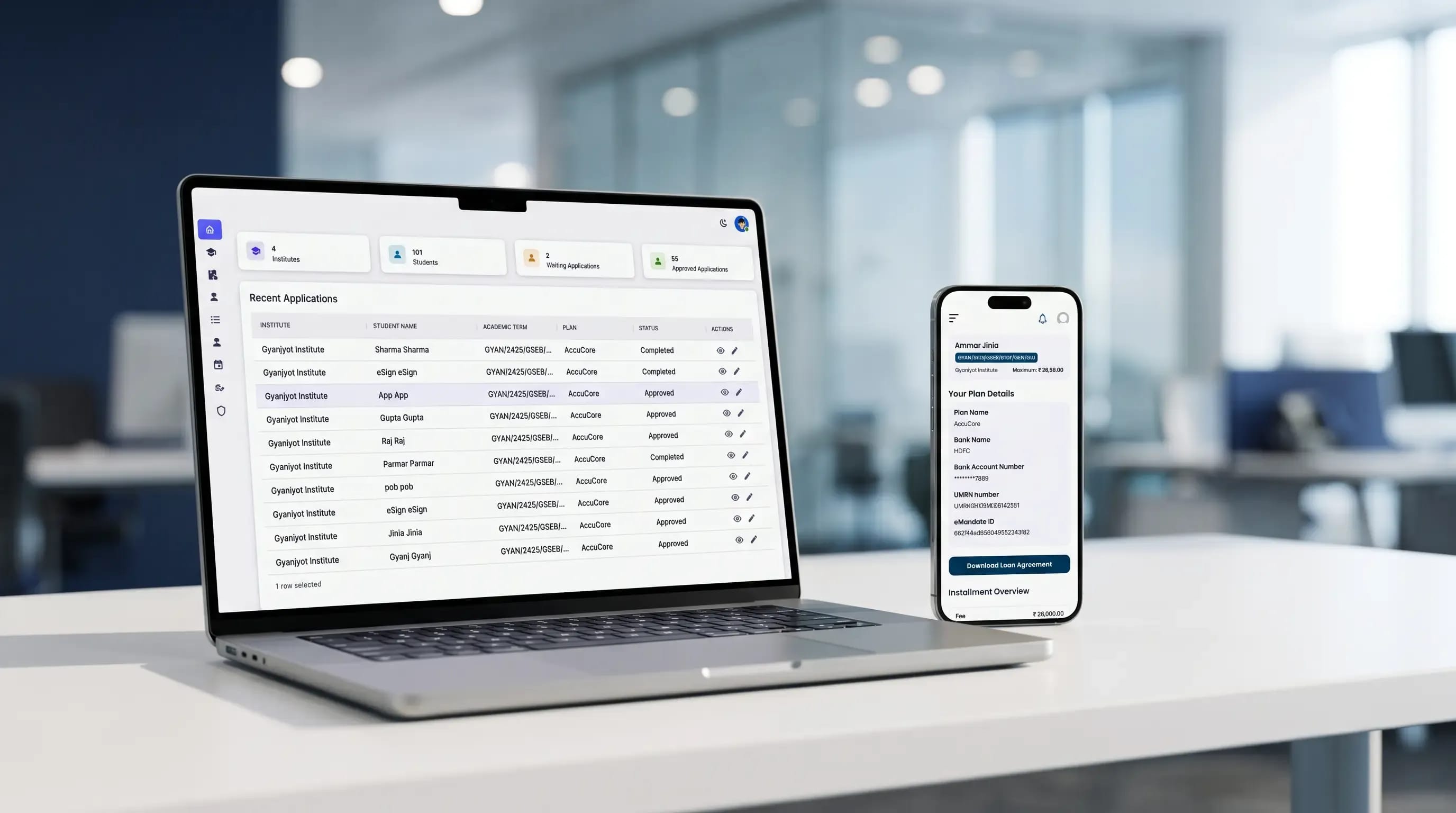
The final application covers the full loop from a parent's first application to an institute's monthly cash flow view, with the compliance and communication layer wired in throughout rather than added at the edges.

User Authentication and Authorization

User Authentication and Authorization

Parents and institute staff register and log in through a role-based access system. Permissions are enforced at the account level, so an institute administrator sees enrollment and payment data across their students, while a parent only sees their own family's account.

Payment Management

Payment Management

The application offers interest-free installment plans as a standard checkout option. Installment amounts are calculated automatically from the total fee and the duration a parent selects, with no manual math on either side.

Application Process

Application Process

Parents submit and track fee-plan applications through a guided online flow instead of paper forms. Institute staff review and process those applications from the same system, cutting out the back-and-forth that paper-based approval used to require.

Cash Flow Management

Cash Flow Management

Institutes get visibility into expected fee collections based on live student enrollment data. The application pulls enrollment and payment status together so finance teams aren't reconciling two separate systems by hand.

Integration With Third-Party APIs

Integration With Third-Party APIs

SignDesk handles eMandate, eStamp, and eSign, integrated through both API calls and an embedded JavaScript widget so digital consent happens inside the application flow instead of redirecting users elsewhere.

Automated Communication and Reminders

Automated Communication and Reminders

MSG91 powers SMS notifications for due dates, confirmations, and missed payments. Reminders go out automatically on schedule, which removes the manual follow-up work institute staff previously handled themselves.

What Changed After We Shipped?

The application replaced a manual, paper-heavy process with a system both parents and institutes could run independently. The changes below reflect what shifted operationally after launch:

Simplified - Application-to-Approval Flow

Simplified - Application-to-Approval Flow

Parents and institute staff now move through registration, plan selection, and digital sign-off in one connected flow instead of scattered paperwork and manual approvals.

Improved - Cash Flow Visibility for Institutes

Improved - Cash Flow Visibility for Institutes

Institutes can compare fee-collection data before and after the platform's rollout, giving finance teams a clearer, enrollment-linked read on incoming payments instead of relying on manual reconciliation.

Reduced - Administrative Load

Reduced - Administrative Load

Automated eMandate, eSign, and SMS reminders cut down the manual follow-up work staff previously handled for every family on a payment plan.

Cross-Device - Access for Parents

Cross-Device - Access for Parents

Application forms and the payment dashboard work consistently across desktop and mobile, so parents aren't tied to one device to manage a payment plan.

Zero-Interest - Payment Plans Live in Production

Zero-Interest - Payment Plans Live in Production

The platform now runs interest-free EMI plans as a standard payment option, with installment amounts calculated automatically based on total fees and chosen duration. None of this required parents or institutes to change how they think about fee payment. It just removed the manual work sitting between the idea of interest-free EMI and actually running it every month.

Building a Fintech or EdTech Payment Platform of Your Own?

If your business needs custom payment logic, digital mandate compliance, or a platform that has to serve two very different user groups at once, this is the kind of build we take on directly. Response within 24 hours. No commitment required.

Start a Conversation
Building a Fintech or EdTech Payment Platform of Your Own?

Solvios Technology brought real engineering depth to the project and understood the fintech and education context we were building for. The team took the time to understand our operational needs, big or small, and that showed in how the platform came together.

Mayank, Founder, a fintech platform for school-fee financing

How the Engagement Ran

The engagement ran six months from discovery to launch, structured in five phases so the team could validate the payment and compliance logic early instead of discovering problems after most of the build was done.

Discovery & Requirement Mapping
01

Discovery & Requirement Mapping

We mapped the full fee-payment lifecycle from both the parent and institute side, including how eMandate and eSign needed to fit into the application flow, before writing any code.

UI/UX Design & Architecture Planning
02

UI/UX Design & Architecture Planning

Design work covered both the parent application flow and the institute admin dashboard in parallel, while the engineering team finalized the Next.js and Laravel architecture and the role-based permission model.

Core Platform Development
03

Core Platform Development

The team built authentication, the EMI calculation engine, the application and approval workflow, and the institute cash flow views as the core of the platform.

Third-Party Integrations
04

Third-Party Integrations

SignDesk's eMandate, eStamp, and eSign APIs and JavaScript widget went in alongside MSG91 for SMS notifications, tested against real sandbox flows before going live.

QA, Deployment & Handover
05

QA, Deployment & Handover

Cross-device testing, payment-flow validation, and security checks preceded deployment, with the DevOps engineer handling release and monitoring setup before handover.

Related Case Studies

filter list background

Frequently Asked Questions

The platform calculates each installment by dividing the total fee amount by the number of months a parent selects, with no interest or hidden charges added to that division. The calculation runs automatically the moment a parent chooses a plan duration during the application process, so both the parent and the institute see the same figure before anything is confirmed. Because the logic lives in the backend rather than a manual spreadsheet, institutes don't need finance staff to recalculate or verify amounts by hand for every family, which is one of the main sources of error in manually run fee-financing programs.

Interest-free EMI plans still involve recurring auto-debits and a binding repayment agreement, which needs legally valid digital consent, not a scanned signature emailed back and forth. eMandate authorizes the recurring debit directly with the bank, and eSign provides a legally recognized digital signature on the agreement itself. Building these into the application flow, rather than treating them as a separate manual step, means parents complete the entire process online in one sitting, and institutes get compliant, auditable records without maintaining physical paperwork.

The system connects student enrollment data directly to the payment engine, so institutes can see expected incoming fee payments tied to actual enrollment numbers rather than guessing based on last year's collections. Finance teams can compare cash flow data from before and after adopting the platform to understand how staggered EMI payments affect monthly liquidity compared to lump-sum collection. This visibility helps institutes plan operating expenses around a predictable payment calendar instead of reacting to whichever fees happen to come in during a given month.

Generic payment or loan management tools aren't built around school-specific fee structures, enrollment cycles, or the combination of eMandate, eStamp, and eSign compliance that education-focused fee financing requires. A custom build lets the payment logic, role-based access for parents versus institute staff, and third-party compliance integrations work together as one system instead of stitching together multiple disconnected tools. It also means the platform can evolve alongside the business model, which is difficult with off-the-shelf software built for a different use case entirely.

This particular platform took six months from discovery through deployment, covering UI/UX design, a Next.js and Laravel build, and integrations with eMandate, eSign, and SMS providers. Timelines for comparable fintech applications typically depend on how many third-party integrations are involved, how complex the role-based permission structure needs to be, and how much compliance validation the payment and consent flows require. Projects with fewer integrations or a single user type can move faster, while multi-sided platforms with financial compliance requirements generally need the fuller runway.

Didn't Find What You Were Looking For?

Get In Touch With Our Experts

Need Project Consultation? Let’s Talk

We'd love to understand what you want to build. The more context you share, the faster we can give you a useful response not a sales pitch, but a genuine assessment of how we can help and what working together would look like.