Startups
 Fintech
 Healthcare
 Manufacturing
 Marketplaces
 Mortgage
 Real Estate
 Retail
 Sports and Fitness
 Telecom and IT
 Logistic
 SaaS Product


 About Us
 Blog
Blog Careers
 Become A Partner
 Contact



API Integration Services
AI-first API integration across payment gateways, CRMs, ERPs, AI APIs and third-party platforms engineered for reliability, security and the AI workloads ahead.
Learn More about API Integration Services
 About Us
 Blog
Blog Careers
 Become A Partner
 Contact
Connecting People With Technology
Solvios is the leading IT company in the business to give you growth, revenue, and a global platform.
The client is a residential real estate brokerage that needed a public-facing website built to generate leads, not just list properties. Their agents were losing prospects to slower, harder-to-search listing pages, and the brokerage had no reliable way to connect its site to live MLS inventory without the two systems drifting out of sync.
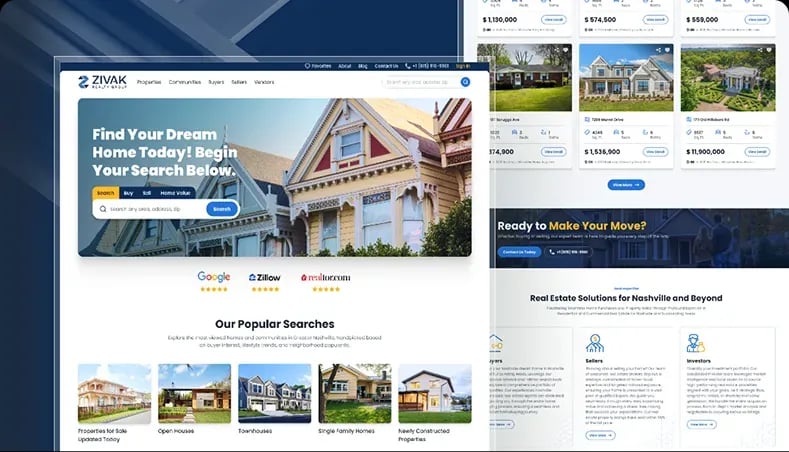
A residential real estate brokerage
Ongoing engagement
Real Estate
Not specified in source material — confirm before publishing
The client, a residential real estate brokerage, needed a lead-generation website built on a live MLS feed that refreshed every five minutes. Solvios designed and built a WordPress platform with a custom MLS API integration, optimized filter queries and a property-details layout built to convert browsers into contactable leads. The result was a fast, SEO-friendly site that stays in sync with MLS inventory without slowing down for visitors.
A brokerage website with no dependable connection to live MLS listing data
A five-minute MLS refresh cycle that had to be mirrored without degrading page speed
Search and filter tools not built to handle the scale of a full MLS database
Property pages that buried the details buyers actually needed to act quickly
No structured system for converting site visitors into contactable leads
A site architecture that had to stay fast while doing constant background data work
The client came to Solvios needing an online presence built specifically around lead generation, not a brochure site with a listings page bolted on. They wanted visitors browsing homes to buy or sell in the area to convert into contactable leads the agents could actually follow up on. That meant the website had to be fast, searchable at MLS scale and structured around what a buyer actually needs to decide.
No existing website architecture built around lead capture as the primary goal
No MLS API integration in place to pull live listing data
No filtering system capable of handling neighborhood, county, zip code and property-type queries at scale
No property-details layout designed to surface decision-relevant information upfront
No process for keeping listing data synchronized without impacting page speed
No SEO-focused technical foundation to support organic visibility for property searches

This wasn't a template website with a widget dropped in. The MLS feed the client depended on updated every five minutes, and every one of those updates had to reach the site without slowing it down. That constraint touched design, data architecture and the API layer all at once, which is why it needed a structural solution instead of a plugin.
High-Frequency Data Without a Performance Trade-Off
MLS data changes every five minutes. Pulling, storing and displaying that volume of updates in near real time while keeping page load times fast is a genuinely hard constraint, not a nice-to-have.
Search That Has to Work at MLS Scale
Buyers filter by neighborhood, county, zip code and property type, often in combination. Running those queries against a large, constantly-updating MLS dataset without slow response times required deliberate query optimization, not default database calls.
A Full API Lifecycle, Not Just a Data Pull
The integration needed to fetch, store, update and delete records as the MLS feed changed, keeping the local dataset accurate instead of just appending new listings on top of stale ones.
Design and Development Had to Move in Lockstep
The wireframes, the high-fidelity design and the API integration all depended on each other. A design decision made without understanding the data model would have meant rework later in the build.
The first decision was sequencing: get the data architecture right before committing to final design, so the interface was built around what the API could actually deliver, not the other way around.
We started with a low-fidelity wireframe to lock the page structure and information hierarchy before investing in visual design, so early feedback stayed cheap to act on.
Once the wireframe was approved, we moved to high-fidelity design informed by what the MLS API could actually return, so the interface didn't promise a layout the data couldn't support.
Our development team built the integration to fetch, store, update and delete listing records as the MLS feed changed, keeping the local database an accurate mirror of the source instead of a one-time import.
We built filtering around how people actually search for homes: by neighborhood, county, zip code and property type, tuning queries so results came back fast even against a large dataset.
We put the most relevant property information upfront on the details page, so buyers spend less time hunting for basics and more time deciding whether a property is worth a call.

The final platform is a WordPress website with a custom MLS integration underneath it, built to stay fast while handling a constantly-refreshing property dataset.

A site structure designed around how buyers and sellers actually browse listings, so visitors reach the outcome they came for without extra clicks.

Search and filter logic tuned to return results from a large MLS database in seconds, across neighborhood, county, zip code and property-type combinations.

A site architecture that stays fast for organic search while running near-real-time synchronization against the MLS grid API in the background.

An integration layer that fetches, stores, updates and deletes listing records as the source feed changes, instead of relying on periodic full re-imports.

Property pages that surface the details buyers weigh first, reducing the research effort needed before a visitor decides to reach out.

A WordPress build structured for organic search performance, so page speed and data freshness both work in the site's favor rather than against it.
The brokerage went from a website with no reliable connection to live inventory to a platform that mirrors the MLS feed on its own refresh cycle, without dragging down page speed.

5-Minute Sync Cadence - Listings Stay Current With the MLS Feed
The site reflects MLS updates on the same five-minute cycle the feed itself publishes on, so listings shown to visitors match what's actually on the market.

Faster - Filtered Search Results
Optimized queries return filtered results from a large MLS dataset in seconds instead of leaving visitors waiting on broad, unoptimized searches.

Improved - Organic Search Readiness
A high-speed, SEO-structured build gives the brokerage's listings a stronger technical foundation to rank for local property searches.

Reduced - Decision Friction on Property Pages
Surfacing key property details upfront cuts down the digging visitors previously had to do before deciding whether to reach out.

Sustained - Client Relationship Post-Launch
The engagement continues on an ongoing basis, with Solvios remaining the team responsible for the platform after launch. None of this was about adding features for their own sake. Every piece — the sync engine, the filters, the property page layout — was built to solve the original problem: a brokerage that needed visitors to convert into leads, on a data feed that never stops moving.
“Communication with the team is top notch. They are always available to answer emails or hop on a quick call. The most impressive or unique thing about this company is communication and their sense of understanding the scope of the project.”
— Bo, Founder, a residential real estate brokerage
If your platform depends on a constantly-updating data source, whether that's MLS listings, inventory or pricing, the same problem applies: staying current without slowing down. That's the kind of integration work we build for.
Response within 24 hours. No commitment required.

The build moved from wireframe to production in stages, with the API integration and the design work checked against each other at every step instead of running in isolation.

We mapped the client's lead-generation goals, the MLS data source and the filtering behavior the site needed to support before any screens were drawn.

We built a low-fidelity wireframe to validate page structure and information hierarchy with the client before committing to visual design.

Once the wireframe was signed off, we converted it into a high-fidelity design that gave the client an accurate view of the finished site.

Our WordPress and integration team built the fetch, store, update and delete logic against the MLS feed alongside the front-end build.

The site launched with the sync engine live, and the engagement continues on an ongoing basis as the client's needs evolve.
We built a dedicated integration layer that fetches, stores, updates and deletes listing records on the same cadence the MLS feed publishes on, rather than relying on periodic full re-imports. Only the records that actually changed get processed, which keeps the sync fast. The website reads from a locally optimized dataset instead of querying the MLS API directly on every page load, so visitors get current listings without the site waiting on an external feed to respond. This approach keeps data freshness and page speed from working against each other.
Yes, but it depends on how the integration is built, not on WordPress alone. We optimized the underlying queries specifically for the filter combinations buyers actually use, neighborhood, county, zip code and property type, instead of relying on default database calls against the full dataset. Combined with a sync process that updates only changed records, the site stays fast even as the MLS database grows. The platform choice matters less than the engineering underneath the search and sync layers.
Start with how often the MLS feed actually updates and confirm the API's rate limits and data structure before any design work begins. Decide upfront which fields buyers need to see first on a listing page, since that shapes the whole layout. Also plan for the full data lifecycle, not just adding new listings, because sold or withdrawn properties need to be removed just as reliably as new ones are added. Skipping this discovery step is where most MLS integration projects run into rework later.
Timelines vary with the complexity of the filtering and the MLS provider's API, but a project like this typically moves through wireframing, high-fidelity design, API integration and testing as sequential, overlapping phases rather than one long build. Getting the wireframe approved early keeps the design and development phases moving in parallel instead of blocking on each other. We provide a phase-based timeline during discovery once the MLS provider and required filters are confirmed.
Off-the-shelf MLS plugins are usually built for generic use cases and don't give enough control over sync frequency, query performance or how data changes are handled. Because this MLS feed refreshed every five minutes and the client's top priority was speed, we needed a custom integration where the fetch, store, update and delete logic could be tuned specifically for that cadence and for the filtering the client's buyers actually used. A generic plugin would have meant compromising on one or the other.
Didn't Find What You Were Looking For?
Get In Touch With Our Experts


We'd love to understand what you want to build. The more context you share, the faster we can give you a useful response not a sales pitch, but a genuine assessment of how we can help and what working together would look like.








Solvios is a leading software development company crafting innovative solutions for businesses. We Specialize in custom software, web & mobile app development, and digital marketing. Partner with us to transform your vision into reality and achieve digital success.