How We Gave a New Private Jet Charter Brand the Digital Presence Its Clients Expected?

The client launched with world-class aviation experience and 15,000 aircraft in its network. What it didn't have was a website worthy of either. We built one from scratch fast enough to pass Core Web Vitals, refined enough to speak to luxury buyers, and structured to turn quote requests into business.

How We Gave a New Private Jet Charter Brand the Digital Presence Its Clients Expected?
Client

Private Jet Charter Brand

Duration

6 Months

Industry

Private Aviation / Luxury Air Charter

Country

United States

Tech Stack

The Challenge They Brought to the Table

The client came to us with a clear brief to build a website from scratch that could compete in the private aviation space on day one. No existing codebase, no design system, no brand assets. Just a business with strong operational credentials and a digital presence that didn't exist yet.

No frontend architecture, CMS, or hosting infrastructure in place

Required SSR-capable frontend to handle heavy visual assets without sacrificing load performance

Needed a content management system the client team could operate without developer involvement

Quote request flow had to be engineered for high-intent mobile users minimal fields, backend notification on submission

Technical SEO had to be built into the architecture from day one not retrofitted after launch

Platform needed to support fleet expansion, content scaling, and future third-party integrations without a rebuild

The Approach We Recommended

The client had the operational foundation ready experienced team, global aircraft network, and a clear service offering. What was missing was the digital infrastructure to support it. When they came to us, there was nothing to work with technically. We were starting from zero.

No existing website, codebase, or hosting environment in place

No brand identity, design system, or UI components to build from

No CMS or content architecture fleet listings, service pages, and safety content had no home

No SEO foundation zero organic visibility in a market where search intent drives qualified leads

No lead generation mechanism the primary revenue driver, the quote request flow, didn't exist yet

Competing against established private aviation brands with polished digital experiences and years of search authority

key challenges background

The Problem That Needed More Than a Quick Fix

Private aviation is a category where brand credibility does a lot of the selling. Buyers chartering a jet aren't clicking around comparing prices; they're evaluating trust, sophistication, and the confidence that every detail will be handled. For a new brand, that's a steep bar to clear with a website.

AI-First Engineering DNA

AI-First Engineering DNA

We don't treat AI as an add-on. Every product we ship is architected for intelligence from the first commit.


Balancing Luxury Design with Technical Performance

High-end aviation websites run on cinematic imagery, full-bleed video, and smooth animations. That aesthetic tends to come at the cost of load speed which is exactly what Google Core Web Vitals penalises, and what impatient buyers on mobile abandon. Getting both right required careful architecture decisions from the first line of code, not as an afterthought during QA.

Turning Visitors Into Quote Requests

The primary commercial goal was lead generation through the 'Request a Quote' flow. But charter clients don't fill out seven-field forms. The UX had to make that conversion feel effortless, short enough that a CEO on a phone can submit it in 60 seconds, persuasive enough that first-time visitors trusted the brand enough to bother.

Building for Scale, Not Just Launch

The client had a clear vision for where the brand was going: more content, more fleet listings, potential integrations, expanded marketing. The platform needed to support that growth without requiring a rebuild in 18 months. Content had to be manageable without developer dependency. The architecture had to accommodate what came next, not just what was needed now.

AI-First Engineering DNA

AI-First Engineering DNA

We don't treat AI as an add-on. Every product we ship is architected for intelligence from the first commit.


Balancing Luxury Design with Technical Performance

High-end aviation websites run on cinematic imagery, full-bleed video, and smooth animations. That aesthetic tends to come at the cost of load speed which is exactly what Google Core Web Vitals penalises, and what impatient buyers on mobile abandon. Getting both right required careful architecture decisions from the first line of code, not as an afterthought during QA.

Turning Visitors Into Quote Requests

The primary commercial goal was lead generation through the 'Request a Quote' flow. But charter clients don't fill out seven-field forms. The UX had to make that conversion feel effortless, short enough that a CEO on a phone can submit it in 60 seconds, persuasive enough that first-time visitors trusted the brand enough to bother.

Building for Scale, Not Just Launch

The client had a clear vision for where the brand was going: more content, more fleet listings, potential integrations, expanded marketing. The platform needed to support that growth without requiring a rebuild in 18 months. Content had to be manageable without developer dependency. The architecture had to accommodate what came next, not just what was needed now.

How We Approached It?

We started with the constraint that mattered most: the audience. Private jet charter clients are used to a level of service where nothing feels effortful. That standard had to translate to the digital experience not just in how the site looked, but in how fast it responded, how naturally it guided users, and how confidently it communicated the brand. Every technical and design decision ran through that filter.

Next.js for Performance Without Sacrifice

We chose Next.js for the frontend because it was the right tool for this specific tension: heavy visual content and fast load times in the same product. Server-side rendering (SSR) handles the initial page load so users see content immediately rather than waiting for JavaScript to hydrate. Cinematic aircraft imagery, smooth scroll behaviour, and subtle micro-interactions load without the performance penalty you'd typically accept for that level of visual fidelity. The architecture also gave us clean URL structures and robust metadata management both essential for the SEO foundation the client needed from day one.

UI/UX Designed Around the Luxury Buyer

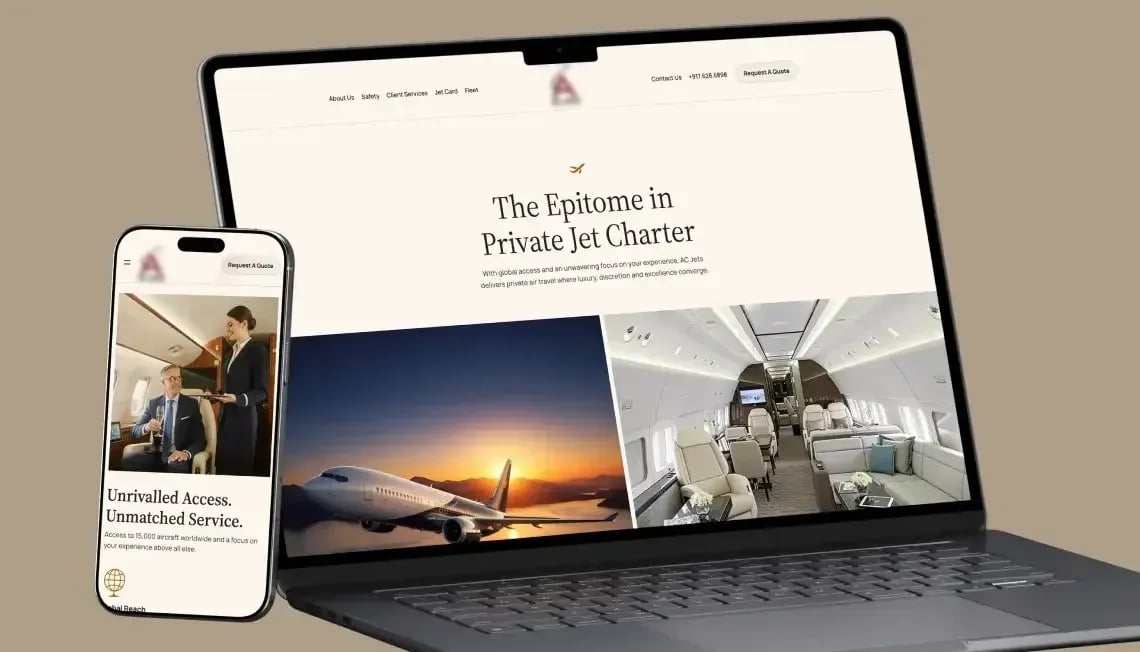
The design brief wasn't 'make it look premium.' It was 'make it feel like the service it represents.' We worked with reference points from high-end travel and aviation brands, the kind of visual restraint that communicates confidence rather than effort. White space did the heavy lifting. Typography was chosen for clarity and character. Imagery ran full-bleed where it earned its place, cropped tightly where the layout called for precision. The hero banner uses a single cinematic aircraft shot with minimal copy overlay because when the product is that clear, decoration gets in the way. Micro-interactions on scroll and hover add a layer of refinement without making the page feel like a demo. And the 'Request a Quote' form was deliberately simplified to a two-step flow: enough friction to qualify intent, not enough to lose the lead.

Strapi Headless CMS for Content Flexibility

Fleet listings, service descriptions, safety information, the Jet Card page this is the kind of content that changes as the business grows. We implemented Strapi as the headless CMS so the client's team could manage and update it without opening a code editor. Content types were structured around the actual taxonomy of the business: aircraft categories, service tiers, route information. The API-first architecture of Strapi also means the same content layer can feed a mobile app, a booking integration, or a client portal down the line without a rebuild.

SEO Architecture Built Into the Build, Not Bolted On

SEO for a luxury aviation brand isn't just about keywords. It's about technical hygiene, clean URL structures, proper schema markup for aviation services, metadata that actually describes what's on each page, and a site architecture that Google can crawl logically. We built all of it in from the start: semantic HTML, structured data for the quote request flow, page-level meta optimised for aviation search intent, and a sitemap structured to surface the pages that drive commercial intent. Core Web Vitals were tracked throughout development, not tested at the end.

AWS Hosting Configured for Reliability

For a brand where a single dropped lead is a significant revenue miss, reliability isn't negotiable. We configured AWS hosting with appropriate redundancy for the traffic profile of a site that gets periodic high-intent bursts from marketing activity rather than sustained volume. CloudFront CDN ensures assets load fast regardless of where the client is in the world, which matters for a global charter audience.

filter list background

What We Built

Six features built to work as a system not a checklist. Each one addresses a specific part of the problem: getting users to the site, making them trust the brand, converting them to leads, and giving the client team the tools to keep it all running without developer dependency.
That's what was just added in the fix. Is that not working for you, or are you looking for alternate wording options to choose from?

SSR-Optimised Homepage with Cinematic Hero

SSR-Optimised Homepage with Cinematic Hero

Full-bleed aircraft imagery, brand positioning headline, and a clean quote request entry point all rendering above the fold via server-side rendering so there's no flash of unstyled content and no LCP failure. First impression lands in under two seconds.

Fleet Pages with Structured Content Architecture

Fleet Pages with Structured Content Architecture

Category-based fleet browsing from Turbo Props to Ultra-Long-Range Jets, each page built with consistent content templates managed through Strapi. Structured data markup on each aircraft category feeds search engines the context they need to surface these pages for relevant queries.

Two-Step Quote Request Flow

Two-Step Quote Request Flow

The commercial engine of the site. Stripped back to the information the client actually needs to respond to a charter enquiry: trip type, route, date, passengers. Designed to work one-handed on mobile. Submission triggers a backend notification through Node.js. No unnecessary fields, no dead ends.

Mobile-First Responsive Design

Mobile-First Responsive Design

High-net-worth travelers charter jets from phones. The entire experience was designed mobile-first and tested across the device range likely used by the target audience premium handsets on both iOS and Android. Touch targets, typography scale, and image loading all tuned specifically for mobile.

Headless CMS Content Management

Headless CMS Content Management

Fleet listings, service pages, safety content, and the Jet Card page are all managed through Strapi's admin interface without developer involvement. The client team can publish new aircraft categories, update service descriptions, and expand into new content areas independently.

Technical SEO Foundation

Technical SEO Foundation

Semantic HTML structure throughout. Schema markup for the business type, service offerings, and quote request action. Page-level metadata structured for aviation search intent. XML sitemap and robots.txt configured correctly. Core Web Vitals benchmarks hit on both mobile and desktop.

What Changed After We Shipped?

The client went live as a brand that looked like it had been in the market for years. The operational credibility the founder brought to the business finally had a digital experience to match it. Here's what the platform delivered:

Passed - Google Core Web Vitals

Passed - Google Core Web Vitals

Clean LCP, FID, and CLS scores on mobile and desktop are a technical baseline that most luxury brand sites fail on the first audit.

Increased - Quote Request Conversion Rate

Increased - Quote Request Conversion Rate

The two-step form replaced a friction-heavy multi-field version. Inquiry volume went up after launch as the simplified flow removed the friction points that were costing qualified leads.

Significantly Faster - Page Load Performance

Significantly Faster - Page Load Performance

SSR via Next.js cuts perceived load time against the pre-launch concept. Assets served via AWS CloudFront CDN regardless of user location.

Competitive Day One - Brand Positioning in Private Aviation

Competitive Day One - Brand Positioning in Private Aviation

The new venture entered a market with established players and immediately presented a digital experience on par with brands that have been operating for a decade.

Scalable - Content & Platform Architecture

Scalable - Content & Platform Architecture

Fleet pages, service content, and future integrations all manageable without developer dependency via Strapi CMS. Platform ready for booking integrations, marketing expansion, and client portal features. The work that mattered most wasn't any single feature. It was building a platform where the design, the performance, and the conversion flow operated as a single coherent system because that's what a luxury brand audience expects, and because anything short of that was going to cost the client business before it had the chance to earn it.

Building Something in the Luxury or Aviation Space?

We work with founders and brand teams who have something worth showing and need a digital experience that makes that clear from the first visit. Whether you're launching a new brand, rebuilding a site that isn't doing the work it should, or architecting a platform that has to scale, we'd like to hear about it. Response within 24 hours. No commitment required.

Start a Conversation
Building Something in the Luxury or Aviation Space?

I want to express how truly impressed and pleased I am with Solvios Technology and the entire team. Everyone has done a remarkable job from the very beginning of this journey to where we are today. The level of support, professionalism, and dedication throughout the process has been greatly appreciated. Thank you for the continued commitment and excellent work.

Adam, CEO, Private Jet Charter Brand

How the Engagement Ran

From the first brief to go-live, the project moved through five phases. Each one had a defined output before the next started because building a luxury brand experience requires sign-off at every stage, not surprises at the end.

Discovery & Brand Brief
01

Discovery & Brand Brief

Detailed brief sessions covering brand vision, target audience, competitor landscape, and conversion goals. Mood board development and visual direction alignment before any design work began.

UI/UX Design & Prototyping
02

UI/UX Design & Prototyping

Wireframes, high-fidelity mockups, and an interactive prototype across key pages: Homepage, Fleet, About, Safety, Jet Card, Contact. Design system established including typography, colour palette, spacing, and component library.

Development
03

Development

Frontend development in Next.js and React. Backend and CMS configuration in Node.js and Strapi. AWS infrastructure setup. Core Web Vitals performance testing built into each development sprint.

QA, SEO & Performance Optimisation
04

QA, SEO & Performance Optimisation

Cross-device and cross-browser QA. Core Web Vitals audit and fixes. Schema markup implementation. Metadata review and optimisation across all pages. Load testing on AWS infrastructure.

Launch & Handover
05

Launch & Handover

DNS migration, final pre-launch checks, CMS training for the client team, and post-launch monitoring. Documentation provided for content management and future development.

Related Case Studies

filter list background

Frequently Asked Questions

Common questions about this project.

For a project of this scope full UI/UX design, custom frontend development, headless CMS integration, and SEO architecture a realistic timeline is 10 to 14 weeks from brief to launch. That includes two to three weeks of discovery and design sign-off, six to eight weeks of development, and a final two-week QA and performance optimisation phase. Compressed timelines are possible but tend to require phased delivery rather than a full-feature launch.

A headless CMS like Strapi separates content management from how that content is displayed. Your team manages content in one place: text, images, aircraft listings, service descriptions and the frontend (the website) pulls it through an API. This means the content layer can feed the website, a future mobile app, a booking integration, or a partner platform without rebuilding anything. It's architecturally cleaner and considerably more flexible than traditional CMS platforms where the content and display are tied together.

The short answer is: you have to design for performance, not just design and then optimise. For this project, server-side rendering with Next.js meant the initial HTML reached the browser fully formed rather than waiting for JavaScript. Images were served in next-gen formats, lazy-loaded below the fold, and sized appropriately for each viewport. CDN delivery through AWS CloudFront handled geographic latency. And we ran Lighthouse and Web Vitals audits continuously during development so we weren't discovering issues at the end of the build.

For every website we build, technical SEO is part of the build, not a separate service you add on. That covers semantic HTML structure, metadata, schema markup, sitemap configuration, URL architecture, and Core Web Vitals performance. On-page content SEO (keyword strategy, content writing, ongoing optimisation) is typically a separate ongoing engagement, but the technical foundation is always included. A site that doesn't have the technical SEO right from launch loses ranking ground that takes months to recover.

Custom website projects of this scope design, development, CMS, hosting setup, and SEO architecture typically start in the $15,000-$40,000 range depending on feature complexity, number of page templates, and integrations required. The most accurate way to get a number is to share your specific requirements. We scope every project individually and provide a fixed-price proposal once we understand what you need.

Didn't Find What You Were Looking For?

Get In Touch With Our Experts

Need Project Consultation? Let’s Talk

We'd love to understand what you want to build. The more context you share, the faster we can give you a useful response not a sales pitch, but a genuine assessment of how we can help and what working together would look like.