The software development process varies based on priorities and specific goals behind the project. Naturally, there cannot be a one-size-fits-all process for every software. When you develop a new application from scratch, it must be fundamentally different from a project that aims to improve an existing system. This refers to the core differences between a greenfield project and a brownfield project. While the first starts with an empty canvas, the other comes with several constituents in place, like the existing code, already agreed decisions on the architecture, integrations, technical debt, business rules, and existing users who have been using the system for some time.
While regular Artificial Intelligence services focus on leveraging AI for automating development and testing tasks, AI-DLC brings us a foolproof AI-assisted and human-guided development model. The difference between greenfield and brownfield development gets an altogether new perspective when artificial intelligence becomes a contributor. AI-DLC, or AI-Driven Development Life Cycle, is conceived and structured to address this new reality. Without following the same sequence of development steps for every software project, AI-DLC focuses more on enhancing the existing state of the software, involving as little friction as possible. Here, the workflows adapt to the existing state of the project, its unique complexity, and business goals.
Here in this short guide, we are going to explore the ways AI-DLC takes on greenfield and brownfield development, how the workflows in respective cases differ, and what really happens at different stages. We would also dig into the risks and how AI-DLC helps organizations to strengthen their quality focus and control despite using this new methodology.
What Is AI-DLC?
AI-DLC, or the AI-Driven Development Life Cycle, is an AI-native development model from AWS that ensures participation of AI at every stage of software development rather than being constrained to only specific tasks like code writing or testing. AI-DLC also promises human guidance and decision-making power at mission-critical checkpoints. Unlike AI Integration services that help automate coding or testing tasks through plugins, AI-DLC offers a methodology of multilayered validation involving both independent reviewer agents and human-controlled checkpoints.
The AI-DLC methodology organizes a software development project into three major phases, as follows:
- Inception
At the Inception phase, the development team decides the objective behind the project and what needs to be built to fulfill this objective. Here, AI further translates this business intent behind the proposed product into specific requirements, user personas, user stories, and possible architecture choices. Based on these constituents, it also organizes the entire workflows into implementation units.
- Construction
At the Construction phase, the requirements and decisions about the solution architecture that are already approved are now executed incrementally. In this phase, the actual working software starts taking shape through planned implementation and testing.
- Operations
The Operations phase focuses on deploying the developed and tested software, monitoring its performance against the validated benchmarks, maintaining the product against glitches, and optimizing it with new features, security enhancements, and performance boosts,
AI-DLC does not just offer a blanket automation for all these development stages, regardless of the project. It does not just provide agentic platforms like Salesforce Einstein AI and Agentforce. Rather, it brings an end-to-end methodology involving both AI agents and human stakeholders to ensure that the workflow adapts to the project goals and requirements.
This adaptive workflow model balances mandatory and conditional stages. It guarantees a rigorous process aimed at optimum output by adjusting workflows as per the demands of the project complexity. Long story short, a specific stage can be mandatory when the project complexity demands it, or it can be considered optional when the project can go without it.
This adaptability and project-specific conditional implementation make the methodology so versatile for both new app development projects and improving legacy systems
Greenfield vs Brownfield Development
Before digging deeper into the role of AI-DLC in Greenfield and Brownfield projects, we need to explain these two development environments first.
What Is a Greenfield Project?
A greenfield project comes with an empty canvas, which means developers need to plan, validate, build, test, and deploy the app from scratch. The team does not have a codebase, technical components, or any existing solution that they can work on.
The possible things that the development team may already have in a greenfield project can be a business problem, specific product requirements, user expectations, technical constraints, regulatory and compliance requirements, and a desired architecture. Naturally, in greenfield projects, many decisions are made for the first time, and the development teams enjoy considerably greater freedom or decision-making power.
What Is a Brownfield Project?
A brownfield project refers to the optimization, modernization, or improvement of an existing software system. Here, the development teams need to work with the existing codebase, user interface, system architecture, integrations, databases, access control, and security mechanisms, and several decision layers that are already part and parcel of the existing system.
The possible things that the developers in a brownfield project already have may include legacy or existing codebase, existing databases, custom business logic, third-party integrations, documented and undocumented dependencies, production configurations, technical debt, existing compliance and security constraints, and architectural considerations. Here, the development team needs to work with bigger constraints and mind every step since the code doesn’t always reveal the entire product. There can be hidden dependencies, undocumented databases, or APIs used by another application, and so a small change can cause disruptions in the existing workflow.
AI-DLC for Greenfield Projects
You may decide to onboard any of the AI consulting services to leverage the AI-DLC methodology in your next greenfield project. The typical AI-DLC workflow in a greenfield environment looks like this:
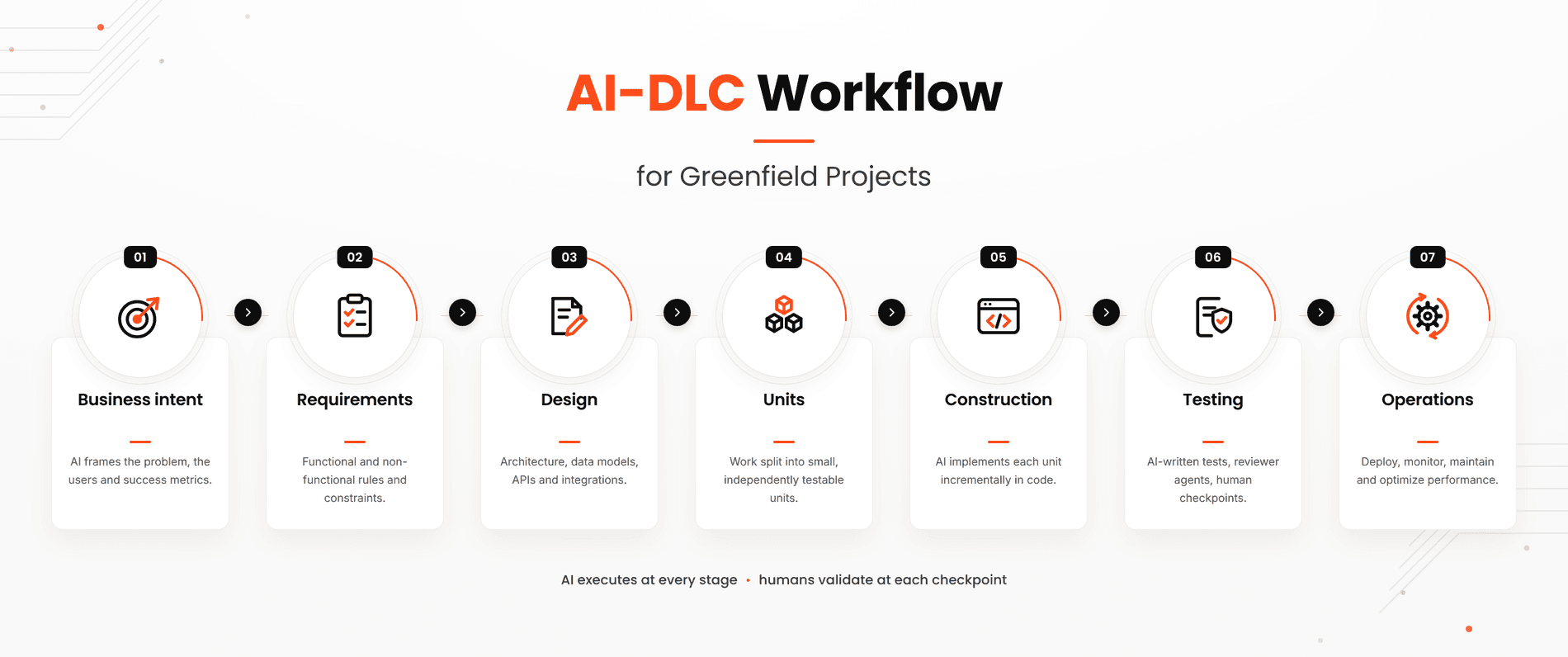
Business intent → Requirements → Design → Units → Construction → Testing → Operations
1. The Foundation: Business Intent
Like any product, a fresh software project must identify a user problem it wants solved. The team must identify the explicit intent with as much rich context as possible.
AI here can create questions and answers that help validate the intent thoroughly. For example, to explore the entire context of user problems, it can ask questions and provide answers to the following:
- Who are the users?
- What problems are they facing?
- Which problems should be prioritized and in which order?
- Which workflows matter most?
- What third-party integrations are needed?
- What security and compliance requirements should be considered?
- What should be the benchmarks of success for the app?
- Which features should be included in the first release?
After AI finishes digging into these questions and decisions, the human stakeholders can start validating them.
2. Requirement Analysis
Once the business intent is established, AI-DLC breaks the intent into specific project requirements. These requirements can vary from functional and non-functional ones, business rules, constraints, assumptions, and criteria of validation.
By leveraging AI at this elementary stage, the model not only speeds up documentation, but also reveals deeper contexts that can guide the development decisions and activities throughout the project.
3. Software Design
As we have already mentioned, greenfield projects enjoy greater design freedom, since they do not need to preserve any existing architecture.
Here in a greenfield project, AI helps validate the solution architecture, solution scope, domain constraints, data models, API structure, infrastructure, authentication, authorization, integration scope and constraints, observability, and scalability. Though here AI explores the design decisions and logic behind them, human stakeholders take the ultimate architecture design decisions.
4. Organizing the Tasks Into Units
Here AI-DLC breaks the entire project into smaller units of tasks. These work units are designed, implemented, tested, and incrementally validated. This incremental and modular approach prevents a particular issue with one unit from escalating across the application. Any issue following detection can be addressed within the unit itself.
5. Building and Testing
After the approval of the plan and organization of work units, AI actively takes part in implementation, creation of test cases, debugging, and validation. Incrementally small parts of the solution are built, tested, and reviewed. In the AI-DLC workflow, both coding and build-and-test tasks are regarded as recurring steps, leaving no room for undetected errors.
AI-DLC for Brownfield Projects
For your brownfield system modernization project, you may have decided to partner with one of the AI Consulting services to leverage the AI-DLC model. Here we help you to have an understanding of the role of AI-DLC in brownfield environments like legacy system modernization, feature integration, performance optimization, etc. The AI-DLC workflow in a brownfield project looks like this:
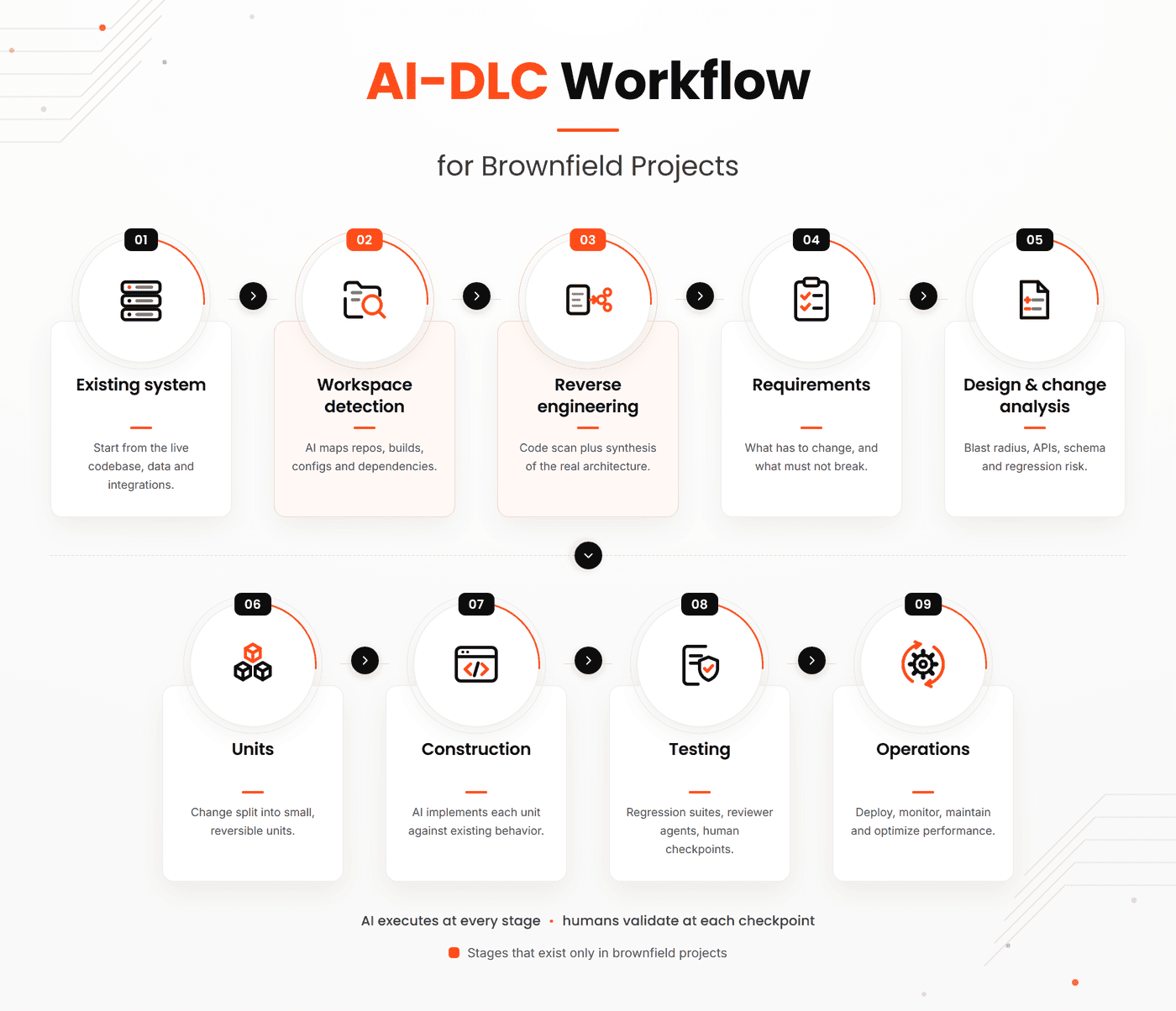
Existing system → Workspace detection → Reverse engineering → Requirements → Design/change analysis → Units → Construction → Testing → Operations
If you notice the workflow, there is a critical step called reverse engineering, which adds an altogether different layer of complexities and constraints.
1. Existing System Audit
As a first step, AI-DLC focuses on understanding the existing system. It carries out a thorough audit of the source code, existing architecture, databases, system configuration, documentation, tests, dependencies, build processes, and deployment considerations. According to AI-DLC official documentation, a developer-agent code scan is conducted, followed by architectural synthesis as part of the reverse-engineering process. Here, the goal of AI-DLC is to create a meticulous model of the existing system that can help in making subsequent decisions for optimizing the system.
2. Exploring Undocumented Dependencies
Undocumented dependencies represent a grey area where many brownfield projects suffer from uncertainties. Here, AI-DLC can play a significant role in understanding the hidden relationships among dependencies that are not covered in product documentation.
For example, in a brownfield project, just changing the status of a customer can create ripple effects for CRM synchronization, reporting process, email notification, billing workflow, and even an API used by a mobile application. AI, by identifying these relationships through context analysis of the project, helps the team navigate these dependencies without creating disruption in the existing system. Here, the human role is also emphasized to understand the reason behind any dependency.
3. Establishing the Current Application State
In a brownfield project, the development team should differentiate between what a system is originally aimed to do and what it actually does as per the product documentation. The development team should also understand what the code achieves and fails to do and the user-specific features that depend on this code. Since there can be inconsistencies among the above findings, AI-DLC treats reverse engineering in a brownfield project as a discovery mechanism rather than an absolute truth.
4. Determining the Changes
In a brownfield project, when every nook and corner of the existing application is analyzed, reverse-engineered, and discovered, AI helps determine the specific changes based on the components that are most affected, the APIs that need modification, whether database changes are needed, the possibility of regression for the existing functionality, the need for new tests, and the need for mitigating technical debt.
It is also assessed whether any of these changes should be done in isolation or in combination with a modernization project. Through this rigorous process of determining changes, AI-DLC addresses the common brownfield mistake of considering the request of a new feature as an isolated coding task. Adding the feature actually involves a broader system-level change.
Final Thoughts
The real value of AI-DLC is best understood by the way it digs out contexts and lays bare hidden dependencies in a brownfield project. In the case of greenfield projects, it helps the development team to follow a more structured path right from establishing the business intent to requirement analysis, architecture design, implementation, testing, and involving human stakeholders in critical checkpoints. This adaptive approach to cater to both fresh development and system modernization projects gave AI-DLC a distinct edge over other AI development toolkits.

 Startups
 Fintech
 Healthcare
 Manufacturing
 Marketplaces
 Mortgage
 Real Estate
 Retail
 Sports and Fitness
 Telecom and IT
 Logistic
 SaaS Product
 About Us
 Blog
Blog Careers
 Become A Partner
 Contact


 About Us
 Blog
Blog Careers
 Become A Partner
 Contact