Overview
APIs have been the backbone of software integration for decades. MCP is newer, narrower, and built for a completely different problem. This guide breaks down what each one does, where they differ, how they work together, and when to use which, without the confusion that comes from treating them as competing technologies when they aren't.
Introduction - Why Do MCPs Exist?
If APIs already let applications communicate with each other, why does MCP exist?
APIs were built for software talking to software. MCP was built for AI applications to leverage tools in a standardized way. Same general territory, completely different design intent.
Most confusion around MCP vs. API comes from comparing them as if they solve the same problem; they don't.
Understanding that early makes the rest of this comparison easier to follow.
What Is an API?
An API is a communication contract between software systems. One application makes a request. Another processes it and returns a response.
REST APIs are the most common and use HTTP methods to interact with endpoints. GraphQL gives clients more control over what data gets returned. SOAP is older and still found in enterprise environments that haven't migrated off it.
Every API requires prior knowledge. The developer building the integration has to know the endpoint, the authentication method, the request schema, the response structure, and the available operations. None of that gets discovered at runtime. It gets documented, read, and coded against.
Simple example:
An application calls a CRM API asking for customer details by ID. The API returns structured data. The application knows exactly what to ask for because a developer defined that relationship in advance.
What Is MCP?
MCP (Model Context Protocol) is an open protocol that connects AI applications and agents to external tools, resources, and data sources in a standardized way.
The architecture:
AI Application / Agent → MCP Client → MCP Server → Tool / API / Database / Service
Where APIs require a developer to pre-define every interaction, MCP is built around capability discovery.
An AI application can ask an MCP server about available tools and how to use them during runtime, without coding every integration manually.
MCP introduces a structure that maps naturally to how AI agents work. Tools represent callable functions. Resources represent data the agent can read. Prompts represent reusable interaction templates. This structure exists because AI agents need something different from what traditional APIs were designed to provide.
Important clarification:
MCP is not simply an API for AI. That framing is useful shorthand but technically incomplete. MCP is a protocol layer that comes before existing APIs.
MCP Vs. API - Quick Comparison
Key Differences That Actually Matter
a. Purpose and design intent
APIs ask: how can one software system communicate with another? MCP asks: how can an AI application discover and use external capabilities without custom integration code for every tool? Different questions produce different designs.
b. Discovery at runtime
Traditional API integration requires a developer to read documentation and write code that encodes that knowledge upfront. MCP servers expose what they can do in a format AI applications can read and act on dynamically.
This matters most when building agents that need to use multiple tools across different systems without a developer manually wiring each one.
Without MCP, you need 4 custom integrations to connect an AI agent to a CRM, an email system, a database, and a calendar.
An MCP server presents those capabilities through a single, standard interface. The underlying systems may still run on their own APIs.
d. Security lives at the implementation layer
MCP doesn't automatically make an integration secure. Authentication, least-privilege access, tool permissions, input validation, audit logs, and prompt-injection protection are still architectural decisions.
Choosing MCP doesn't resolve them. How the MCP server, tools, and underlying APIs are designed and governed does.
How MCP and APIs Work Together
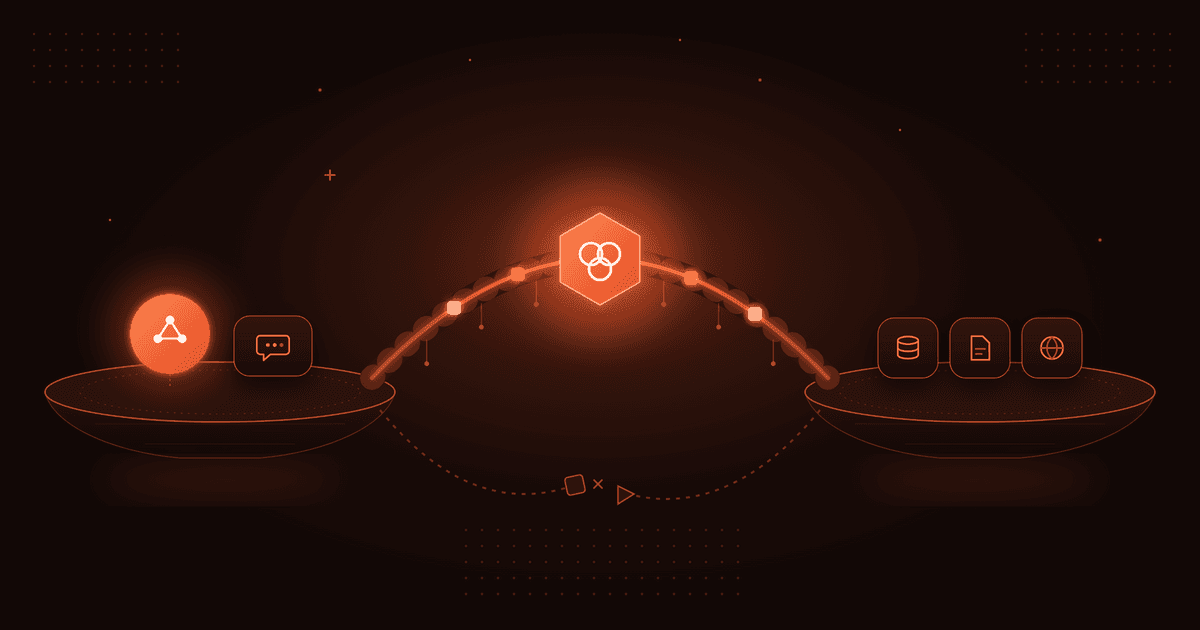
They are not mutually exclusive. In most serious enterprise architectures, they run alongside each other.
A company has a CRM running on a REST API. They want an AI agent to interact with customer data. Instead of building a custom agent-to-CRM integration, they stand up an MCP server that exposes CRM capabilities as tools. The agent talks to MCP. MCP talks to the CRM API. The CRM API talks to the database.
AI Agent → MCP Client → MCP Server → CRM API → CRM
The API doesn't go away. It moves one layer down the stack while MCP provides the AI-facing interface above it. This is where AI integration services become the practical differentiator: connecting the agent layer to existing systems rather than rebuilding everything from scratch.
When to Use Each
Switch to APIs when:
- Building standard software integrations between backend systems.
- Connecting mobile or web applications to server-side logic.
- Exposing business functionality to external developers.
- Integrating payment systems, CRMs, ERPs, or third-party platforms.
Switch to MCP when:
- Building AI agents that need access to multiple tools.
- You need to give an LLM the ability to take actions across enterprise systems.
- Creating reusable tool interfaces multiple AI applications can use.
- Building agentic workflows where capability discovery matters.
Use both when:
You need to expose existing enterprise APIs to AI agents through a standardized interface.
Most enterprises leverage systems like Salesforce, HubSpot, SAP, and ServiceNow. MCP sits in front of them and gives AI agents a consistent way to interact with all of them without rebuilding each integration separately.
Real-World Example: AI Sales Agent
A business wants an AI agent that can retrieve CRM data, check order status, create tasks, send emails, and update opportunity records.
API-only approach: Five separate custom integrations. Each needs its own authentication, error handling, and maintenance. New capability means a new custom integration.
MCP-based approach: One MCP server exposes all five capabilities as tools. The agent discovers what's available and calls what it needs.
AI Agent → MCP → CRM / Email / Order APIs
The underlying APIs still do the work. MCP provides the interface the agent uses to reach them. The architecture scales as new capabilities are added to the MCP server, rather than requiring new custom code each time.
Can MCP Replace APIs?
No. APIs remain the underlying integration mechanism for most software systems. MCP is a protocol layer that sits above them. Existing APIs don't become obsolete when MCP enters the architecture; they become the foundation MCP builds on.
The more accurate framing: APIs connect systems to systems. MCP connects AI to those systems in a standardized way. Both have a job. Neither makes the other redundant.
Where This Is Heading?
The integration stack is evolving in a clear direction:
APIs → AI APIs → Tool Calling → MCP → Multi-Agent Integration
APIs will remain the foundation. MCP and similar protocols are becoming an important abstraction layer for AI-agent interaction. For enterprises building agentic AI workflows, the practical question isn't MCP or API. It's how to design an architecture where both do what they were built for.
How Solvios Can Help
Whether you're connecting existing APIs to an MCP layer, building AI agents that need access to enterprise tools, or figuring out the right architecture before committing to a build, Solvios works from your requirements, not a generic integration playbook.
- API integration services across CRM, ERP, and enterprise platforms.
- AI integration services including MCP server design and agent tool integration.
- AI agent development for autonomous and multi-agent workflows.
- AI consulting services for integration architecture and implementation roadmap.
Ready to build AI integration that actually scales? Book a free consultation with Solvios today.

 Startups
 Fintech
 Healthcare
 Manufacturing
 Marketplaces
 Mortgage
 Real Estate
 Retail
 Sports and Fitness
 Telecom and IT
 Logistic
 SaaS Product
 About Us
 Blog
 Careers
 Become A Partner
 Contact


 About Us
 Blog
 Careers
 Become A Partner
 Contact