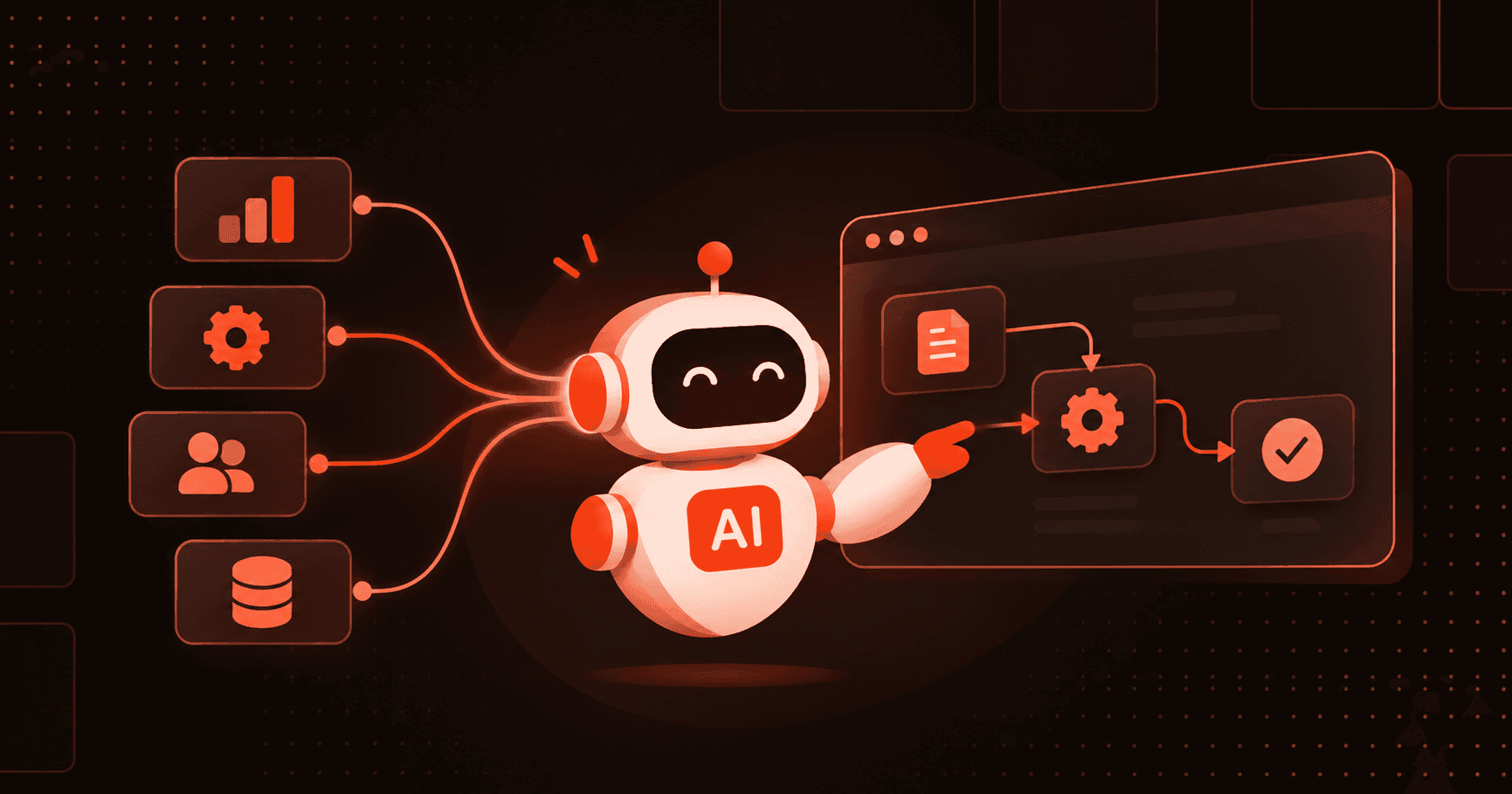
AI agents don't just answer, they plan and complete multi-step tasks on their own.
Multi-agent teams are replacing rigid rule-based automation, handling messy, changing processes.
Humans move to supervising, and strong governance and security decide who scales successfully.
Overview
Agentic AI is the most significant shift in enterprise technology in 2026. Not because AI is getting smarter in isolation, but because enterprises are beginning to redesign entire workflows, software systems, and human roles around what AI agents can actually do. This guide covers the key trends driving that shift, where implementation gets complicated, and what businesses need to understand before they start building.
Introduction - The Shift Nobody Saw Coming Fast Enough
A year ago, most enterprises were still treating AI as a productivity layer. Tools that helped individuals work faster. Copilots that drafted emails and summarized meetings.
That framing is already outdated.
According to Google Cloud research drawing on insights from over 3,466 executives and AI experts, enterprise AI is shifting from prompts and individual tasks to systems that autonomously orchestrate complex, multi-step workflows.
In 2026, enterprises aren't asking whether to adopt AI agents. It's how fast they can redesign their operations around them without breaking what already works.
What Is Agentic AI?
Three generations of AI have different jobs:
Type
Primary Level
Autonomy Level
Traditional AI
Predicts, classifies, detects patterns
Low - task-specific
Generative AI
Creates content, responds to prompts
Moderate - human-directed
Agentic AI
Plans, executes, adapts across systems
High- goal-oriented
The agent loop that makes this possible: Goal → Reason → Plan → Access tools and data → Execute → Evaluate → Adapt or Escalate
One important clarification before getting into trends. Enterprise agentic AI rarely means fully autonomous systems doing whatever they want. Deloitte specifically highlights graduated autonomy and human oversight as critical for real enterprise deployments.
The agent executes while humans set the boundaries and approve exceptions.
5 Agentic AI Trends Reshaping Enterprise in 2026
1. From AI Assistants to Autonomous Workflow Agents
The progression most enterprises are somewhere in the middle of right now:
Chatbot → Copilot → AI Agent → Multi-Agent Workflow
The distinction that actually matters: agents don't just answer questions. They execute actions across connected systems. A customer service agent doesn't suggest a refund - it processes it.
A finance reconciliation agent doesn't flag a discrepancy: it traces it, logs it, and routes it for approval. A procurement agent doesn't recommend a vendor; it initiates the purchase order.
Google Cloud describes this as the movement from individual tasks to complete digital assembly lines. The enterprises building these workflows now are not running experiments. They are redesigning how work gets done.
2. Multi-Agent Systems and Agent-to-Agent Collaboration
Single agents handling isolated tasks are the starting point. The real complexity and value live in multiple specialized agents collaborating across a workflow.
Here’s how the sequence looks:
One agent qualifies the lead while another schedules the follow-up.
Another pulls relevant case studies from the knowledge base and personalizes the outreach.
Another updates the CRM and notifies the sales rep when it needs human judgment.
This shift signifies a move from agents acting alone to agent ecosystems working together within organizations and even firms. This has been enabled by infrastructure that includes protocols like MCP and A2A.
3. AI Agents Embedded Directly Into Enterprise Software
Agents are no longer separate applications sitting alongside enterprise systems. They are being built into CRMs, ERPs, HR platforms, ITSM tools, customer portals, and developer platforms.
This changes the commercial equation significantly. Enterprise value increasingly comes not from standalone AI applications but from connecting agents to the systems businesses already run.
An agent embedded in a CRM that can update records, trigger workflows, and escalate exceptions is fundamentally more useful than an AI tool that sits beside the CRM and gives suggestions.
This is where AI integration services become the real differentiator, not the AI capability itself.
4. Human-on-the-Loop Rather Than Human-in-the-Loop
There is a certain trajectory that the supervision model for enterprise AI is heading:
Human executes → Human helps AI → Human oversees AI -> Agent runs with exception handling
The transition from human-in-the-loop to human-on-the-loop is significant. Humans are moving from approving every action to setting the limits of what agents can do and looking at exceptions, not the normal decisions.
But humans will still be needed for high-risk decisions, compliance approvals, financial transactions above a certain limit, sensitive customer interactions, and anything that requires true strategic judgment.
The agent handles the volume while humans handle the edge cases and the stakes.
5. Governance, Security and Observability Are Now Foundational
Scaling agentic systems without governance frameworks isn't a shortcut; it's a liability. Deloitte identifies governance and control as a primary barrier to enterprise agentic adoption at scale.
What governance actually requires in practice:
Permission management defining what each agent can and cannot access
Identity and access controls specific to agent actions
Complete audit trails of every agent decision and action
Monitoring for drift, failure, and unexpected behavior
Guardrails preventing prompt injection and tool misuse
Human approval points for defined action categories
Failure recovery protocols that don't silently drop tasks
Enterprises that treat governance as a post-deployment concern are discovering the hard way that retrofitting controls onto a live agentic system is significantly more expensive than building them in from the start.
Brownfield vs. Greenfield: Where Enterprises Are Actually Starting
Most enterprises can't start from scratch. That's the practical reality of agentic AI deployment in 2026.
Factor
Greenfield
Brownfield
Starting point
Clean infrastructure
Legacy systems in production
Agent architecture
Native from day one
Integrated around existing constraints
Data and API design
Built for agents
Adapted from existing structures
Workflow redesign
Full redesign possible
Incremental modernization
Primary challenge
Scope creep
Legacy integration complexity
Timeline
Faster initial deployment
Phased over months
Deloitte specifically flags legacy systems, data architecture, and integration complexity as the major obstacles to agentic adoption. The enterprises moving fastest aren't necessarily those with the cleanest infrastructure. They're the ones that planned brownfield integration deliberately rather than discovering its constraints mid-project.
The Forward Deployed Engineer in Enterprise AI
A role that has emerged specifically because AI model capability and enterprise implementation are two different problems.
Forward Deployed Engineers work directly in client environments, understand the business workflow, connect AI systems to enterprise infrastructure, build and iterate prototypes in production, and bridge the gap between what an AI agent can theoretically do and what it can practically deliver within a specific organization's constraints.
Cognizant and Accenture both describe FDE roles appearing specifically around deploying agentic and generative AI workflows into enterprise technology platforms.
AI Integration, Chatbots, and Getting Agents Into Existing Apps
Businesses don't need to build foundation models. They need to connect AI to the systems they already run: CRM, ERP, APIs, databases, SaaS platforms, internal knowledge bases, and workflow engines.
Existing Application → AI Layer → Model → Knowledge and Data → Tools and APIs → Agent Orchestration → Monitoring
On AI chatbot development cost specifically: there is no universal number because the variables are too significant. A basic FAQ chatbot costs a fraction of what a RAG-enabled conversational agent with enterprise integrations, authentication, and agentic workflows costs.
The honest answer is that cost scales directly with integration depth, model requirements, and the degree of autonomy the agent needs to operate reliably.
Enterprise AI Maturity in 2026
Stage
Description
Stage I - Experimentation
Individual employees using AI tools independently
Stage II - AI Assistants
AI embedded into specific business functions
Stage III - Workflow Automation
Agents executing defined, bounded workflows
Stage IV - Multi-Agent Operations
Multiple agents coordinating across systems
Stage V - Agent-Native Enterprise
Processes and applications redesigned around agents
Most enterprises in 2026 are somewhere between Stage 2 and Stage 3. The ones at Stage 4 are building competitive advantages that are genuinely difficult to replicate quickly.
What Enterprises Should Do Now
Identify workflows with repetitive decisions, coordination steps, and system interactions; these are agent-ready.
Audit data quality and API accessibility before scoping agent deployment.
Decide explicitly whether the project is brownfield or greenfield; the implementation path is different.
Build governance frameworks before deployment, not after.
Start with bounded autonomy and expand agent permissions as trust is established.
Define human approval points for high-stakes actions from day one.
Measure business outcomes, not technical performance metrics.
The Future Is Agentic, But Not Fully Autonomous
The biggest agentic AI trend in 2026 isn't that agents are getting smarter. It's that enterprises are beginning to redesign software, workflows, and human roles around what agents can actually execute. The organizations building that capability now — with proper governance, deliberate brownfield integration, and the right implementation support — are not running pilots. They are building the operational foundation for the next several years.
Frequently Asked Questions
The term “agentic AI” refers to systems that can reason, plan, use tools, and execute multi-step workflows to achieve a defined goal. Generative AI takes a prompt and responds. Agentic AI takes a goal and acts on it across connected systems with different levels of autonomy and human supervision.
Key Agentic AI trends include autonomous agents that execute operations across systems. This enables embedding agents into enterprise software while including humans in the loop.
A chatbot waits for a question and answers it. That's the whole job. An AI agent works differently; it takes a goal, figures out what needs to happen, uses tools to make it happen, checks whether it worked, and either moves forward or flags something for a human. One responds. The other acts.
Greenfield means starting clean with new infrastructure, new architecture, designed for agents from day one. Brownfield is the reality most enterprises actually face: existing systems, legacy databases, APIs. The implementation path for each is fundamentally different, and confusing the two is one of the more common reasons enterprise AI projects stall.
Think of the gap between what an AI demo looks like and what actually ships inside a real enterprise environment. The FDE lives in that gap. They sit inside the client's infrastructure, understand how the business actually runs, connect AI systems to the tools and data that already exist, and keep iterating until the thing works in production, not just in a sandbox.
AI-DLC is an agentic approach to software development in which AI agents participate across planning, design, implementation, testing, and operations, while humans provide approval and governance at defined checkpoints. AWS Labs describes it as a structured workflow for AI coding agents with defined stages and verification gates.
Like What You See? Share with a Friend
About Author
Jigesh Shah
Founder & CEO of Solvios Technology
Jigesh Shah is a visionary technology leader dedicated to driving innovation and transforming digital experiences. With a strong passion for solving complex challenges and a commitment to excellence, he has led Solvios Technology in delivering advanced solutions that empower businesses to grow and scale. His strategic mindset, customer-first approach, and deep expertise in emerging technologies continue to inspire teams and drive remarkable outcomes.
We'd love to understand what you want to build. The more context you share, the faster we can give you a useful response not a sales pitch, but a genuine assessment of how we can help and what working together would look like.
Join our community and get updates, insights, and ideas delivered right to your inbox. Stay connected!
We respect your privacy. Unsubscribe anytime.
Solvios is a leading software development company crafting innovative solutions for businesses. We Specialize in custom software, web & mobile app development, and digital marketing. Partner with us to transform your vision into reality and achieve digital success.

 Startups
 Fintech
 Healthcare
 Manufacturing
 Marketplaces
 Mortgage
 Real Estate
 Retail
 Sports and Fitness
 Telecom and IT
 Logistic
 SaaS Product
 About Us
 Blog
Blog Careers
 Become A Partner
 Contact


 About Us
 Blog
Blog Careers
 Become A Partner
 Contact