11
May
Salesforce
23 Min Read

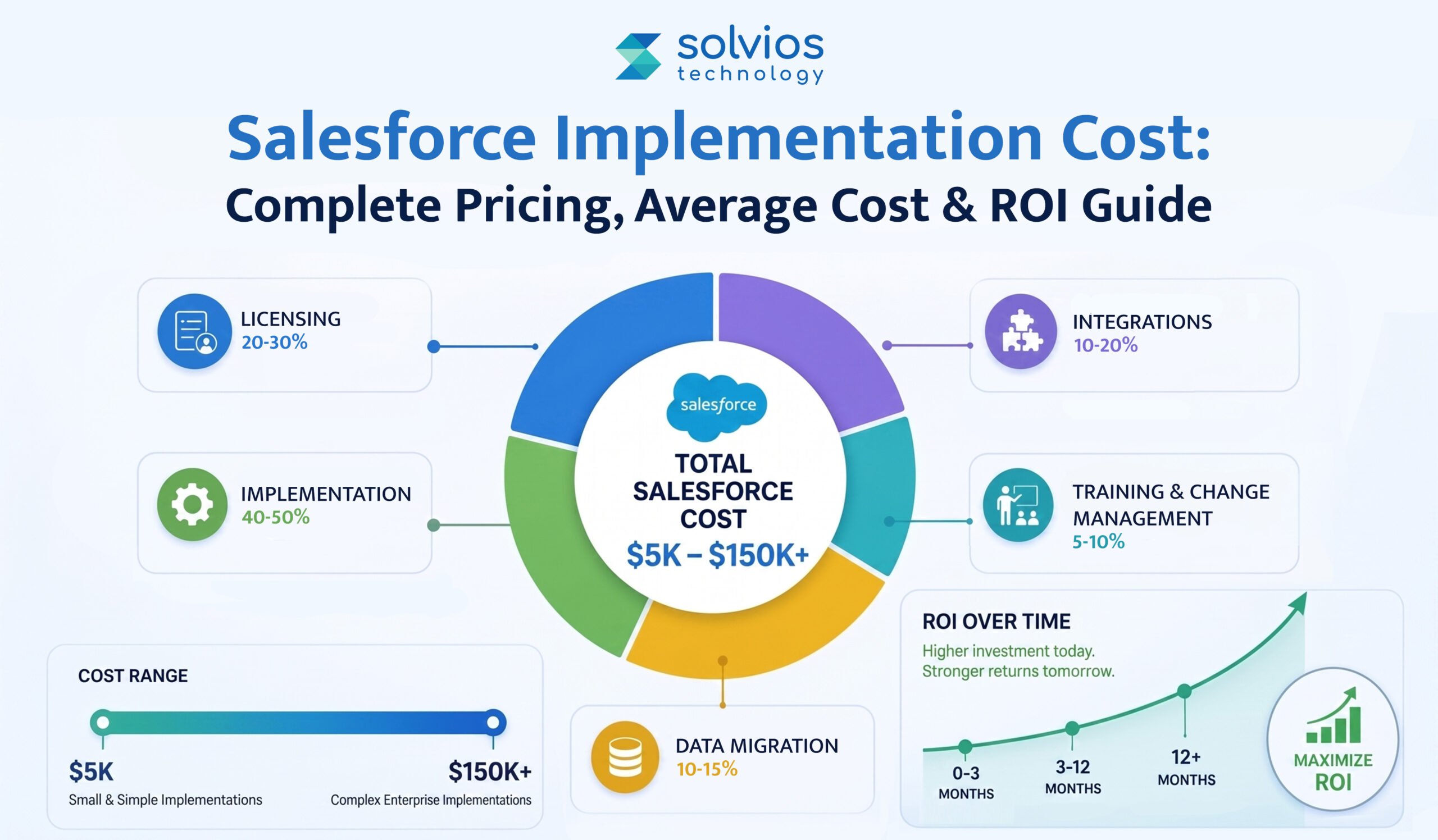
So, how much does it cost to implement Salesforce?
There’s no fixed cost for a Salesforce implementation; it rarely is. Salesforce implementation pricing varies widely depending on customization, integrations, and business requirements.
Some businesses spend a few thousand, and others cross six figures without realizing how it adds up.
The gap comes from what sits behind the setup, not the software itself.
Most teams assume the license is the main cost, but it’s not. The real spend comes from how Salesforce is configured, connected, and used across the business. Integrations, custom workflows, data cleanup: this is where budgets start moving.
This is also the area where estimates usually go wrong. Costs look simple at the start, then expand as requirements become clearer.
This guide breaks it down properly: what you actually pay for, where costs increase, and how to plan without getting surprised midway.
Salesforce implementation isn’t just about making the system live… real operations start after go-live.
You’re customizing the platform around how your business runs – sales processes, support flows, and reporting. All of which need to be aligned with your workflow.
This is where Salesforce Consulting Services often play a critical role, helping businesses design the platform around actual operational needs instead of generic system defaults.
Salesforce comes with a lot of different products, like:
Each one handles a different part of the business, but when they aren’t aligned with your operations, these add-ons are generic.
Implementation makes it usable.
It usually includes system setup, workflow configuration, custom fields, integrations with other tools, and moving your existing data into the system. Then comes user training and adoption.
That’s what businesses pay for: not just the integration, but the alignment of Salesforce with your operations.
If you’re still evaluating whether Salesforce is the right platform, understanding why businesses choose Salesforce CRM can help clarify the bigger picture.
Most business owners confuse pricing and implementation cost.
Salesforce pricing and implementation costs are not the same thing. A license is a fee you pay per month for usage. In contrast, the implementation is a one-time expense.
Let’s break down the difference:
| Cost | What You Pay for | How it Works |
| Licensing | Monthly fees for using Salesforce | Recurring, fixed cost |
| Implementation | This includes setup, customization, integration, and data migration | One-time setup fees |
In many cases, implementations cost more than the license. That’s why choosing the right Salesforce consulting partner early can make a major difference in budget control.
When moving to Salesforce, the pricing doesn’t come from a single source. It’s split between access and the work around it.
Here’s what that usually looks like:
This is the monthly fee. It stays steady unless you add users or change plans.
This is where most of the effort goes. Set up, make adjustments, and make the system fit how your team works.
Salesforce needs to connect with other tools. Some connections are simple; others take more work. Reviewing these Salesforce integration essentials before starting often prevents unnecessary expenses.
Data rarely moves cleanly. It needs to be sorted, mapped, and checked before it’s usable.
Teams need time to get used to it. Without that, even a good setup doesn’t get used properly.
Once it’s live, small fixes and updates continue. These don’t stop after launch.
There’s no fixed cost for Salesforce implementation. It mostly depends on the level of customization you’re opting for.
Here’s a closer look at the implementation cost based on business size:
| Business Size | What Setup Looks Like | Estimated Cost |
| Small | Basic CRM setup with minimal customization | Costs between $5,000 -25,000 |
| Medium | Custom workflows with a few integrations | Costs between $25,000 – 1,00,000 |
| Enterprise | Multiple integrations with more customization | Costs between $100,000- 500,000 |
The price difference depends on the level of customization, adding to the cost of implementation. Businesses looking for advanced flexibility often benefit from exploring custom Salesforce solutions before finalizing scope.
The average cost of Salesforce implementation typically ranges between $25,000 and $150,000 for mid-sized businesses, depending on customization, integrations, and project complexity.
The level of customization you need on your Salesforce platform is directly proportional to the cost. The higher the level of customization, the higher the implementation cost.
More users means more setup, more roles, and more data to manage. It’s not just licensing that grows.
Every system you connect adds another layer. Some are simple. Others need custom work.
Certain industries need more structure. Compliance, approvals, and reporting can make setups heavier.
If your existing data is messy, it slows everything down. Cleaning it takes effort before migration even starts.
The structure of your implementation determines how your project behaves later. Here’s a closer look at the different implementation and pricing approaches:
| Model | When It’s Used | What Happens to Cost |
| Fixed Price | Well-defined scope | You get predictable costs that change with the level of customization |
| Time & Materials | If you have evolving requirements | The cost depends on the time and labor |
| Hybrid | It’s a mix of well-defined scope and evolving requirements | It offers limited control and flexibility |
Therefore, use:
Best when teams have laid out an implementation strategy and are ready for additional costs for customization.
Best when the requirements are not very clear. You get the flexibility to pay by the hour.
Best when there’s an approach to implementation. This works best when teams have partial clarity. Following structured Salesforce implementation steps can also reduce scope creep.
Tech or SaaS companies generally focus on lead tracking, sales pipeline, and reporting. This results in a lighter setup for them compared to other industries.
Approximate pricing: $10k – $50k
Retail and eCommerce brands need more integrations in their system. This adds to the cost of your basic CRM setup, increasing the overall cost.
Approximate pricing: $25k – $100k
Manufacturing businesses include workflows, system integrations, and approvals that require a more structured layout. It results in higher costs than in other industries.
Approximate pricing: $50k – $200k+
The difference usually comes down to the number of integrations and the depth of the workflow.
Considering the overall Salesforce implementation cost, Salesforce doesn’t give ROI upon integration. When migrating to the platform, you need to pay for setup and team training.
Here’s what the overall cost of using Salesforce looks like:
| Timeline | Salesforce Cost | Business Value |
| 1st Year | High | Initial setup requires costTeams need to adjustAdjustments need to be made |
| 2nd Year | Stable | More streamlined processesRequires less manual work |
| 3rd Year Onwards | Controlled | Better insights into operationsStronger pipelineConsistent usage |
Changes don’t happen overnight. Your system attracts ROI through consistent improvement. Many businesses also improve returns faster by learning how Salesforce improves sales processes.
To control Salesforce implementation pricing, Most budgets go off track because everything is planned at once. However, it’s best to break down the implementation into several stages.
Here’s a clear breakdown on how you can define your budget:
Most cost issues don’t come from Salesforce itself. They come from how the project is planned.
Solvios works on that part first. Instead of jumping into setup, our team focuses on defining your unique requirements and managing your workflows to avoid complications later. We plan integrations and data migration from the start, so there are no surprises later.
Remember, you don’t implement Salesforce every day; ensure you get the right team for successful implementation.
Salesforce implementation cost typically ranges from $5,000 to $150,000+, depending on customization, integrations, data migration, and business complexity. Enterprise implementations can exceed $500,000 for advanced workflows and multi-system integrations.
The biggest cost drivers include customization level, number of integrations, data quality, user count, and industry complexity. Poor planning or unclear requirements often increase costs during implementation.
Yes, in most cases, Salesforce implementation costs more than licensing. While licensing is a recurring monthly fee, implementation is a one-time investment covering setup, customization, integrations, and data migration.
Most businesses start seeing ROI within 12–24 months. Initial costs are higher in year one, but efficiency, automation, and better insights drive long-term value and cost recovery.
To reduce Salesforce implementation costs, start with a smaller scope, prioritize essential features, plan integrations early, clean your data, and work with experienced implementation partners.
Fixed pricing works best for well-defined projects, while time-based models suit evolving requirements. Many businesses choose a hybrid approach to balance cost control with flexibility.
Planning something next? Let’s turn ideas into action.

Join our community and get updates, insights, and ideas delivered right to your inbox. Stay connected!
 We respect your privacy. Unsubscribe anytime.